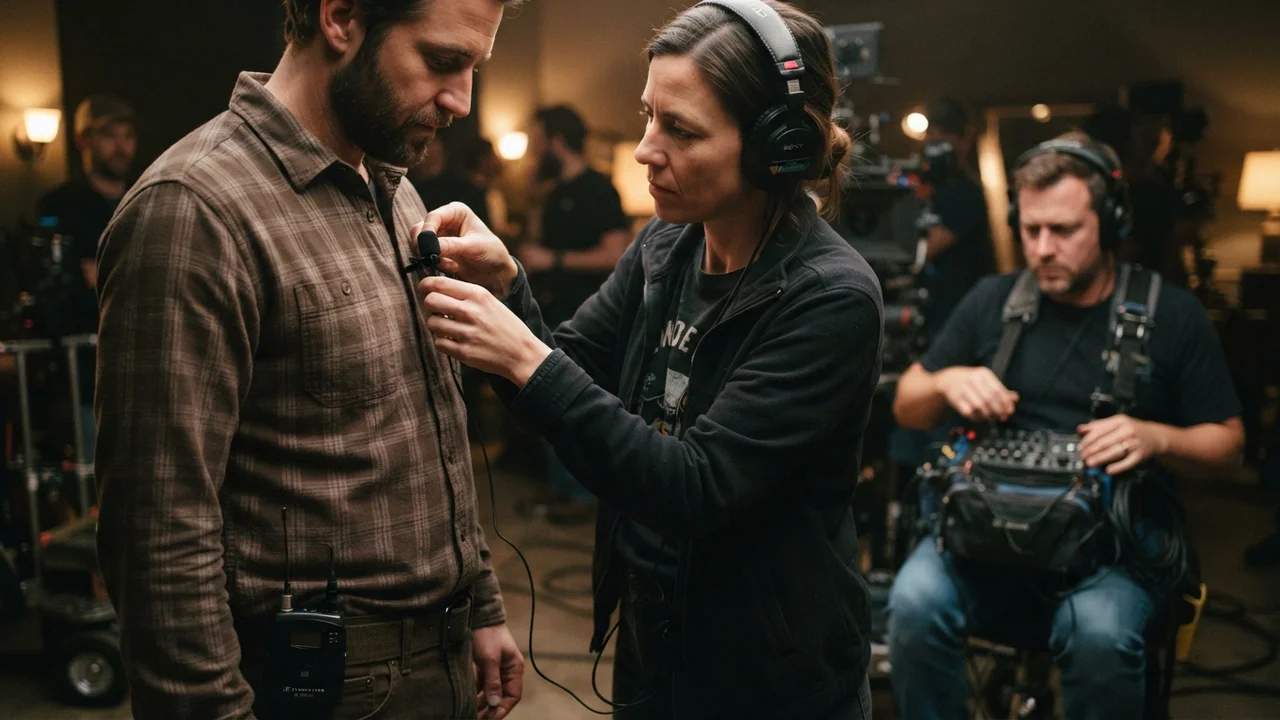
Technical Details
Professional wireless lav systems operate with 24-bit/48-kHz digitization and achieve a dynamic range of up to 120 dB. The transmission power is typically 10-50 mW, and latency in digital systems ranges from 2-4 ms. Diversity receivers use two antennas to minimize dropouts caused by multipath propagation. Modern true diversity systems continuously switch between signal paths. Compander systems compress the signal at the transmitter and expand it at the receiver for noise reduction. Battery life is 6-8 hours with lithium-ion batteries.
History & Development
The first commercial wireless lav system for film was developed by Vega in 1976 with the analog System 55. Sennheiser introduced the evolution series in 1982, which combined FM modulation with companding. The transition to digital systems began in 2009 with Audio-Technica's System 10, followed by Sennheiser's AVX (2013) and Shure's Axient Digital (2016). The shift from analog UHF to 2.4 GHz technology occurred from 2015 onwards due to frequency scarcity caused by LTE expansion.
Practical Use in Film
On "1917," sound mixer Oliver Tarney used over 20 Sennheiser G4 wireless lav systems simultaneously for the one-shot sequences, as cable deployment was impossible. In action films like "Mission: Impossible," wireless lav systems enable sound recording during stunts without the risk of cable breakage. The workflow includes frequency scanning before shooting begins, timecode synchronization with the camera, and continuous monitoring for dropouts. Disadvantages include battery consumption, radio interference in urban areas, and potential latency issues in playback scenes.
Comparison & Alternatives
Wireless lav systems differ from wired lavaliers by offering freedom of movement at a higher technical cost. Recorders like the Zaxcom ZMT4 combine a wireless lav system and recording in a bodypack. Modern alternatives include the Deity Connect series or Røde Wireless Go with integrated recording. UHF systems offer greater range, while 2.4 GHz systems are license-free but more susceptible to interference. For exterior shoots with many actors, hybrid setups of wireless and wired systems are used.