Filmlexikon.
Support
Junior Receiver
Lighting · Equipment

Junior Receiver

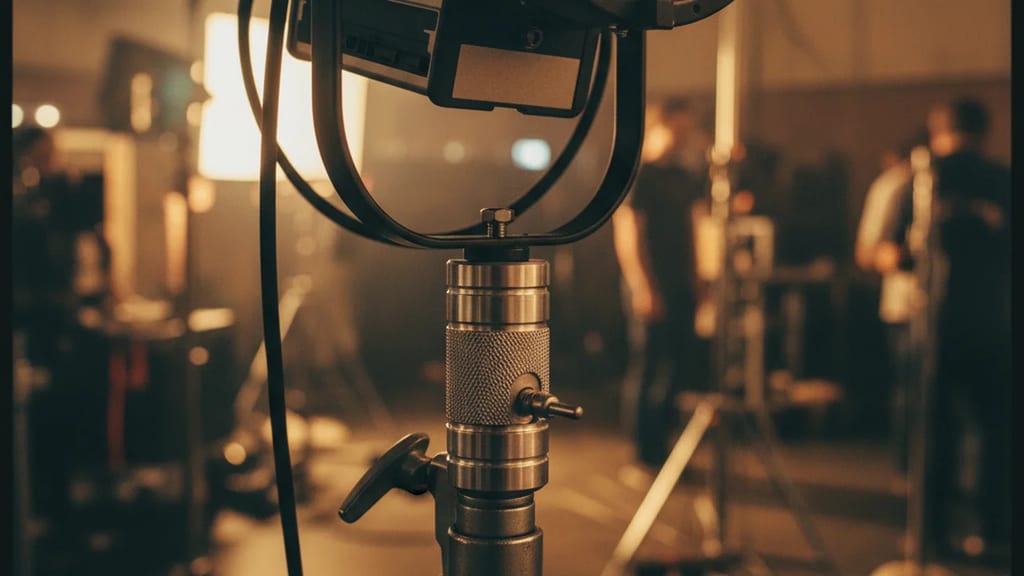
Murnau AI illustration
baby receiver receiver wireless dmx wireless follow focus wireless lav wireless video color temperature

Receiver mount for film lights with 5/8"-27 TPI female threads; supports up to 2.5 kW HMI or LED panels, 360° swivel with locking mechanism.

Technical Details

The Junior Receiver uses a 5/8"-27 TPI (Threads Per Inch) mount with a maximum insertion depth of 19 mm. The receiver is made of hardened steel or aluminum and weighs between 0.8-1.5 kg depending on the version. Modern Junior Receivers feature a 360° pan range and 90° tilt angle with locking knobs. Variants include Baby-Junior adapters (reduction to 1/2-inch), Double Junior Receivers for two lights, and offset versions with a lateral displacement of 15-30 cm.

History & Development

Mole-Richardson introduced the Junior Receiver standard in 1947 in response to the growing demand for more manageable lighting solutions. Film production was increasingly moving from studios to real locations, requiring more compact equipment. In 1962, Arri expanded the standard with metric variants for the European market. Matthews Studio Equipment standardized the current tolerances and safety regulations in 1978.

Practical Use in Film

Junior Receivers are preferably used with HMI lights up to 2.5 kW and LED panels. In "Blade Runner 2049" (2017), DoP Roger Deakins used Junior-mounted ARRI SkyPanels for precise facial lighting in close-ups. The compact design allows for close placement between actors and the camera. Disadvantages become apparent with heavy Tungsten lights over 2 kW, where the load limit is reached and a switch to Senior systems is necessary.

Comparison & Alternatives

Junior Receivers differ from Senior Receivers (1 1/8-inch, 50 kg load capacity) in terms of lower weight and space requirements. Baby Pins (1/2-inch) are suitable for lights under 5 kg. Modern quick-release systems like the Manfrotto Super Clamps are increasingly replacing screwed connections in documentary productions. Magic Arms and Friction Arms offer more flexible positioning but do not achieve the stability of Junior Receivers for longer setups.

From the crafts

Perspectives

Cinematographer

Junior-Aufnahmen geben mir die präzise Kontrolle über Lichtpositionen, die ich für komplexe Ausleuchtungen brauche – besonders wenn ich mit mehreren Leuchten gleichzeitig arbeite und jede einzeln feinjustieren muss. Die 360°-Rotation ermöglicht es mir, während der Aufnahme subtile Korrekturen vorzunehmen, ohne die gesamte Leuchte neu positionieren zu müssen.

Director

Mit Junior-montierten Leuchten kann ich atmosphärische Nuancen schaffen, die meine narrative Intention unterstützen – eine leichte Drehung des Lichts kann die Stimmung einer Dialogszene komplett verändern. Die schnelle Umpositionierbarkeit hilft mir beim Experimentieren mit verschiedenen emotionalen Lichtstimmungen, ohne dass mein Set-Rhythmus darunter leidet.

Producer

Junior-Equipment reduziert meine Transportkosten um etwa 30% gegenüber Senior-Systemen und benötigt ein Crew-Mitglied weniger pro Licht-Setup, da die Montage deutlich schneller geht. Die Standardisierung bedeutet weltweite Verfügbarkeit von Mietequipment und keine teuren Spezialadapter bei internationalen Koproduktionen.

More in the lexikon

Related terms

Test your knowledge

Quiz

1. Was beschreibt „Junior-Aufnahme" am besten?

2. Zu welchem Department gehört „Junior-Aufnahme"?

3. Wie viele verschiedene Fachperspektiven bietet dieser Eintrag?

Report an error
From the Filmfarm ecosystem

Understand visual language, budget productions, connect crew.

The Lexikon is part of the Filmfarm ecosystem — alongside budgeting (FilmBalance), an industry magazine (FilmCircus) and crew networking (FilmCall, CrewMesh). One shared vocabulary for the whole production.

FilmFarm FilmRadarComing soonFilmPulseComing soonFilmNumbersComing soonFilmCapitalComing soonFilmLabComing soonFilmBalanceComing soonFilmCircusComing soon