Filmlexikon.
Support
Wireless Follow Focus
Camera · Equipment

Wireless Follow Focus

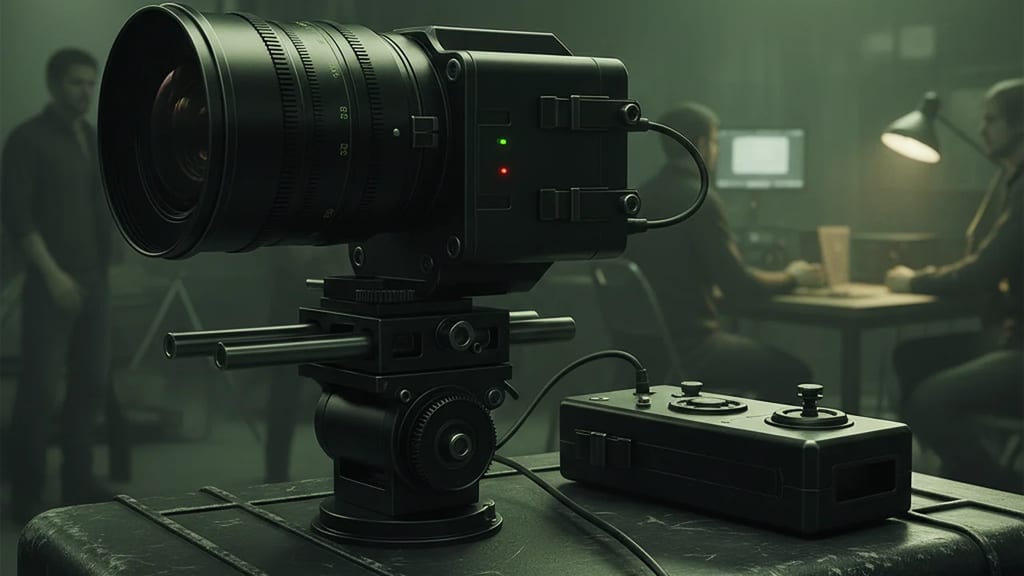
Murnau AI illustration
baby receiver junior receiver receiver wireless dmx wireless lav wireless video flow focus

Radio-controlled focus system enabling wireless lens focus adjustment with sub-20ms latency and 0.02° motor precision. Allows focus pullers remote operation during crane, Steadicam, and drone shots.

Technical Details

Modern wireless follow focus systems operate with a latency of under 20 milliseconds and offer a resolution of up to 0.02° motor angle precision. The motor drive generates a torque between 0.8 and 3.5 Nm, allowing even stiff cine lenses to be precisely controlled. Transmission is digitally encrypted via proprietary protocols or standardized systems such as RT Motion (RED) or CMotion (ARRI). High-quality systems feature lens mapping functions that can store and recall focus marks with millimeter accuracy.

History & Development

Heden developed the first commercial wireless follow focus system in 1995 for broadcast applications. Preston Cinema Systems established the MDR standard for cinema productions in 2003 with the FIZ system (Focus/Iris/Zoom). In 2012, ARRI revolutionized the market with the Wireless Compact Unit (WCU-4) through intuitive handwheel control and seamless camera integration. Since 2018, systems like the Teradek RT Motion have enabled real-time data transmission with sub-frame accuracy for high-speed shots up to 1,000 fps.

Practical Use in Film

In "1917" (2019), cinematographer Roger Deakins coordinated complex Steadicam sequences across multiple focus pullers using RT Motion systems. Wireless follow focus is indispensable for crane and drone shots – "Skyfall" (2012) utilized Preston systems for the Istanbul motorcycle chase with Technocrane insertions. In confined shooting situations, it allows the 1st AC to operate outside the set boundaries. Disadvantages include radio interference in electromagnetically charged environments and battery dependency for long takes.

Comparison & Alternatives

In contrast to mechanical focus pulling via rods (Follow Focus Rod), wireless follow focus offers unlimited freedom of movement. Wired systems like Preston Light Ranger eliminate radio interference but limit the range to 150 meters. Modern alternatives include AI-based autofocus systems (Canon Dual Pixel CMOS AF) and LiDAR-assisted distance measurement (DJI LiDAR Range Finder). Wireless follow focus remains the standard for professional productions with moving camera systems, while mechanical systems are preferred for static studio setups.

From the crafts

Perspectives

Cinematographer

Ich setze Funkschärfe bei allen bewegten Kamerafahrten ein, weil sie mir ermöglicht, komplexe Schärfenverlagerungen millimetergenau zu planen und zu wiederholen. Besonders bei Steadicam-Aufnahmen kann mein 1st AC aus sicherer Entfernung arbeiten, ohne durch Kabel in der Bewegung eingeschränkt zu werden. Die Lens-Mapping-Funktion ist unverzichtbar für Matching-Shots und Wiederholungen.

Director

Mit Funkschärfe kann ich Schärfenverlagerungen als narratives Element einsetzen, ohne dass die Kamera oder Schauspieler in ihrer Bewegung eingeschränkt werden. Ich lasse bewusst Unschärfe entstehen und führe den Blick des Zuschauers durch präzise Fokusübergänge – etwa vom Vordergrund-Detail zum Gesicht im Hintergrund. Das schafft emotionale Ebenen, die mit starrer Schärfe nicht möglich wären.

Producer

Ein hochwertiges Funkschärfe-System kostet zwischen 15.000 und 45.000 Euro, amortisiert sich aber durch Zeitersparnis bei komplexen Takes. Statt zehn Wiederholungen für einen perfekten Schärfeverlauf schaffen wir es oft in drei Versuchen. Bei 30-Tage-Drehplänen spare ich dadurch mindestens zwei Drehtage und reduziere gleichzeitig das Risiko von Kabelschäden bei bewegten Aufnahmen.

More in the lexikon

Related terms

Test your knowledge

Quiz

1. Was beschreibt „Funkschärfe" am besten?

2. Zu welchem Department gehört „Funkschärfe"?

3. Wie viele verschiedene Fachperspektiven bietet dieser Eintrag?

Report an error
From the Filmfarm ecosystem

Understand visual language, budget productions, connect crew.

The Lexikon is part of the Filmfarm ecosystem — alongside budgeting (FilmBalance), an industry magazine (FilmCircus) and crew networking (FilmCall, CrewMesh). One shared vocabulary for the whole production.

FilmFarm FilmRadarComing soonFilmPulseComing soonFilmNumbersComing soonFilmCapitalComing soonFilmLabComing soonFilmBalanceComing soonFilmCircusComing soon