Cinematographer
Ich montiere den Sender direkt am Rig und spare mir 50 Meter schweres SDI-Kabel bei Steadicam-Shots. Die 60ms Latenz sind beim Fokus ziehen spürbar, deshalb verlasse ich mich weiterhin auf den Kamera-Sucher für präzise Einstellungen.
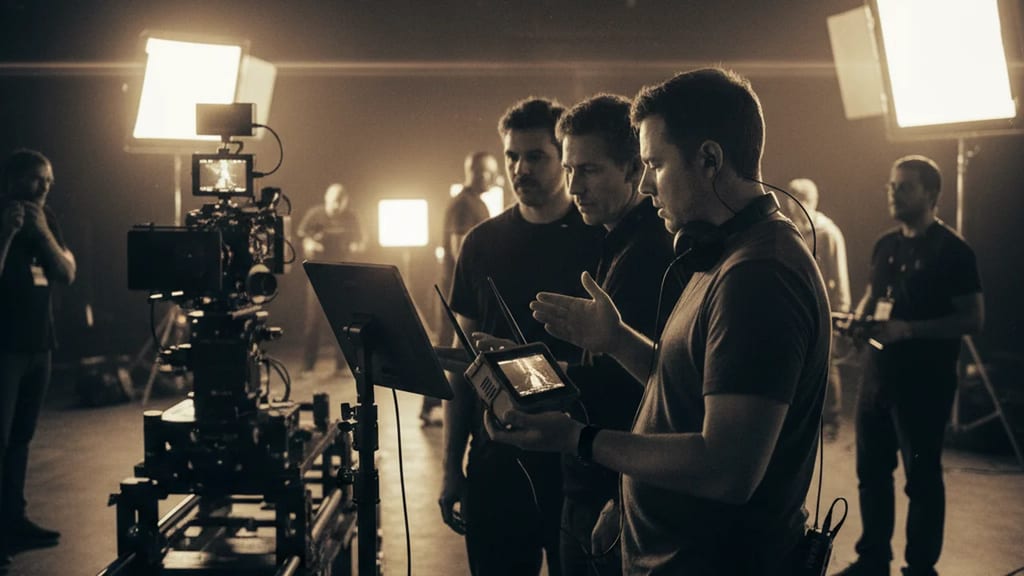
Wireless transmission of camera footage to remote monitors using H.264/H.265 compression. Systems like Teradek Bolt achieve sub-1ms latency over ranges up to 6km.
Modern wireless video systems operate with H.264 or H.265 compression and achieve bitrates between 6-20 Mbps. The transmitter (typically 95x60x25mm, 200-300g) is mounted directly to the camera, while receivers can distribute signals to up to 4 monitors simultaneously. High-quality systems like Teradek Bolt 4K utilize zero-latency technology with under 1ms latency over proprietary frequencies. Transmission power is a maximum of 100mW (Europe) or 1W (USA), with MIMO antenna technology (2x2 or 4x4) improving signal stability around obstacles.
The first professional wireless video systems launched in 2003 with Paralinx Arrow, but only achieved a range of 150 meters at SD quality. Teradek revolutionized the market in 2009 with the Cube system, offering a compact form factor and HD transmission. In 2015, SmallHD introduced integrated wireless receivers into monitors for the first time with the 502 Bright. Since 2018, systems like the DJI Transmission have enabled 4K transmission with under 28ms latency over a distance of 6 kilometers.
Wireless video allows script supervisors and directors to follow the shot away from the camera, while the cinematographer can operate without restriction. On "1917" (2019), Steadicam operators used Teradek Bolt systems for the lengthy sequence shots, allowing director Sam Mendes to maintain picture control at all times. In confined spaces or during fast camera movements, they completely replace video cables. The systems work through metal walls but lose stability in densely built-up areas or with other 2.4GHz devices.
Compared to wired HD-SDI connections, wireless video systems offer freedom of movement but introduce latency and potential signal loss. Smartphone-based solutions like Accsoon SeeMo cost under €200 but only achieve a range of 60 meters. Professional systems (Teradek Bolt, Hollyland Mars) start at €1,500 and offer encrypted transmission as well as timecode synchronization. For critical applications, fiber optic systems like the Camplex SMPTE Hybrid remain the most reliable, but also the most expensive, alternative.
Ich montiere den Sender direkt am Rig und spare mir 50 Meter schweres SDI-Kabel bei Steadicam-Shots. Die 60ms Latenz sind beim Fokus ziehen spürbar, deshalb verlasse ich mich weiterhin auf den Kamera-Sucher für präzise Einstellungen.
Ich kann mit dem drahtlosen Monitor am Set frei bewegen und dabei jedes Detail der Aufnahme verfolgen, ohne dem Kameramann im Weg zu stehen. Besonders bei langen Einstellungen oder Drohnenflügen behalte ich so die kreative Kontrolle über das Bild.
Ein Funk-Video-System für 2.500€ spart täglich zwei Stunden Setup-Zeit und eliminiert Stolperfallen durch Kabel, was Versicherungskosten senkt. Bei 30 Drehtagen amortisiert sich die Anschaffung gegenüber der Miete bereits nach dem ersten Projekt.
1. Was beschreibt „Funk-Video" am besten?
2. Zu welchem Department gehört „Funk-Video"?
3. Wie viele verschiedene Fachperspektiven bietet dieser Eintrag?
The Lexikon is part of the Filmfarm ecosystem — alongside budgeting (FilmBalance), an industry magazine (FilmCircus) and crew networking (FilmCall, CrewMesh). One shared vocabulary for the whole production.