Filmlexikon.
Support
Uncoated Lens
Camera · Equipment

Uncoated Lens

Murnau AI illustration
anamorphic lens anamorphic projection lens angenieux optimo prime arri master prime arri signature prime arri ultra prime arri zeiss variable prime atlas lens co

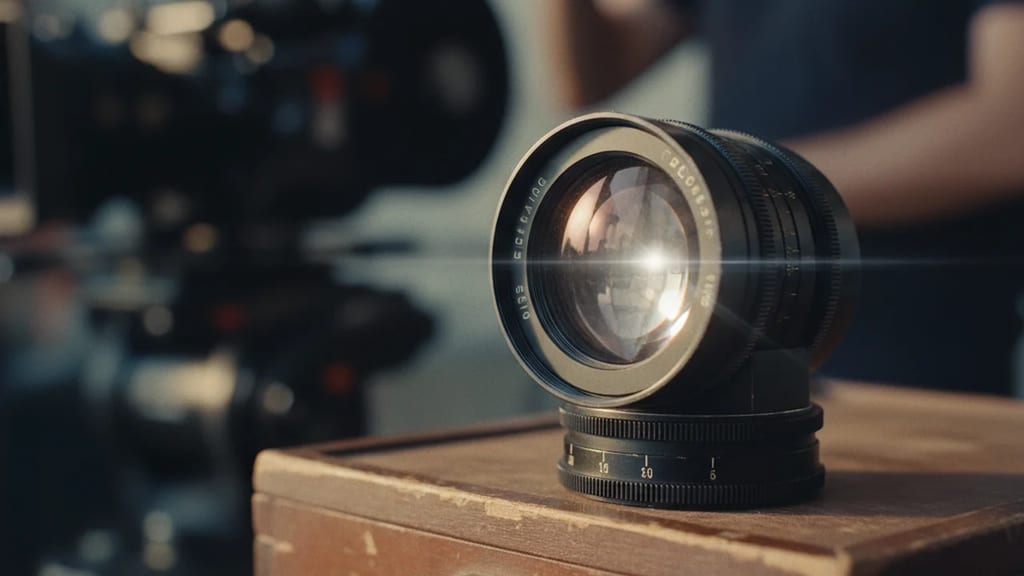
Lens without anti-reflective coating — produces warm flares, reduced sharpness, and lower contrast for a vintage film aesthetic.

Technical Details

According to Fresnel's formulas, each uncoated glass surface reflects approximately 4% of perpendicularly incident light at a refractive index of 1.5. A typical five-element lens thus loses about 32% of its transmission. The lack of coating intensifies lens flares, ghosting, and reduces contrast to approximately 1:50 to 1:100, compared to 1:500 for modern multi-coated lenses. Stray light between lens elements generates characteristic hexagonal or octagonal reflections corresponding to the aperture shape.

History & Development

The first cinematic lenses from Zeiss and Cooke (1895-1930) were exclusively uncoated. Carl Zeiss developed the first anti-reflection coating in 1935, which was used in the T* series from 1939. Kodak introduced Ektar lenses with magnesium fluoride coating in 1940. After 1950, uncoated lenses largely disappeared from mass production, but experienced a renaissance from the 1990s for special cinematic effects in commercials and music videos.

Practical Use in Film

Derek Jarman deliberately used uncoated Cooke lenses from the 1920s for "Caravaggio" (1986) to reproduce the muted contrast of the paintings. Cinematographer Darius Khondji partially used uncoated lenses for "Se7en" (1995) to enhance the dark atmosphere through reduced contrast. In the advertising industry, DoPs specifically use uncoated lenses for soft lens flares in backlight shots. The reduced contrast lends skin tones a velvety quality, while highlights bloom gently.

Comparison & Alternatives

Compared to single-coated lenses (one layer of coating), uncoated lenses offer stronger flare effects but significantly less transmission. Multi-coated lenses (multilayer coating) achieve 95-98% transmission and eliminate flares almost completely. Pro-Mist or Black Pro-Mist filters partially simulate the look of uncoated optics on modern lenses. Vintage lenses such as Cooke Speed Panchros or Zeiss Standard Speeds from the pre-coating era today fetch collector prices of 15,000-40,000 Euros per set.
From the crafts

Perspectives

Cinematographer

Ich nutze unvergütete Objektive gezielt für organische Lens Flares und den charakteristischen Kontrastverlust, der digitale Aufnahmen filmischer wirken lässt. Bei Gegenlichtszenen entstehen weiche, natürliche Überstrahlungen ohne die harten Kanten moderner Optiken. Der Lichtverlust von 1-2 Blendenstufen erfordert entsprechend stärkere Beleuchtung oder höhere ISO-Werte.

Director

Unvergütete Objektive transportieren eine nostalgische, traumhafte Bildsprache durch ihre weichen Kontraste und organischen Flares. Ich setze sie für Flashback-Sequenzen oder romantische Szenen ein, wo der gedämpfte Look die emotionale Distanz oder Verklärung der Erinnerung visuell unterstützt. Der vintage Charakter verstärkt die Authentizität bei Periodenfilmen der 1920er bis 1950er Jahre.

Producer

Originale unvergütete Vintage-Objektive kosten 20.000-60.000 Euro pro Set und erfordern spezialisierte Wartung durch wenige Fachbetriebe weltweit. Die reduzierte Lichtausbeute verlängert Drehzeiten um 15-25% wegen zusätzlicher Beleuchtung. Versicherungsprämien steigen aufgrund des Sammlerwerts, aber der distinctive Look rechtfertigt die Mehrkosten bei High-End-Produktionen oder Werbespots.

More in the lexikon

Related terms

Test your knowledge

Quiz

1. Was beschreibt „Unvergütetes Objektiv" am besten?

2. Zu welchem Department gehört „Unvergütetes Objektiv"?

3. Wie viele verschiedene Fachperspektiven bietet dieser Eintrag?

Report an error
From the Filmfarm ecosystem

Understand visual language, budget productions, connect crew.

The Lexikon is part of the Filmfarm ecosystem — alongside budgeting (FilmBalance), an industry magazine (FilmCircus) and crew networking (FilmCall, CrewMesh). One shared vocabulary for the whole production.

FilmFarm FilmRadarComing soonFilmPulseComing soonFilmNumbersComing soonFilmCapitalComing soonFilmLabComing soonFilmBalanceComing soonFilmCircusComing soon