Technical Details
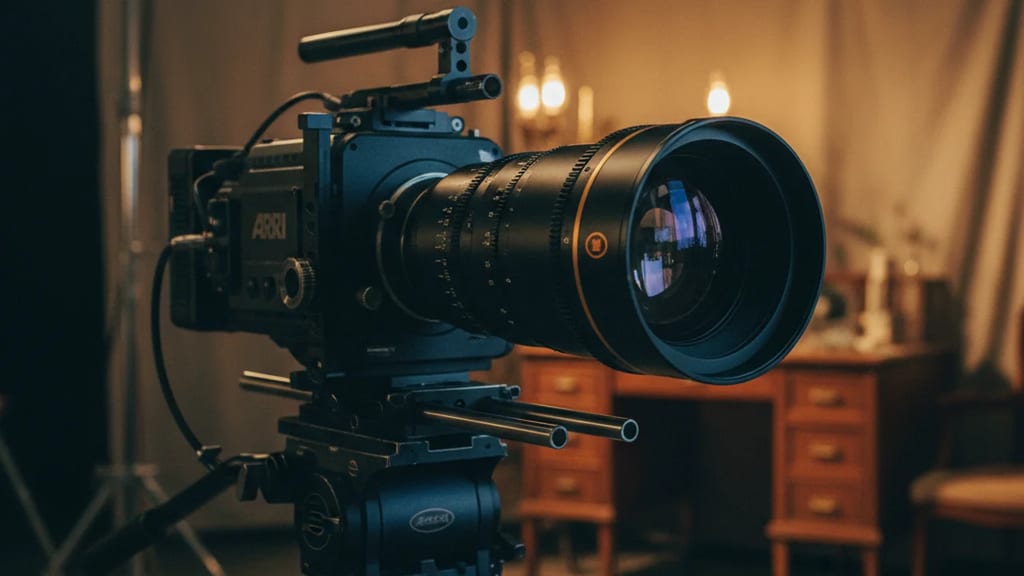
Standard anamorphic projection lenses operate with a de-squeeze factor of 2:1 and are mounted as an attachment lens in front of projector lenses with focal lengths between 35mm and 160mm. The cylindrical glass elements compensate for the horizontal compression created during recording with anamorphic camera lenses. Modern anamorphic projection lenses consist of 4-6 lens elements and achieve a light transmission of 92-95%. Mechanical mounting is done via standard threads from 95mm to 127mm in diameter, depending on the projector type used.
History & Development
Henri Chrétien developed the first anamorphic system, "Hypergonar," in 1927 for the French Navy to improve periscopes. In 1952, 20th Century Fox acquired the rights and introduced the system as "Cinemascope" – the first film, "The Robe" (1953), revolutionized widescreen cinema. Bausch & Lomb manufactured the first series-produced anamorphic projection lenses; later, Zeiss, Panavision, and ISCO took over production. With the introduction of digital projection systems from 2005 onwards, mechanical anamorphic lenses were replaced by software algorithms that perform de-squeezing electronically.
Practical Use in Film
Classic CinemaScope productions like "Ben Hur" (1959), "Lawrence of Arabia" (1962), or "Apocalypse Now" (1979) required the installation of anamorphic projection lenses in all cinemas. The projectionist had to check the correct positioning before each screening and readjust the focus. In modern anamorphic productions like "Mad Max: Fury Road" (2015) or "Dune" (2021), de-squeezing is done during the Digital Intermediate (DI) or directly in the digital projector. 35mm film prints with anamorphic compression are now only produced for special screenings or archival purposes.
Comparison & Alternatives
Anamorphic projection lenses fundamentally differ from spherical wide-angle lenses because they only de-squeeze horizontally. Unlike recording anamorphic lenses, they are optimized for a fixed projection distance and do not have variable focusing. Modern DCP (Digital Cinema Package) projectors replace mechanical anamorphic lenses with pixel-mapping algorithms that display different aspect ratios without lens changes. IMAX projections use their own spherical systems and do not require anamorphic de-squeezing.