Definition
A special lens that creates characteristic circular blur gradients through asymmetrical lens correction or deliberately retained spherical aberrations. The bokeh (Japanese "boke" = blur) displays spiral or concentric swirl patterns that increase from the center of the image towards the edges. Typical focal lengths range from 50mm to 135mm with maximum apertures from f/1.2 to f/2.8.
Technical Details
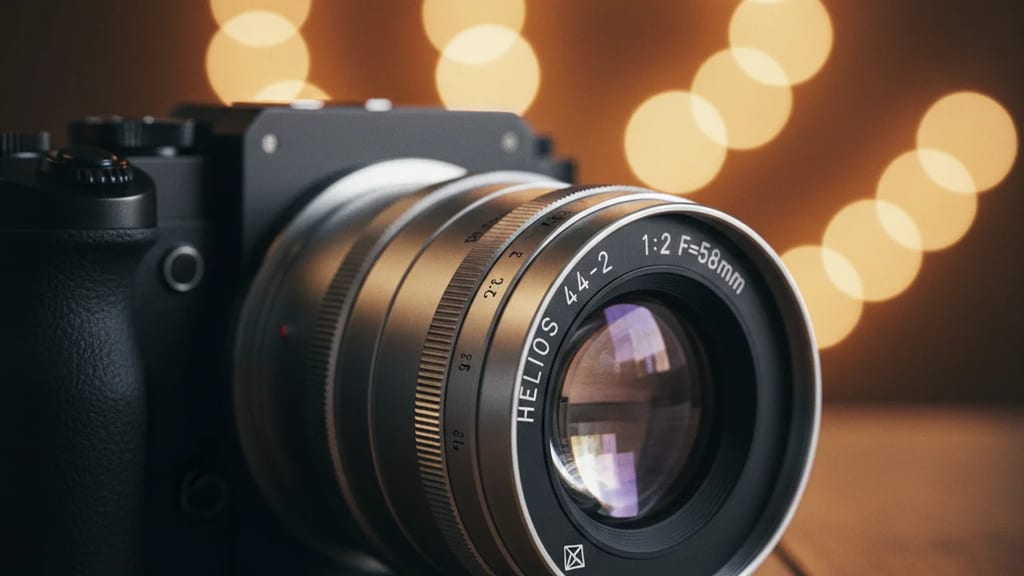
The swirl effects are caused by uncorrected coma aberrations and residual astigmatic errors in the lens design. Classic examples like the Helios 44-2 58mm f/2 use a modified Biotar construction with six elements in four groups. The characteristic swirl pattern intensifies from f/2.8 aperture and reaches its maximum expression at wide open aperture. Modern variants such as the Lensbaby Twist 60 or Meyer-Optik Trioplan 100mm f/2.8 utilize controlled optical "flaws" for targeted effect generation. The swirl radius correlates directly with the distance between subject and background, as well as the focal length used.
History & Development
The Helios 44-2, based on the German Zeiss Biotar from the 1920s, established the characteristic look in Soviet film production from 1958 onwards. Originally developed for Zenit 35mm cameras, it experienced a renaissance in digital cinematography from 2010 onwards through adaptation to modern camera systems. Meyer-Optik-Görlitz reactivated the historical Trioplan design in 2017 with improved coatings. Lensbaby introduced the first swirly bokeh lens specifically optimized for video production with a cine housing in 2019.
Practical Use in Film
Terrence Malick used Soviet Helios lenses for dream-sequence-like passages in "Knight of Cups" (2015). The circular blur gradients enhance narrative disorientation and psychological states. In fashion photography, swirly bokeh creates natural vignetting effects without post-production. Technical limitations include reduced corner sharpness and contrast fall-off at wide open aperture. Manual focusing requires precise focus control, as the transition zone between sharpness and blur is abrupt.
Comparison & Alternatives
Regular bokeh shows uniform, concentric blur circles without rotational patterns. Anamorphic lenses create oval bokeh shapes with horizontal orientation. Digitally generated swirl effects using radial blur differ by the lack of optical depth staging. Tilt-shift lenses offer selective planes of focus, but without characteristic swirling. Modern cine versions with T-stop calibration and standardized focus gears are increasingly replacing adapted vintage lenses in professional productions.