Filmlexikon.
Support
Rhythmic Montage
Editing · Terms

Rhythmic Montage

Murnau AI illustration
flow montage roll

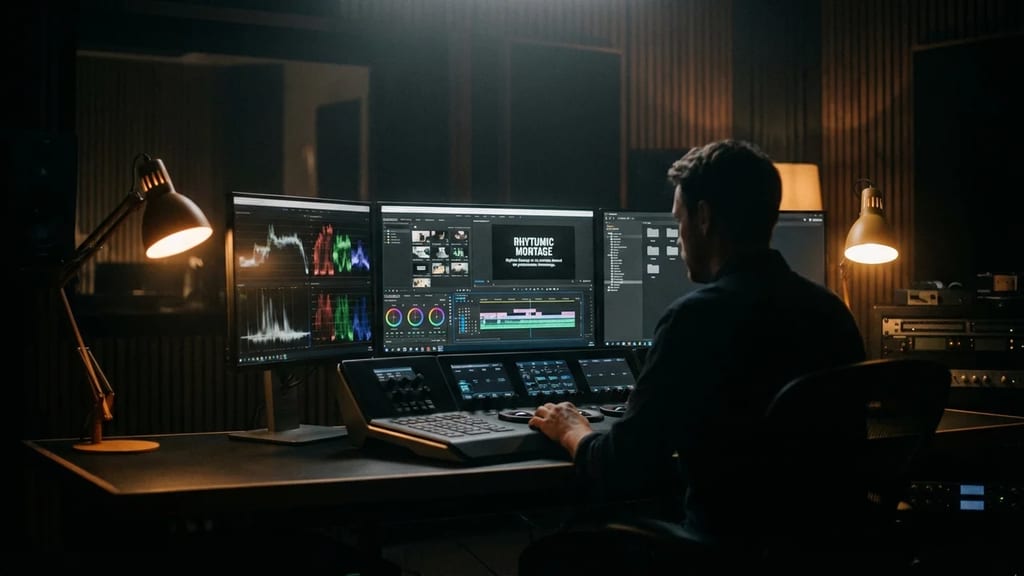
Editing technique synchronizing cut frequency to musical beats (typically 60–180 BPM) with frame-accurate precision in digital NLEs.

Technical Details

In rhythmic montage, the editing frequency is based on beats per minute (BPM), with common values ranging between 60-180 BPM. A 4/4 time signature at 120 BPM results in cut intervals of exactly 2 seconds per beat. Modern digital editing systems like Avid or DaVinci Resolve offer BPM synchronization with an accuracy of ±1 frame at 24fps. Three main variants exist: metric montage (constant cut durations), syncopated montage (deliberate rhythm breaks), and polyrhythmic montage (multiple overlapping rhythm layers).

History & Development

Sergei Eisenstein developed rhythmic montage in 1925 for "Battleship Potemkin," particularly in the Odessa Steps sequence with 155 cuts in 6 minutes. Dziga Vertov perfected the technique in 1929 in "Man with a Movie Camera" through 1,775 cuts in a 68-minute runtime. MTV established modern music video editing from 1981 onwards, with an average of 3-4 cuts per 10 seconds. Since the 2000s, digital audio waveform displays have enabled frame-accurate synchronization.

Practical Application in Film

Kubrick's "2001" uses rhythmic montage to the waltz melody in the space station sequence with 47 cuts synchronized to Strauss' "The Blue Danube." Action films like "Mad Max: Fury Road" employ accelerated editing rhythms of 0.8-1.2 seconds per cut in chase scenes. The workflow first requires creating a tempo track, then setting edit markers on each beat, before rhythmically adjusting the footage. Advantages: emotional intensification and hypnotic effect. Disadvantages: potential viewer overstimulation if overused.

Comparison & Alternatives

Rhythmic montage differs from intellectual montage through its emotional rather than cerebral focus. Parallel editing follows narrative, not musical, principles. Modern alternatives include computer-aided beat detection software like Mixed In Key or algorithmic editing tools. In quiet dramas, dramaturgical montage with variable cut lengths between 3-15 seconds is more commonly used. Music videos and commercials consistently employ rhythmic montage, while arthouse films use it sparingly as a stylistic device.
From the crafts

Perspectives

Cinematographer

Ich muss bei rhythmischer Montage bereits beim Dreh an die spätere Schnittfrequenz denken und entsprechend mehr Coverage mit kürzeren, dynamischeren Einstellungen produzieren. Kamerabewegungen plane ich so, dass sie innerhalb der anvisierten 2-4 Sekunden Schnittlänge ihre volle Wirkung entfalten, ohne abrupt unterbrochen zu wirken. Besonders bei Steadicam-Fahrten kalkuliere ich präzise, welche Bewegungsabschnitte später als eigenständige Rhythmus-Beats funktionieren.

Director

Ich setze rhythmische Montage gezielt für emotionale Höhepunkte ein, wo das Publikum in einen tranceähnlichen Zustand versetzt werden soll - etwa in Kampf-, Tanz- oder Liebesszenen. Die Herausforderung liegt darin, trotz der musikalischen Struktur die narrative Logik nicht zu opfern, deshalb arbeite ich bereits im Drehbuch mit Rhythmus-Notationen. In ruhigen Szenen breche ich bewusst den etablierten Rhythmus, um dramatische Akzente zu setzen.

Producer

Rhythmische Montage erfordert 20-30% mehr Drehtage für zusätzliche Coverage und verlängert die Postproduktion um durchschnittlich 2 Wochen, da jeder Schnitt millimetergenau abgestimmt werden muss. Die Musikrechte müssen früh geklärt sein, da der Final Cut direkt von der Tracklänge abhängt - nachträgliche Änderungen sind kostspielig. Dafür reduzieren sich oft die Kosten für Sound Design, da die Musik bereits strukturgebend wirkt.

More in the lexikon

Related terms

Test your knowledge

Quiz

1. Zu welchem Department gehört „Rhythmische Montage"?

2. Wie viele verschiedene Fachperspektiven bietet dieser Eintrag?

Report an error
From the Filmfarm ecosystem

Understand visual language, budget productions, connect crew.

The Lexikon is part of the Filmfarm ecosystem — alongside budgeting (FilmBalance), an industry magazine (FilmCircus) and crew networking (FilmCall, CrewMesh). One shared vocabulary for the whole production.

FilmFarm FilmRadarComing soonFilmPulseComing soonFilmNumbersComing soonFilmCapitalComing soonFilmLabComing soonFilmBalanceComing soonFilmCircusComing soon