Technical Details
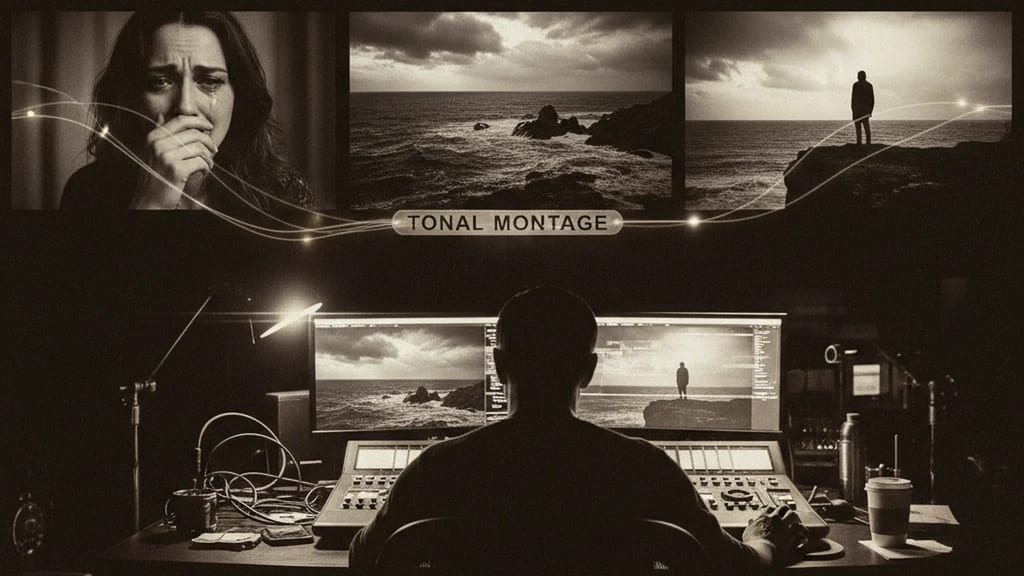
In tonal montage, shots are categorized by their fundamental visual mood: bright versus dark image values, warm versus cool color temperatures (measured in Kelvin between 2700K-6500K), and ascending versus descending lines in the composition. The editing pace varies between 0.5 and 8 seconds per shot, depending on the desired emotional intensity. Modern digital editing systems like Avid Media Composer or DaVinci Resolve, through their color grading tools, enable precise adjustment of tonal values during the editing process itself. Three main variants exist: contrasting tonal montage (abrupt mood shifts), harmonic tonal montage (flowing transitions), and modulating tonal montage (gradual mood changes).
History & Development
Eisenstein developed tonal montage in 1925 during his work on "Battleship Potemkin," first systematically applied in the mourning sequence for the shot sailor Vakulinchuk. In 1929, he theorized the concept in his essay "The Montage of Attractions." The Nouvelle Vague adopted the technique in the 1960s, notably Jean-Luc Godard in "Breathless" (1960). Andrei Tarkovsky perfected it in "Andrei Rublev" (1966) through extremely long, tonal shot sequences of up to 4 minutes. Since the 1990s, it has seen increased use in digital compositing workflows.
Practical Application in Film
A classic application can be found in Terrence Malick's "The Tree of Life" (2011), where 47 shots in the nature sequence are edited solely based on lighting mood and emotional coloring. Denis Villeneuve uses tonal montage in "Blade Runner 2049" (2017) for the Las Vegas sequence: 23 shots transition from orange-yellow (2700K) to bluish (5600K) color temperatures over 8 minutes. The workflow requires close collaboration between the editor and colorist from the rough cut phase. Disadvantage: more time-consuming than conventional editing methods, as each shot must be analyzed for its emotional impact.
Comparison & Alternatives
Distinction from rhythmic montage: Rhythmic montage follows musical beat patterns, while tonal montage builds emotional harmonies. Associative montage works with thematic connections rather than atmospheric ones. Modern motion graphics software like After Effects offers "Lumetri Color" tools for tonal analysis of footage. AI-based systems like "ScriptBook" have been able to automatically generate tonal editing suggestions since 2020. For action-heavy sequences, rhythmic montage is more suitable, while tonal montage is better for character-driven dramas. Documentaries often use hybrid forms of both techniques.