Definition
Cutting rhythm refers to the temporal sequence and frequency of cuts in a film sequence, measurable by the Average Shot Length (ASL) in seconds per shot. Modern action films achieve ASL values of 1.5-3 seconds, while classic Hollywood productions of the 1940s averaged 8-12 seconds per shot. The term originates from music theory and describes the percussive effect of successive cuts on viewer perception.
Technical Details
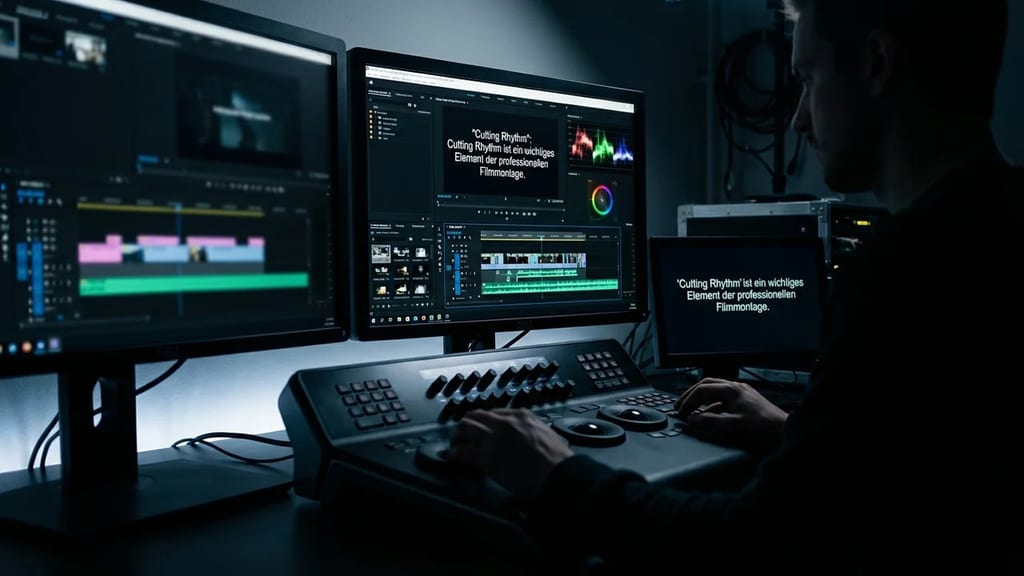
Cutting frequency is measured in Cuts Per Minute (CPM), with values between 20-40 CPM considered moderate, and over 60 CPM considered fast cutting. Digital editing systems like Avid Media Composer visualize cutting rhythm through waveforms and timecode analyses. Three main types exist: metric cutting (uniform intervals), rhythmic cutting (oriented to music), and organic cutting (adapted to action). Beat cutting occurs precisely on music beats with frame-accurate precision at 24/25/30fps.
History & Development
Sergei Eisenstein first consciously developed rhythmic montage principles in 1925 in "Battleship Potemkin," particularly in the Odessa Steps sequence with accelerating cutting intervals from 8 to 0.5 seconds. MTV established fast music video editing from 1981 onwards, with an average ASL of 2-3 seconds. The Bourne trilogy (2002-2007) popularized hyper-kinetic cutting with up to 3000 cuts per film. Modern Marvel productions reach peak values of 80+ CPM in action sequences.
Practical Application in Film
"Mad Max: Fury Road" (2015) uses accelerating cutting rhythm from 4 seconds ASL in quiet moments down to 0.8 seconds in chase scenes. Horror films employ stinger cuts (abrupt cuts after longer takes) for shock effects. Dialogue editing typically follows natural speech pauses, while action sequences often cut against natural movement (cutting on action). Non-linear editors automatically calculate ASL statistics for rhythm matching between scenes.
Comparison & Alternatives
Cutting rhythm differs from tempo (narrative speed) and pacing (dramatic tension distribution). Jump cuts deliberately disrupt rhythmic continuity, while match cuts create rhythmic transitions. Long-take aesthetics (Béla Tarr, Andrei Tarkovsky) completely forgo rhythmic montage in favor of hypnotic visual impact. Split-screen and picture-in-picture enable simultaneous rhythm layers without physical cuts.