Technical Details
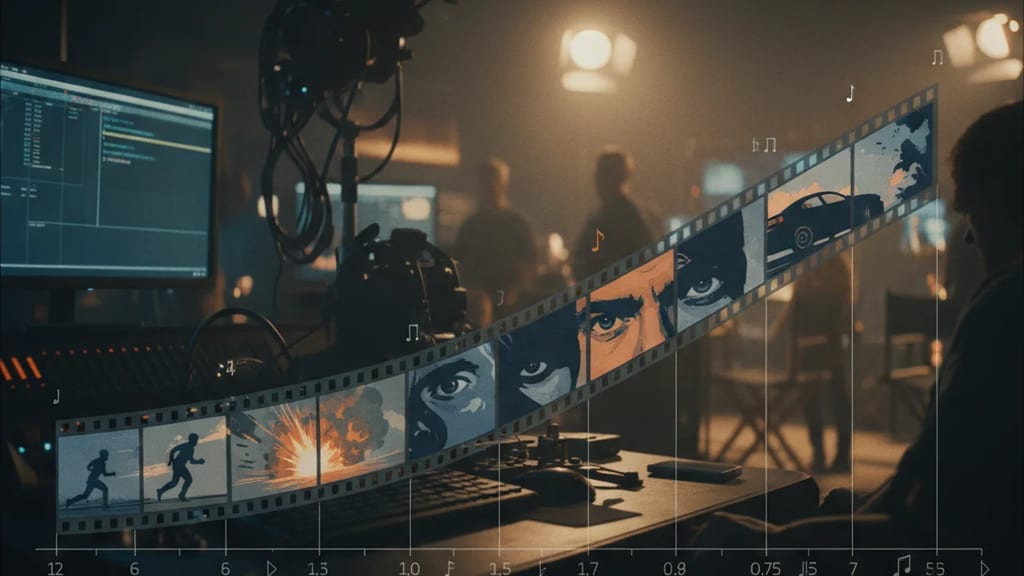
In metric montage, shots are cut at absolutely equal time intervals, typically between 1-10 seconds per shot. In the analog era, this meant exact film meter counts: with 35mm film at 24fps, 4 seconds correspond to exactly 5.76 meters of film material. Digitally, this is implemented via timecode markers or automated editing functions. Variants include progressive metric montage (shortening intervals of 8-4-2-1 seconds) and modular systems with alternating but mathematically defined patterns such as 3-6-3-6 seconds.
History & Development
Eisenstein developed his montage theory in 1925 as a reaction to the French Impressionist school, defining metric montage as the basic level of his system. Its first practical application was in "Battleship Potemkin" (1925) during the Odessa Steps sequence, where 155 cuts at precisely calculated intervals amplified the rhythm of the descending crowd. In the 1960s, New Wave directors like Jean-Luc Godard took up the concept. Digitization since the 1990s has enabled more precise implementations through frame-accurate editing capabilities.
Practical Use in Film
Stanley Kubrick used metric montage in "2001: A Space Odyssey" (1968) for the spaceship sequences with 6-second intervals to visualize technical precision. Nicolas Winding Refn employed 4-second cycles for driving scenes in "Drive" (2011). The workflow requires precise pre-planning: editing tables with exact timecodes are created before editing. Advantages: hypnotic effect, rhythm generation independent of the material. Disadvantages: potential monotony, ignoring natural tension arcs, high demands on the source material.
Comparison & Alternatives
Metric montage fundamentally differs from rhythmic montage, which is based on movement rhythms within the image, and from emotional montage, which follows psychological tension curves. Modern alternatives include algorithmic editing processes and AI-based montage systems that combine mathematical precision with content analysis. Music videos often use beat-synchronous variants of metric montage. The classical form is suitable for experimental projects, trance sequences, or industrial/technical depictions, while narrative films mostly prefer hybrid approaches.