Overview
HEVC stands for High Efficiency Video Coding and refers to a video compression standard that is also known under the names H.265 (ITU-T) and MPEG-H Part 2 (ISO/IEC). It is not a lighting or grip device, but a codec technology from the realm of camera/recording and post-production. HEVC was jointly developed by the ITU-T VCEG and ISO/IEC MPEG (in the Joint Collaborative Team on Video Coding, JCT-VC) and adopted in 2013.
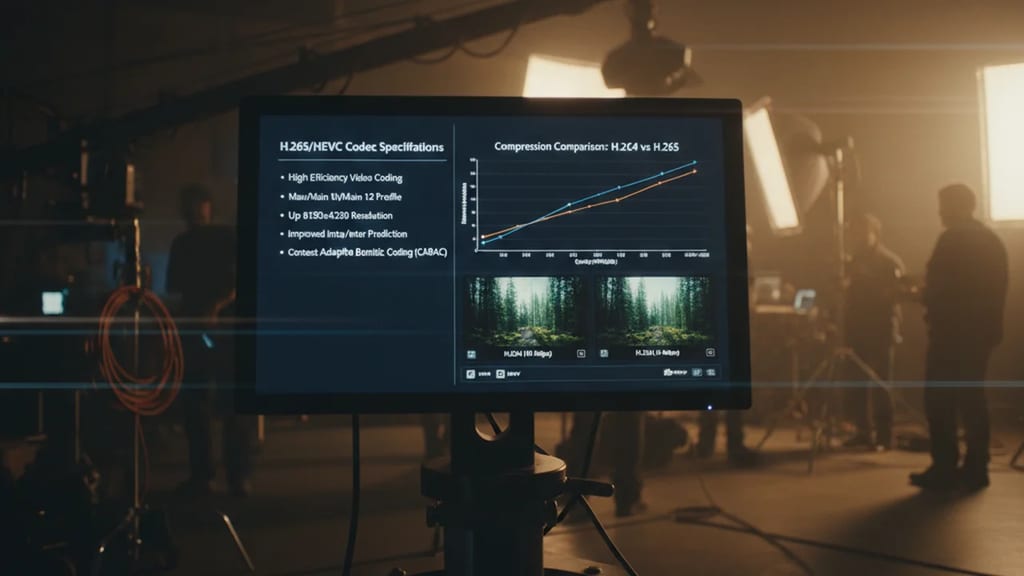
HEVC is the successor to H.264/AVC and pursues the same goal: the highest possible image quality at the lowest possible data rate. The key advantage is efficiency – HEVC achieves comparable image quality to H.264 at about half the data rate.
Technical Fundamentals
HEVC replaces the rigid macroblock structure of H.264 with flexible Coding Tree Units (CTUs), which can process significantly larger block sizes. Large, uniform image areas are compressed with a few large blocks, while detailed edges and textures are handled with smaller blocks. Additionally, there are more intra-prediction modes than in H.264, which further increases efficiency.
- Resolution: up to 8K UHD (8192 × 4320 pixels)
- Color Depth: 8, 10, and 12 bits (via profiles like Main, Main 10, Main 12)
- Chroma Sampling: 4:2:0, 4:2:2, and 4:4:4
- HDR Support: compatible with HDR formats such as HDR10, HDR10+, and Dolby Vision
| Feature | H.264 / AVC | HEVC / H.265 |
|---|
| Data Rate at Equal Quality | Reference | approx. 50% lower |
| Block Architecture | Macroblocks (max. 16 × 16) | Coding Tree Units (up to 64 × 64) |
| Maximum Resolution | 4K range | up to 8K UHD |
On-Set and Post-Production Usage
Many current cameras offer HEVC as a recording format, often in conjunction with 10-bit 4:2:2 recording. The codec is primarily used here to capture high-resolution material (UHD/4K and higher) at a moderate data rate and small file sizes on memory cards. Canon, for example, offers a variant as XF-HEVC (H.265 in an MXF container) in cinema and professional camcorders.
HEVC, as a delivery and recording format, is highly compressed and – depending on the implementation – computationally intensive to decode. For actual editing, HEVC material is therefore converted into an edit-friendly intermediate format like ProRes in many workflows, as such intermediate codecs are designed for smooth editing rather than minimal file size. For distribution and streaming, however, HEVC fully leverages its bandwidth efficiency.