Overview
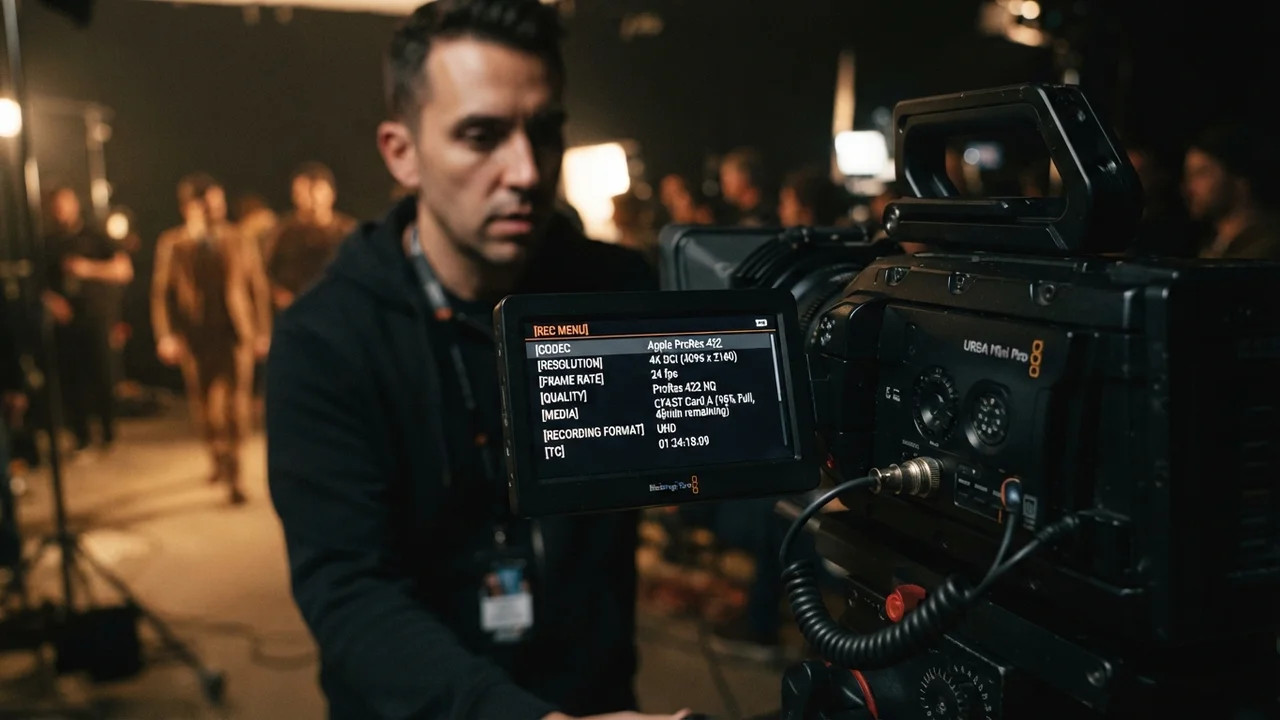
ProRes 422 is a professional video codec developed by Apple for recording, editing, and post-production. It is not lighting or grip equipment, but technically belongs to the camera and post-production world: Many cameras (e.g., from ARRI, Blackmagic, RED, Sony, Canon, as well as Pro-series iPhones) record directly in ProRes, and editing software like Final Cut Pro, DaVinci Resolve, Premiere Pro, and Avid Media Composer work with it natively.
ProRes is an intra-frame coded codec (each individual frame is compressed completely and independently, without inter-frame dependencies). This facilitates cutting, trimming, and playback because each frame can be decoded on its own. It operates with variable bitrate (VBR) and adjusts the data amount depending on the image content. The designation "422" refers to 4:2:2 color sampling: full luminance resolution (luma) with horizontally halved color resolution (chroma).
The ProRes 422 Family
"ProRes 422" refers to both a specific variant (the standard profile) and the overarching 4:2:2 family. All four variants use 10-bit color depth and 4:2:2 sampling, and differ primarily in their compression ratio or data rate. For higher color depth or an alpha channel (4:4:4:4), ProRes 4444 and 4444 XQ exist separately and do not belong to the 422 family.
| Variant | Target Data Rate (1920×1080, 29.97 fps) | Typical Use |
|---|
| ProRes 422 Proxy | approx. 45 Mbps | Offline editing, lightweight proxies at full resolution |
| ProRes 422 LT | approx. 102 Mbps | Space-saving, broadcast workflows with reduced data volume |
| ProRes 422 | approx. 147 Mbps | Standard mastering and editing format, good balance |
| ProRes 422 HQ | approx. 220 Mbps | Demanding recording, color grading, VFX |
On-Set and Post-Production Use
In practice, ProRes 422 (often the HQ variant) is a common recording format for external recorders (e.g., Atomos, Blackmagic Video Assist) and in-camera recording. It delivers visually high-quality results with significantly more manageable file sizes than uncompressed or RAW material and is widely compatible as a post-production codec. The 10-bit depth and 4:2:2 sampling provide sufficient latitude for color correction, compositing, and keying. For offline editing on less powerful hardware, the Proxy and LT variants are used, while final delivery often occurs via ProRes 422 or 422 HQ.