Filmlexikon.
Support
DNxHD
Camera · Technique

DNxHD

Murnau AI illustration
prores 422 hq prores 422 prores 4444 xq prores 4444 prores raw prores hd dnxhr

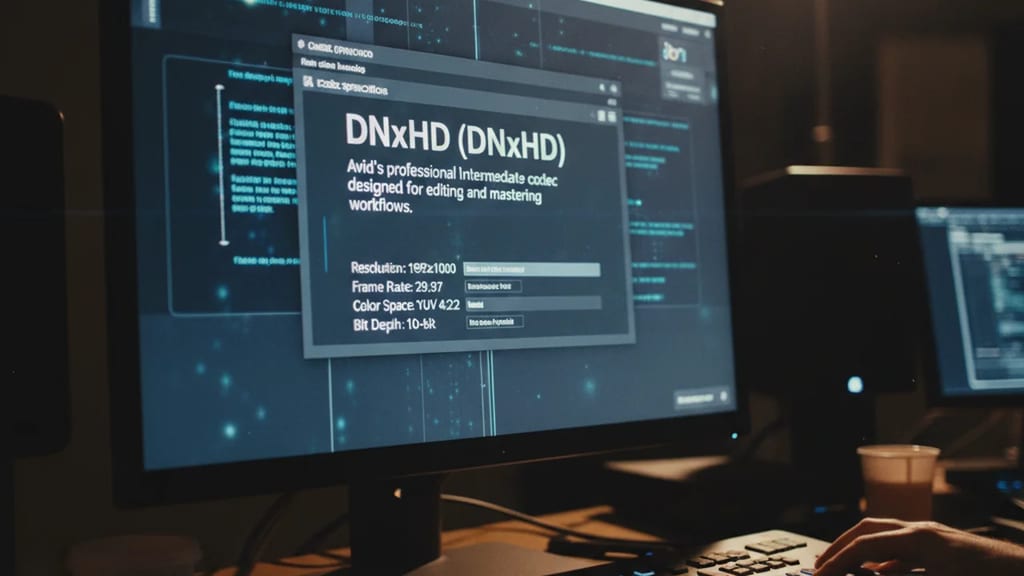
Avid's professional intermediate codec designed for editing and mastering workflows.

Technical Details

DNxHD operates with fixed quality levels: DNxHD 36 (36 Mbps, offline), DNxHD 115 (115 Mbps, online), DNxHD 175 (175 Mbps, high quality), and DNxHD 440 (440 Mbps, highest quality). The codec supports YUV 4:2:2 color sampling and uses DCT (Discrete Cosine Transform) compression. Unlike Long-GOP codecs such as H.264, DNxHD compresses exclusively within individual frames, enabling CPU-friendly decoding and frame-accurate editing. The wrapper formats are MXF or QuickTime.

History & Development

Avid introduced DNxHD in 2004 as a response to the increasing demands of HD post-production. The codec was intended to bridge the gap between uncompressed HD formats and highly compressed distribution formats. In 2008, DNxHD was standardized as SMPTE VC-3. With the introduction of 4K workflows, Avid developed its successor, DNxHR (High Resolution), in 2013, which supports higher resolutions and 10-bit color depth.

Practical Use in Film

DNxHD established itself as the standard intermediate codec in Avid Media Composer and other NLE systems. Films such as "The Social Network" (2010) and "Gone Girl" (2014) utilized DNxHD workflows for offline and online editing. In typical workflows, camera footage is transcoded to DNxHD 115 for offline editing and to DNxHD 175 or 440 for online editing and color grading. The codec offers fast decoding on standard hardware but requires significant storage space compared to Long-GOP formats.

Comparison & Alternatives

DNxHD directly competes with Apple ProRes, with ProRes offering broader platform support, while DNxHD is more tightly integrated into Avid environments. Compared to Sony XAVC-I, DNxHD offers more flexible bitrate options. For 4K material, DNxHD has been replaced by DNxHR, which supports resolutions up to 8K and extended color spaces. In pure Avid workflows, DNxHD remains relevant for HD productions, while cross-platform working teams often prefer ProRes.
From the crafts

Perspectives

Cinematographer

Ich nutze DNxHD 175 als Proxy-Format beim Monitoring am Set, da es die Bildqualität meiner RED-Aufnahmen gut repräsentiert ohne die Speicherkarten zu überlasten. Die konstante Bitrate gibt mir verlässliche Qualitätskontrolle – DNxHD 115 für Dailies, DNxHD 440 wenn der Colorist maximale Bildinformation für komplexe Looks braucht.

Director

DNxHD ermöglicht mir flüssiges Arbeiten im Schnittbereich ohne technische Verzögerungen – jeder Frame ist sofort verfügbar für präzise Schnittentscheidungen. Die verschiedenen Qualitätsstufen lassen mich je nach Produktionsphase entscheiden: DNxHD 36 für erste Rohschnitte mit dem Editor, DNxHD 175 für finale Abnahmen mit gleichbleibender Bildqualität.

Producer

DNxHD-Workflows reduzieren Renderzeiten in der Post um etwa 40% gegenüber unkomprimierten Formaten, was direkt Facility-Kosten spart. Die Speicheranforderungen sind kalkulierbar – 90 Minuten in DNxHD 115 benötigen circa 60 GB, DNxHD 175 etwa 95 GB. Bei Avid-basierten Postproduktionen entstehen keine Lizenzkosten für den Codec.

More in the lexikon

Related terms

Test your knowledge

Quiz

1. Was beschreibt „DNxHD" am besten?

2. Zu welchem Department gehört „DNxHD"?

3. Wie viele verschiedene Fachperspektiven bietet dieser Eintrag?

Report an error
From the Filmfarm ecosystem

Understand visual language, budget productions, connect crew.

The Lexikon is part of the Filmfarm ecosystem — alongside budgeting (FilmBalance), an industry magazine (FilmCircus) and crew networking (FilmCall, CrewMesh). One shared vocabulary for the whole production.

FilmFarm FilmRadarComing soonFilmPulseComing soonFilmNumbersComing soonFilmCapitalComing soonFilmLabComing soonFilmBalanceComing soonFilmCircusComing soon