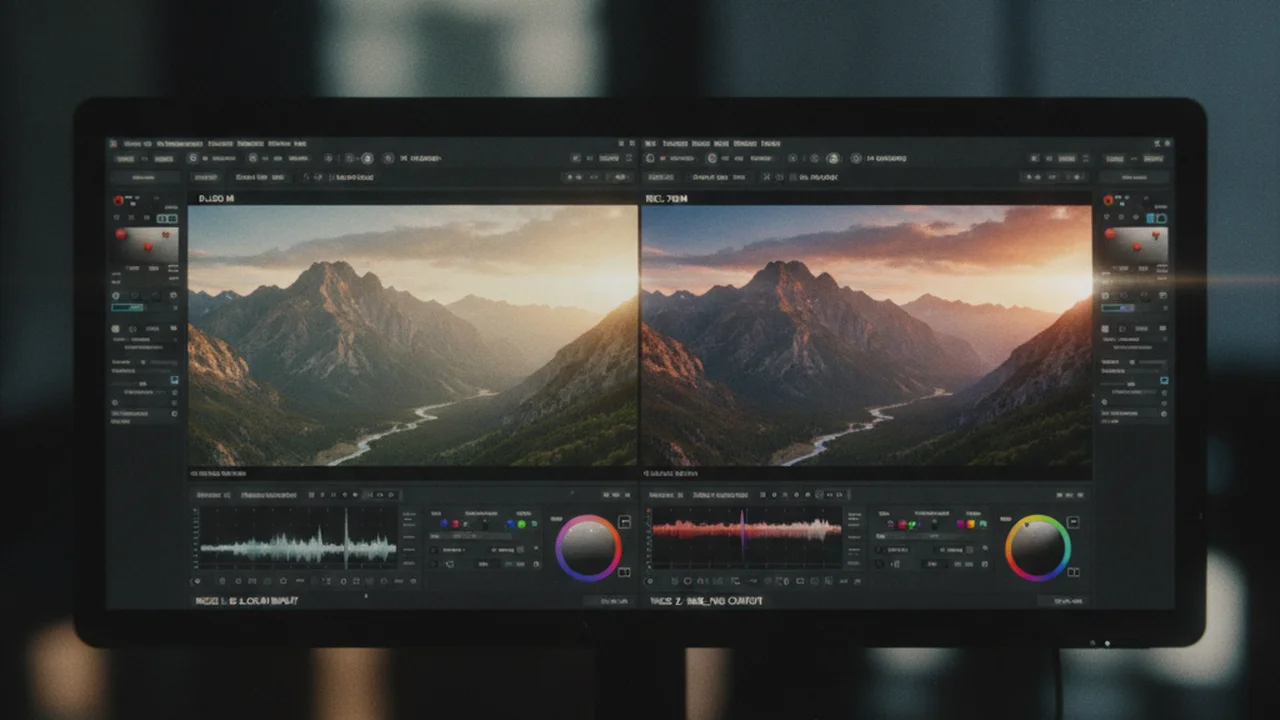
DJI's reduced logarithmic recording profile in 10-bit — flatter than Rec. 709, tamer than full D-Log, designed for the small sensors in action cameras and drones.
D-Log M is DJI's attenuated log profile. The M stands for Medium and denotes precisely that: a curve that lies between the full D-Log of DJI's larger cameras and a normal Rec. 709 image. It is found on devices like the Osmo Pocket 3, the Osmo Action 5 Pro, and smaller drones—in other words, where the sensor is small.
What it is and what it isn't
D-Log M is a recording curve, not a LUT and not a look. The tonal values are distributed more evenly across the brightness range than in a standard profile, so more detail is retained in highlights and shadows. The image looks flat and low-contrast straight out of the camera—this is the purpose, not a flaw. Recording is done in 10-bit, which means around one billion color values instead of the 16.7 million of an 8-bit recording. Without this bit depth, a log profile would be counterproductive: stretching the contrast in color grading would create banding in skies and skin tones.
Why the attenuated profile exists at all
A full log profile requires dynamic range. A sensor that lacks it, under an aggressive log curve, primarily delivers one thing: boosted noise in the shadows. D-Log M is the answer to this—less flat, but cleaner. The sensor of the Osmo Action 5 Pro measures 1/1.3 inches with a pixel size of 2.4 micrometers, achieving up to 13.5 stops. This is remarkable for this size and significantly less than what a cinema camera delivers. D-Log M is at home precisely within this range.
What this means on set
Three things. First: expose to the right, but without clipping highlights—log forgives underexposure less than any standard profile because noise is amplified with contrast. Second: manual white balance, because automatic correction causes the color temperature to shift during a shot, and this cannot be cleanly separated in color grading. Third: a monitor LUT, otherwise no one on set will be able to judge what they are seeing.
Classification
D-Log M is in the same category as S-Log3, V-Log, Log-C, and RED Log—with the difference that it is not intended for large sensors but rather to compensate for their absence. It is the threshold at which a camera under the thousand-euro mark enters a professional grading workflow. What is produced is not the image of a cinema camera. However, it is footage that can be cut into the same timeline as footage from a cinema camera.
Related terms
Quiz
1. Was beschreibt „D-Log M" am besten?
2. Zu welchem Department gehört „D-Log M"?