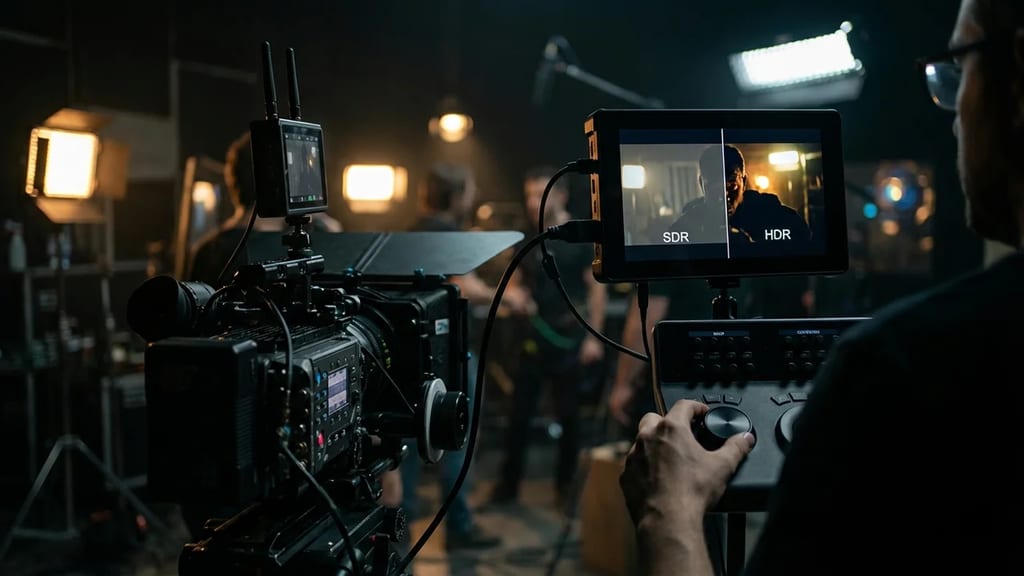
Overview
HDR stands for High Dynamic Range and, in the film and TV sector, refers to recording, editing, and playback methods that display a significantly wider brightness range and an extended color gamut (Wide Color Gamut) than classic SDR (Standard Dynamic Range). While SDR images are designed for a peak brightness of around 100 nits (cd/m²), HDR aims for considerably higher highlights and, simultaneously, deeper, purer black tones. HDR is not a single device but a continuous signal chain from the camera through grading to the display.
HDR directly impacts camera and post-production technology: conventional SDR material is insufficient for a usable HDR image. The prerequisite is recording material with a high dynamic range, meaning Log or RAW recording (e.g., ARRI Log-C, Sony S-Log3, Blackmagic RAW). Modern cinema camera sensors (like ARRI's ALEV family) achieve a dynamic range on the order of approximately 14 to 17 stops, which forms the basis for HDR evaluation.
Transfer Functions and Delivery Formats
HDR replaces the classic gamma curve with new transfer functions (EOTF):
- PQ (Perceptual Quantizer, SMPTE ST 2084): encodes absolute brightness values; a code value always corresponds to a fixed nit value. Theoretically displayable up to 10,000 nits. Basis of HDR10, HDR10+, and Dolby Vision.
- HLG (Hybrid Log Gamma, ITU-R BT.2100): works relatively and is backward compatible with SDR displays. It does not require metadata and is therefore common in broadcast/live applications.
The most important delivery formats differ primarily in the metadata that describes the mastering:
| Format | Transfer Function | Metadata |
|---|
| HDR10 | PQ | static |
| HDR10+ | PQ | dynamic (scene-based) |
| Dolby Vision | PQ | dynamic (scene-based) |
| HLG | HLG | none |
HDR content is also mastered in an extended color space: Rec. 2020 (BT.2020) or, in practice, often the DCI-P3 contained within it, instead of Rec. 709 (BT.709) which is standard for SDR.
Usage on Set and in Post
For the gaffer and the camera team, HDR shifts the exposure philosophy: highlights, practical lights, and window brightness become more visible and "real" in the HDR image, rather than clipping early. This increases creative freedom but also demands a deliberate lighting concept, as bright light sources are more noticeable in the HDR master.
In practice, this means continuous Log or RAW recording, a calibrated HDR reference monitor on set and in post-production, and an HDR-capable grading workflow. Typically, a derived SDR cut (HDR-to-SDR trim) is also created, as not all distribution paths and end devices support HDR. Industry references such as ITU-R BT.2100 or UHD Premium specifications define target values for peak brightness and black level of mastering displays for this purpose.