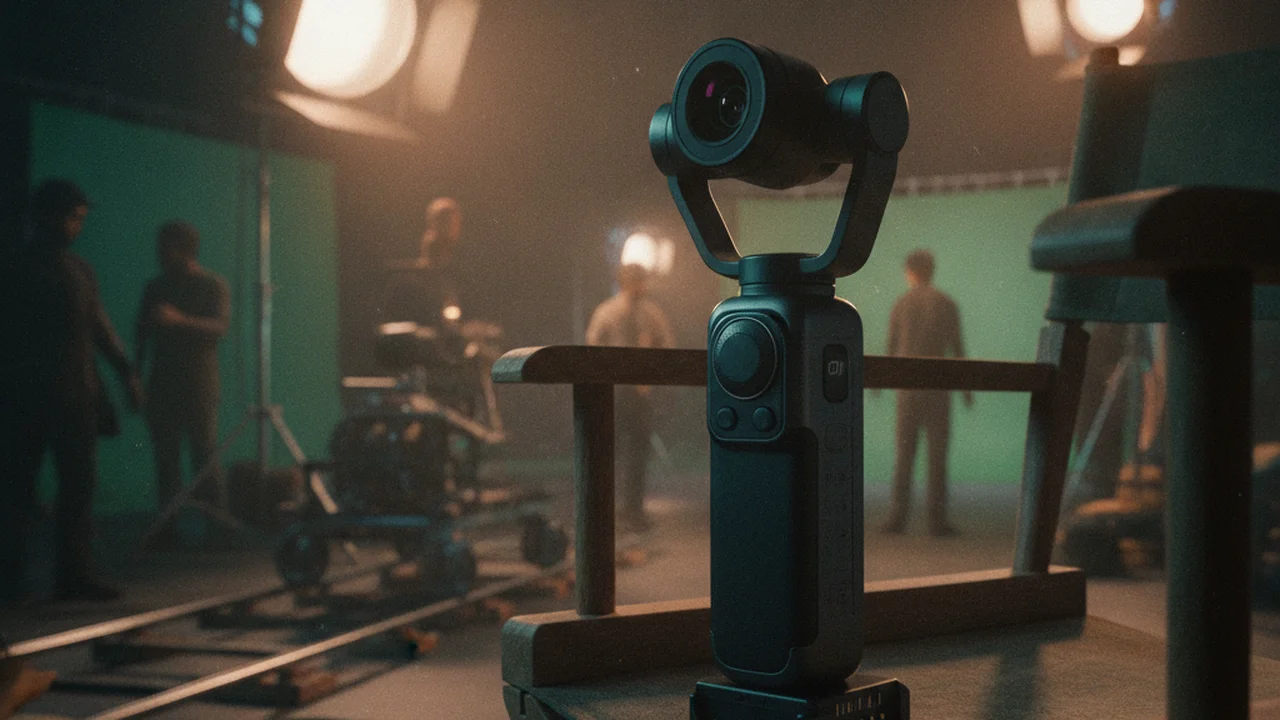
Handheld camera with a 1-inch sensor and a mechanical three-axis gimbal in the camera head, up to 4K/120p in 10-bit D-Log M — the smallest camera whose footage grades like cinema footage.
The Osmo Pocket 3 is a camera the size of a pocketknife, topped with a mechanical three-axis gimbal. It has been marketed as a vlogging device and is increasingly used for what it technically is: a small camera with a decent sensor and a professional Log profile.
The Specs
1-inch CMOS with 9.4 effective megapixels, a fixed lens with a 20mm full-frame equivalent focal length at f/2.0. Up to 4K at 120 frames per second. Recording in 10-bit D-Log M and 10-bit HLG. The camera head sits on a mechanical gimbal, not electronic stabilization — the difference is significant because it results in no cropping or distortion. It also features a rotatable 2-inch OLED touchscreen. Introduced on October 25, 2023.
Why the 1-inch Sensor is the Breakthrough
The predecessor had a significantly smaller sensor, and that's where everything else failed: insufficient dynamic range for a Log profile, too much noise for color grading. With 1 inch and 10-bit, that changes. D-Log M provides enough latitude to integrate the footage into the same grading workflow as that of a cinema camera — not with the same result, but without the break that immediately identifies footage as foreign.
The Gimbal is the Real Selling Point
What the Pocket 3 brings to productions is not image quality, but its form factor. A mechanically stabilized camera head in a housing of this size can get into places where neither a gimbal with a cinema camera nor a Russian Arm can: the footwell of a vehicle, a wheel arch, through a door crack. The comparison with a large rig is therefore incorrect. The correct comparison is: this shot or no shot at all.
What it Cannot Do
A fixed focal length of 20mm full-frame equivalent, no interchangeable lenses, no filter thread without an adapter, no professional audio without accessories. The 1-inch sensor produces visibly more noise in low light than a Super 35 sensor, and the depth of field at f/2.0 on this format is so large that subject isolation is practically non-existent. Anyone planning this device as a replacement for a cinema camera is planning incorrectly.
Classification
Compared to GoPro and Insta360, the Pocket 3 gains in sensor size, dynamic range, and color — and loses in robustness and field of view. Within a production, it is the device for the two to five shots that wouldn't be possible with the main body. That it becomes eighty percent of a film in individual cases says more about budgets than about the camera.
Related terms
Quiz
1. Was beschreibt „DJI Osmo Pocket 3" am besten?
2. Zu welchem Department gehört „DJI Osmo Pocket 3"?