Overview
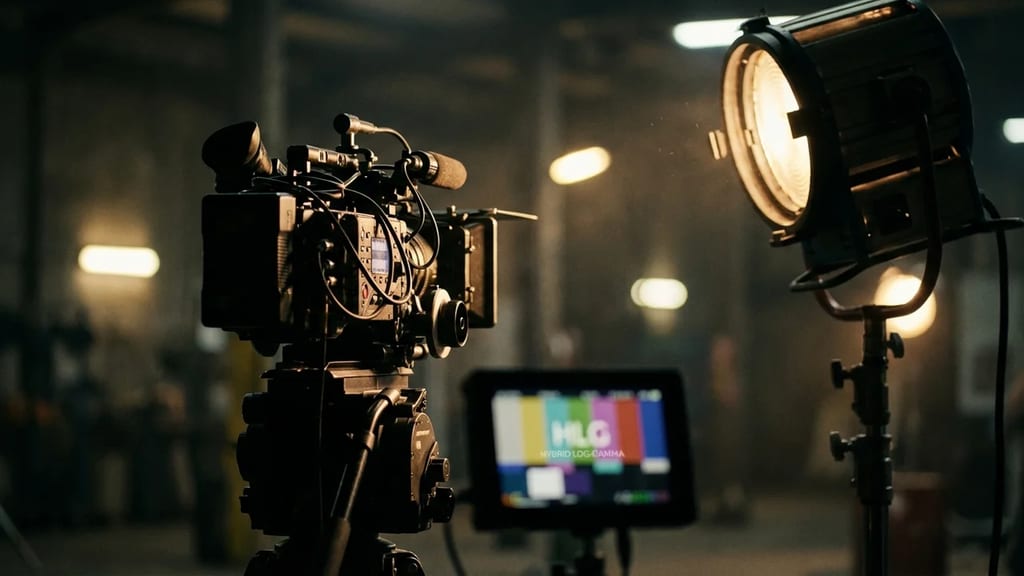
HLG stands for Hybrid Log-Gamma and refers to a transfer function for High Dynamic Range (HDR). It was jointly developed by the British BBC and Japanese broadcaster NHK; the joint announcement was made on May 15, 2015. HLG is not a device or a lamp, but a camera or signal standard that defines how brightness values are encoded between capture (camera) and playback (display).
The name describes the operating principle: the curve is "hybrid" because it follows a classic gamma curve (root function) for the lower signal values and transitions to a logarithmic curve for the upper values. This allows extended brightness ranges to be mapped without losing compatibility with conventional Standard Dynamic Range (SDR) devices.
Technical Classification
HLG is anchored in several standards:
- ARIB STD-B67 (Japanese broadcast standard, original standard)
- ITU-R Rec. BT.2100 (one of the two HDR transfer functions defined therein, alongside PQ)
- ATSC 3.0 and DVB UHD-1 Phase 2 (broadcast transmission)
The crucial difference to PQ-based methods like HDR10 and Dolby Vision: HLG works without dynamic or static metadata. The brightness information is entirely contained within the signal itself; the playback display interprets the curve to match its own peak brightness. This makes HLG backward compatible with the SDR transfer curve: an HLG signal can be displayed on both SDR and HDR screens without requiring two separate versions to be sent.
| Feature | HLG | PQ (HDR10/Dolby Vision) |
|---|
| Developer | BBC / NHK | Dolby (PQ curve) |
| Metadata | not required | static (HDR10) or dynamic (HDR10+/Dolby Vision) |
| SDR Backward Compatibility | yes | no (separate versions needed) |
| Typical Use | Live broadcast, fast workflows | Cinema, streaming, mastering |
Use on Set and in Post-Production
On set, HLG is primarily encountered as a selectable HDR profile in cameras and on monitors. Many professional and prosumer cameras offer HLG as a recording mode, delivering a look that is largely "instant HDR"-ready and appears broadcast-ready even without extensive grading. This makes HLG particularly attractive for live productions, TV broadcast, and fast delivery chains where there is no time for full HDR mastering.
It should be noted: In combination with the wide Rec. 2020 color space, an HLG signal may appear desaturated on pure Rec. 709 SDR devices. For the lighting and camera department, HLG primarily means that exposure and monitoring must be adjusted to the extended dynamic range of the curve to ensure highlights and shadows are captured correctly.