Filmlexikon.
Support
Bounce
Lighting · Equipment

Bounce

Murnau AI illustration
hard light soft light diffused light bounce light negative fill ambient light available light color temperature

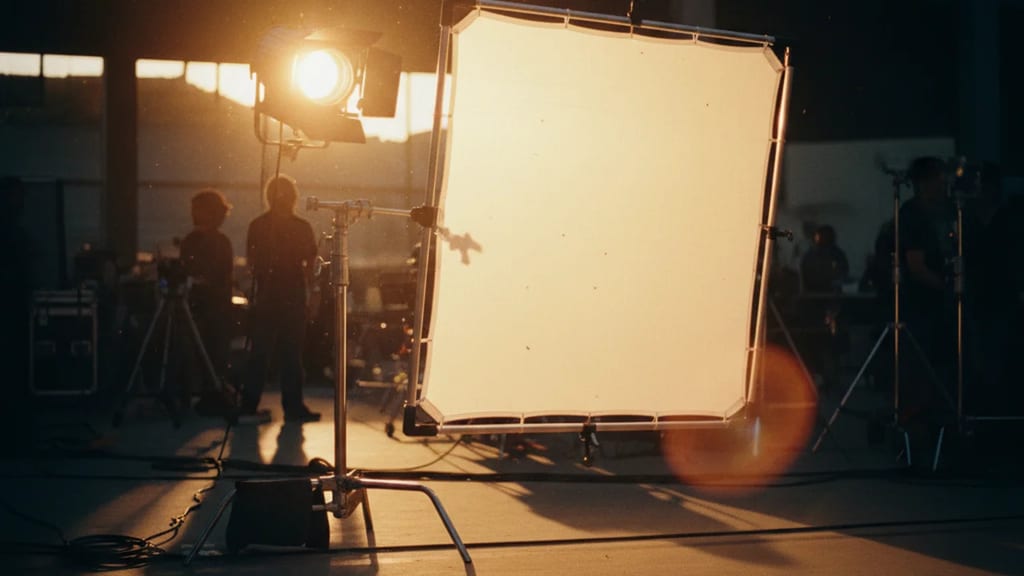
Indirect lighting technique using white reflective surfaces (foam board, reflector panels) to bounce light and create soft, diffused illumination without harsh shadows.

Technical Details

Film reflectors consist of a foldable frame with a stretched reflective surface. Silver surfaces achieve a reflection efficiency of 85-90% with hard, directed light with color temperature neutrality. White surfaces reflect 70-80% of the light diffusely with a slight warm shift of 200-300 Kelvin. Golden variants reduce the color temperature by 800-1200 Kelvin for sunset effects. 5-in-1 reflectors combine a translucent diffuser (60% transmission) with four reflective surfaces in a removable cover. Professional butterfly reflectors (6x6 to 20x20 feet) use Grifflith White or Bleached Muslin for large-scale light shaping.

History & Development

Reflectors emerged with studio lighting in the 1920s, when Paramount and MGM used polished metal plates for light control. In 1960, Mole-Richardson developed the first foldable film reflector with a silver coating. In 1986, Photoflex revolutionized the market with the first 5-in-1 system and spring steel frame. Modern LED panels have reduced reflector usage indoors since 2010, but have increased their importance for outdoor shoots with daylight balance.

Practical Use in Film

In "1917," Roger Deakins used large white reflectors for even facial illumination during continuous camera movements. Emmanuel Lubezki exclusively used daylight with silver reflectors in "The Revenant" to brighten Leonardo DiCaprio's face in backlight situations. Typical workflow: position the key light, open shadows with a reflector, vary the distance for hardness control. Reflectors eliminate additional power supply and heat generation. Disadvantages: susceptibility to wind, personnel effort for positioning, limited control in changing light conditions.

Comparison & Alternatives

Bounceboards are permanently mounted reflectors from 4x4 feet upwards for studio work, while mobile reflectors are designed for location shoots. LED panels offer constant light output but require power supply and produce an artificial spectrum. HMI daylight spotlights surpass reflectors in light output but cost 200-500 Euros per day rental compared to 15-30 Euros for reflectors. In direct sunlight and static scenes, the reflector remains unbeatable in cost-effectiveness.
From the crafts

Perspectives

Cinematographer

Ich positioniere Reflektoren millimetergenau – ein 120cm Silberreflektor in 2m Abstand gibt mir genau eine Blende Aufhellung, bei 1m bereits anderthalb Blenden. Die Augenlichter entstehen perfekt natürlich, während LED-Panels oft mehrere Spitzlichter in der Iris erzeugen. Bei Außendrehs tausche ich zwischen Gold- und Silberseite je nach Sonnenstand, um die Farbtemperatur konstant zu halten.

Director

Ich nutze Reflektoren gezielt für emotionale Lichtführung – warmes Gold für romantische Szenen, hartes Silber für Thriller-Sequenzen. Das weiche, natürliche Licht von Reflektoren lässt Schauspieler entspannter agieren als bei gleißenden LED-Panels. In Dialogszenen variiere ich die Reflektor-Intensität durch Abstand, um Machtverhältnisse zwischen Charakteren visuell zu verstärken.

Producer

Ein 5-in-1-Reflektor-Set kostet 150 Euro und ersetzt fünf verschiedene Lichtgeräte ohne Stromkosten oder Transportaufwand. Bei Außendrehs spare ich täglich 300-500 Euro Generator-Miete und reduziere die Crew um einen Elektriker. Die Zeitersparnis beim Setup ist erheblich – 30 Sekunden Reflektor-Aufbau gegen 15 Minuten für vergleichbare HMI-Ausleuchtung.

More in the lexikon

Related terms

Test your knowledge

Quiz

1. Was beschreibt „Reflektor" am besten?

2. Zu welchem Department gehört „Reflektor"?

3. Wie viele verschiedene Fachperspektiven bietet dieser Eintrag?

Report an error
From the Filmfarm ecosystem

Understand visual language, budget productions, connect crew.

The Lexikon is part of the Filmfarm ecosystem — alongside budgeting (FilmBalance), an industry magazine (FilmCircus) and crew networking (FilmCall, CrewMesh). One shared vocabulary for the whole production.

FilmFarm FilmRadarComing soonFilmPulseComing soonFilmNumbersComing soonFilmCapitalComing soonFilmLabComing soonFilmBalanceComing soonFilmCircusComing soon