Filmlexikon.
Support
Color Temperature
Lighting · Technique

Color Temperature

Murnau AI illustration
flow roll take

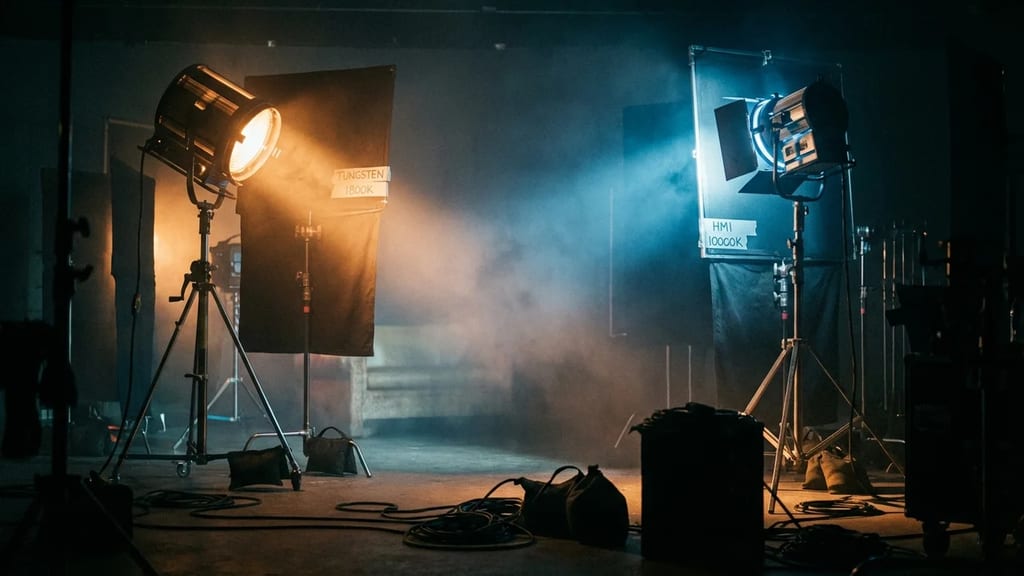
Color temperature is the color of light measured in Kelvin, ranging from warm orange (1800K) to cool blue (10000K).

Technical Details

Tungsten incandescent lamps reach 3200K, while daylight ranges between 5500K-6500K. HMI lights produce daylight-equivalent 5600K, LED panels are continuously adjustable from 2700K to 10000K. The Correlated Color Temperature (CCT) index defines the measurement precisely. Color temperature meters like the Sekonic C-700 measure with ±10K accuracy. Modern LED systems achieve CRI values over 95 with variable Kelvin settings.

History & Development

Lord Kelvin developed the absolute temperature scale in 1848. Since the 1930s, Hollywood has used standardized 3200K tungsten lighting for interior shots. In 1970, HMI lamps introduced daylight-balanced 5600K lighting. From 2010 onwards, tunable LED panels with bi-color technology (3200K/5600K) revolutionized film production. Today, RGB+W LEDs enable spectral control from 1600K to 20000K.

Practical Application in Film

Emmanuel Lubezki used natural 6500K daylight in "The Revenant" (2015) for harsh realism, contrasted with warm 2700K candlelight. Roger Deakins combined cool 8000K neon lighting with warm 3000K accents in "Blade Runner 2049" (2017). Digital Intermediate (DI) allows for post-production color temperature corrections, however, practical light sources remain more authentic. White balance on the camera compensates for color casts, while Creative White Balance creates desired color shifts.

Comparison & Alternatives

Color temperature differs from Tint (magenta-green axis) and color saturation. Color gels (CTO/CTB) convert between 3200K and 5600K, but reduce light output by 30-60%. Modern bi-color LEDs are increasingly replacing gel filters. Spectral measurement using a spectroradiometer surpasses simple Kelvin values for complex light sources. TLCI (Television Lighting Consistency Index) evaluates LED quality more accurately for specific cameras than traditional CRI values.
From the crafts

Perspectives

Cinematographer

Ich arbeite täglich mit Kelvin-Werten von 2700K bis 8000K und stelle meine Kameras entsprechend ein. Bei Mischbeleuchtung verwende ich CTB/CTO-Filter oder gleiche in der Postproduktion aus, wobei praktische Angleichung immer natürlicher wirkt. LED-Panels mit präziser Kelvin-Kontrolle haben meine Arbeitsweise revolutioniert, da ich ohne Filterverluste verschiedene Farbtemperaturen mischen kann.

Director

Farbtemperatur ist mein direktes Werkzeug für emotionales Storytelling – warme 2700K-Töne für Intimität und Geborgenheit, kalte 7000K für Isolation und Bedrohung. Ich plane Farbtemperatur-Verläufe bereits im Storyboard, um die emotionale Reise der Charaktere zu unterstützen. Der Kontrast zwischen verschiedenen Kelvin-Werten in einer Szene verstärkt dramatische Spannungen ohne Worte.

Producer

LED-Technologie mit variabler Farbtemperatur reduziert meine Grip-Kosten erheblich, da weniger Gel-Filter und Konversionslampen nötig sind. Schnelle Kelvin-Umstellungen sparen täglich 2-3 Setup-Stunden, besonders bei Tageszeit-Simulationen. Ich kalkuliere 15-20% höhere Anfangsinvestition für Bi-Color-LEDs, die sich durch Zeitersparnis und Stromkosten binnen sechs Monaten amortisiert.

More in the lexikon

Related terms

Test your knowledge

Quiz

1. Zu welchem Department gehört „Farbtemperatur"?

2. Wie viele verschiedene Fachperspektiven bietet dieser Eintrag?

Report an error
From the Filmfarm ecosystem

Understand visual language, budget productions, connect crew.

The Lexikon is part of the Filmfarm ecosystem — alongside budgeting (FilmBalance), an industry magazine (FilmCircus) and crew networking (FilmCall, CrewMesh). One shared vocabulary for the whole production.

FilmFarm FilmRadarComing soonFilmPulseComing soonFilmNumbersComing soonFilmCapitalComing soonFilmLabComing soonFilmBalanceComing soonFilmCircusComing soon