Filmlexikon.
Support
Bounce Light
Lighting · Equipment

Bounce Light

Murnau AI illustration
hard light soft light diffused light bounce negative fill ambient light available light color temperature

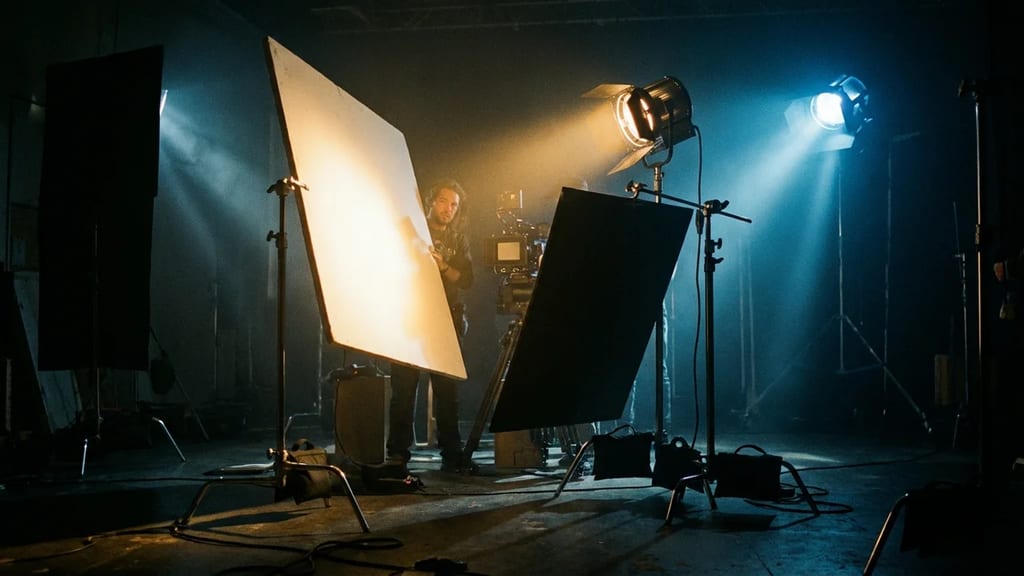
Indirect lighting technique where light bounces off white reflective surfaces (foam board, plywood) to create soft, diffused illumination. Eliminates harsh shadows for beauty shots and close-ups.

Technical Details

Standard reflectors have diameters from 60cm to 120cm, large studio reflectors reach 2x3 meters. White surfaces reflect 85-95% of light neutrally, silver achieves 95-98% with a slight increase in contrast, gold 90-95% with a color temperature shift of 200-300 Kelvin towards warm tones. Styrofoam boards (4x8 feet) cost 8-15 Euros and reflect 80-85% of light. Professional Lastolite reflectors with various surfaces (white/silver, gold/white) are foldable and weigh 0.8-2.5kg depending on size.

History & Development

The technique established itself in the 1930s in Hollywood studios, where large white canvases were used as "bounce boards." In 1952, Mole-Richardson developed the first collapsible reflector for exterior shoots. In the 1970s, Lastolite introduced foldable round reflectors, which revolutionized transport. Modern LED panels with built-in diffusers have been electronically simulating bounce effects since 2010.

Practical Use in Film

Roger Deakins used 12x12 foot bleached muslin as bounce surfaces for natural-looking facial illumination in the trenches for "1917" (2019). Emmanuel Lubezki relied exclusively on natural light in "The Revenant" (2015), enhanced by white reflectors for detail rendering in shadows. The workflow requires 20-30% more lighting time, as reflectors must be precisely positioned and readjusted during camera movements. Advantage: natural light direction without visible hard shadows. Disadvantage: weather-dependent for exterior shoots and requires space.

Comparison & Alternatives

In contrast to direct light (hard light), bounce light creates soft transitions with twice the illumination area. Diffusion through silk or Lee filters reduces intensity more strongly (2-3 stops) than reflection. Modern softboxes combine both principles: internal reflection plus frontal diffusion. When space is limited, LED panels with a 120° beam angle replace bounce setups but do not achieve the same naturalness of light distribution.
From the crafts

Perspectives

Cinematographer

Ich positioniere den Bouncer immer 45° zur Kamera-Motiv-Achse, um Modelling zu erhalten – rein frontales Bounce Light macht Gesichter flach. Mit einem Spot-Meter messe ich die Differenz zwischen Key und Bounce: 2:1 Ratio ergibt natürliche Plastizität, 1:1 wird zu flach für Drama.

Director

Ich nutze warmes Bounce Light für emotionale Nähe in Dialogszenen – die weiche Ausleuchtung lässt Schauspieler verletzlicher wirken. Bei Thriller-Sequenzen verzichte ich bewusst darauf, damit harte Schatten die Spannung unterstützen. Bounce Light suggeriert immer "Tageslicht" oder "häusliche Wärme".

Producer

Bounce Light bedeutet 30% längere Einrichtungszeit pro Setup, weil Reflektoren exakt ausgerichtet werden müssen. Dafür spare ich Geld: Ein 4x8 Fuß Styropor kostet 12 Euro statt 800 Euro für eine Softbox gleicher Größe. Bei Außendrehs plane ich Wind-Dopplers ein – umfallende Reflektoren kosten Drehtage.

More in the lexikon

Related terms

Test your knowledge

Quiz

1. Was beschreibt „Reflektiertes Licht" am besten?

2. Zu welchem Department gehört „Reflektiertes Licht"?

3. Wie viele verschiedene Fachperspektiven bietet dieser Eintrag?

Report an error
From the Filmfarm ecosystem

Understand visual language, budget productions, connect crew.

The Lexikon is part of the Filmfarm ecosystem — alongside budgeting (FilmBalance), an industry magazine (FilmCircus) and crew networking (FilmCall, CrewMesh). One shared vocabulary for the whole production.

FilmFarm FilmRadarComing soonFilmPulseComing soonFilmNumbersComing soonFilmCapitalComing soonFilmLabComing soonFilmBalanceComing soonFilmCircusComing soon