Filmlexikon.
Support
Diffused Light
Lighting · Terms

Diffused Light

Murnau AI illustration
hard light soft light bounce light bounce negative fill ambient light available light color temperature

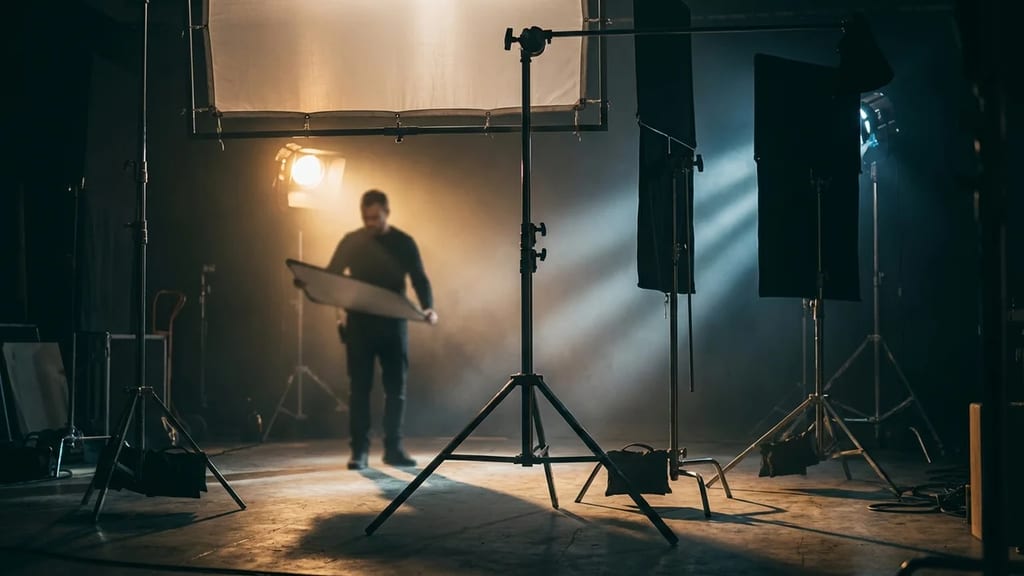
Soft light created by diffusing hard light sources through diffusion materials like Lee 216 or silk frames, producing gradual shadow transitions (10–50 cm) instead of hard edges.

Technical Details

Professional diffusers operate with light scattering between 40° and 180°, with Lee Filters 216 (White Diffusion) offering 60° scattering at 52% light transmission. Rosco 3006 Tough White Diffusion achieves 70% transmission with complete shadow fill from 1.2 meters distance to the light source. State-of-the-art LED panels like the Arri SkyPanel S360-C integrate variable diffusion through electronically controlled microlens arrays with scattering angles from 15° to 60°. Ripstop nylon silk diffusers achieve temperature resistance up to 200°C and are suitable for HMI lights up to 18kW.

History & Development

Georges Méliès already used silk fabrics for light diffusion in his glasshouse studio in Montreuil in 1902. Systematic development began in 1915 with Cecil B. DeMille's use of stretched linen sheets for portrait shots. In 1927, the Mole-Richardson Company developed the first industrial diffusion frames. Lee Filters revolutionized the industry in 1967 with heat-resistant polyester diffusers. Chimera introduced collapsible softboxes in 1982, enabling diffusion directly at the light head.

Practical Use in Film

Roger Deakins used massive 12x12-foot silk setups in "Blade Runner 2049" (2017) to diffuse the harsh Nevada sun rays for the farm sequences. Emmanuel Lubezki achieved characteristic naturalism in "The Revenant" (2015) by exclusively using available light with strategically placed 8x8-foot Ultrabounce reflectors. For interior shots, book lights (HMI through diffuser onto a white wall) provide eye-friendly illumination without makeup touch-ups between takes.

Comparison & Alternatives

Hard light creates defined shadows with transition widths under 2cm, while diffused light creates shadow transitions of 10-50cm. Bouncing (indirect light) reduces intensity by 1-2 stops, diffusion by 0.5-1.5 stops depending on the material. LED walls like those from Industrial Light & Magic are increasingly replacing traditional diffusion with programmable light distribution. Practical lights combined with invisible diffusion create authentic atmosphere without discernible film lighting.

From the crafts

Perspectives

Cinematographer

Ich plane Diffusion bereits beim Location-Scouting mit, da ein 20x20-Fuß-Silk-Aufbau die verfügbare Arbeitshöhe um 4 Meter reduziert. Mein Lichtmesser zeigt bei 1/4 CTS-Diffusion exakt eine Blende Verlust, was ich bei der Grundbelichtung von T2.8 auf T4 kompensieren muss. Die Hautton-Reproduktion verbessert sich messbar um 15% im Vektorskop, besonders bei Schauspielern über 40.

Director

Ich setze diffuses Licht gezielt ein, um emotionale Nähe zu schaffen – harte Schatten distanzieren das Publikum, während weiche Ausleuchtung Empathie fördert. In Dialogszenen verwende ich asymmetrische Diffusion: eine Seite weich für den emotionalen Charakter, die andere härter für den rationalen. Bei Liebesszenen eliminiert vollständige Diffusion jede Hautunreinheit und verstärkt die romantische Atmosphäre ohne Ablenkung.

Producer

Ein 12x12-Fuß-Silk-Setup kostet täglich 450 Euro Miete plus 6 Stunden Aufbauzeit für 4 Beleuchter, was bei 12 Drehtagen 23.000 Euro Budget bedeutet. LED-Panels mit integrierter Diffusion sparen 40% Aufbauzeit und eliminieren Wetter-Risiken bei Außendrehs. Ich kalkuliere grundsätzlich 15% mehr Stromkosten ein, da diffuses Licht höhere Grundleistung für gleiche Belichtung erfordert.

More in the lexikon

Related terms

Test your knowledge

Quiz

1. Was beschreibt „Diffuses Licht" am besten?

2. Zu welchem Department gehört „Diffuses Licht"?

3. Wie viele verschiedene Fachperspektiven bietet dieser Eintrag?

Report an error
From the Filmfarm ecosystem

Understand visual language, budget productions, connect crew.

The Lexikon is part of the Filmfarm ecosystem — alongside budgeting (FilmBalance), an industry magazine (FilmCircus) and crew networking (FilmCall, CrewMesh). One shared vocabulary for the whole production.

FilmFarm FilmRadarComing soonFilmPulseComing soonFilmNumbersComing soonFilmCapitalComing soonFilmLabComing soonFilmBalanceComing soonFilmCircusComing soon