Filmlexikon.
Support
Bounce Board
Lighting · Equipment

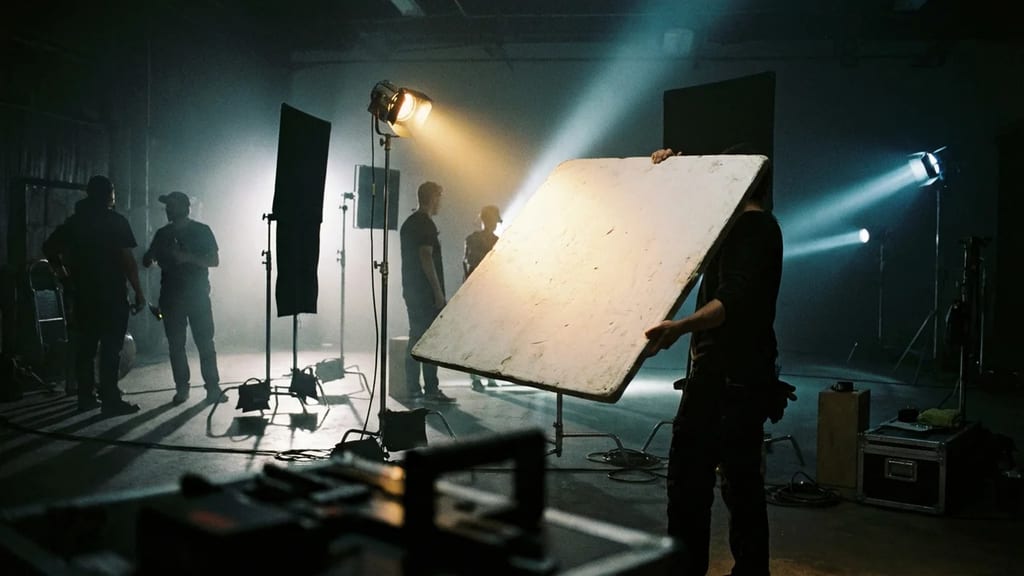
Bounce Board

Murnau AI illustration
bounce color temperature flow roll take

Collapsible aluminum frame with interchangeable fabric surfaces for light reflection. White side reflects 85–90% diffusely, silver 95% with contrast, gold produces warm light.

Technical Details

Professional bounce boards consist of a foldable aluminum frame with interchangeable fabric covers. The white side diffusely reflects 85-90% of incident light, the silver side reflects 95% with higher contrast, while the gold variant produces warm light at 80% reflectivity. Black bounce boards (negative fill) absorb 98% of light and enhance shadows. Modern variants like the Lastolite TriGrip (45 cm) or the Californian Sunbounce Pro (130×190 cm) use specially coated fabrics with defined reflection values.

History & Development

Bounce boards originated in the 1930s in Hollywood as simple white-painted plywood panels. Cecil B. DeMille already used large white canvases for fill light in "The Ten Commandments" in 1923. In 1979, the British manufacturer Lastolite developed the first foldable round reflector with a spring-steel-like rim. Matthews Studio Equipment introduced the Butterfly/Overhead system in 1985, where 12×12 foot bounce boards are stretched over stands.

Practical Use in Film

Roger Deakins used massive 20×12 foot bounce boards for the desert scenes in "Blade Runner 2049" (2017) to control the harsh sunlight. For portraits, 45° bounce boards are typically positioned opposite the main light source in a 3:1 ratio for shadow fill. Emmanuel Lubezki used exclusively natural light with large white bounce boards in "The Revenant" (2015) to enhance the available light aesthetic. The disadvantage: wind turns large bounce boards into sails, while small ones only offer localized fill.

Comparison & Alternatives

Unlike softboxes, bounce boards do not produce their own light but modify existing light. LED panels like the Litepanels Astra are increasingly replacing bounce boards in controlled lighting situations as they operate independently of the main light source. Kino Flo tubes offer more even illumination than bounce boards but require a power supply. For exterior shots, bounce boards remain unrivaled – a 6×6 foot bounce board costs 800 Euros, the equivalent HMI setup 15,000 Euros.

From the crafts

Perspectives

Cinematographer

Ich bevorzuge silberne Aufheller bei bewölktem Himmel, da sie mehr Kontrast liefern als weiße, aber trotzdem weicher sind als direktes Kunstlicht. Bei Nahaufnahmen verwende ich ausschließlich die weiße Seite - silber erzeugt zu harte Catchlights in den Augen. Die größte Herausforderung ist die Positionierung: Der Aufheller muss groß genug sein, um die gesamte Bildfläche gleichmäßig aufzuhellen, ohne ins Bild zu ragen.

Director

Aufheller ermöglichen mir, die Stimmung subtil zu steuern - weniger Aufhellung verstärkt Drama und Mysterium, mehr Aufhellung schafft Offenheit und Optimismus. Bei Dialogszenen kann ich durch gezieltes Aufhellen einzelner Gesichter die Aufmerksamkeit des Zuschauers lenken, ohne die natürliche Lichtsituation zu zerstören. Gold-Aufheller verwende ich für Erinnerungssequenzen oder romantische Momente.

Producer

Ein komplettes Aufheller-Set kostet 2.000 Euro und hält zehn Jahre, während vergleichbare Kunstlichtlösungen 50.000 Euro kosten und regelmäßige Wartung brauchen. Der Zeitgewinn ist erheblich: Aufheller-Setup dauert 5 Minuten, ein komplettes Licht-Setup 45 Minuten. Bei Außendrehs spare ich täglich 3-4 Stunden Setup-Zeit, was bei 20 Drehtagen dem Gehalt eines zusätzlichen Beleuchters entspricht.

More in the lexikon

Related terms

Test your knowledge

Quiz

1. Was beschreibt „Aufheller" am besten?

2. Zu welchem Department gehört „Aufheller"?

3. Wie viele verschiedene Fachperspektiven bietet dieser Eintrag?

Report an error
From the Filmfarm ecosystem

Understand visual language, budget productions, connect crew.

The Lexikon is part of the Filmfarm ecosystem — alongside budgeting (FilmBalance), an industry magazine (FilmCircus) and crew networking (FilmCall, CrewMesh). One shared vocabulary for the whole production.

FilmFarm FilmRadarComing soonFilmPulseComing soonFilmNumbersComing soonFilmCapitalComing soonFilmLabComing soonFilmBalanceComing soonFilmCircusComing soon