Filmlexikon.
Support
ZEISS Supreme Prime Radiance
Camera · Equipment

ZEISS Supreme Prime Radiance

ZEISS
ei zeiss supreme prime zeiss zeiss master prime zeiss ultra prime p3 anamorphic lens anamorphic projection lens

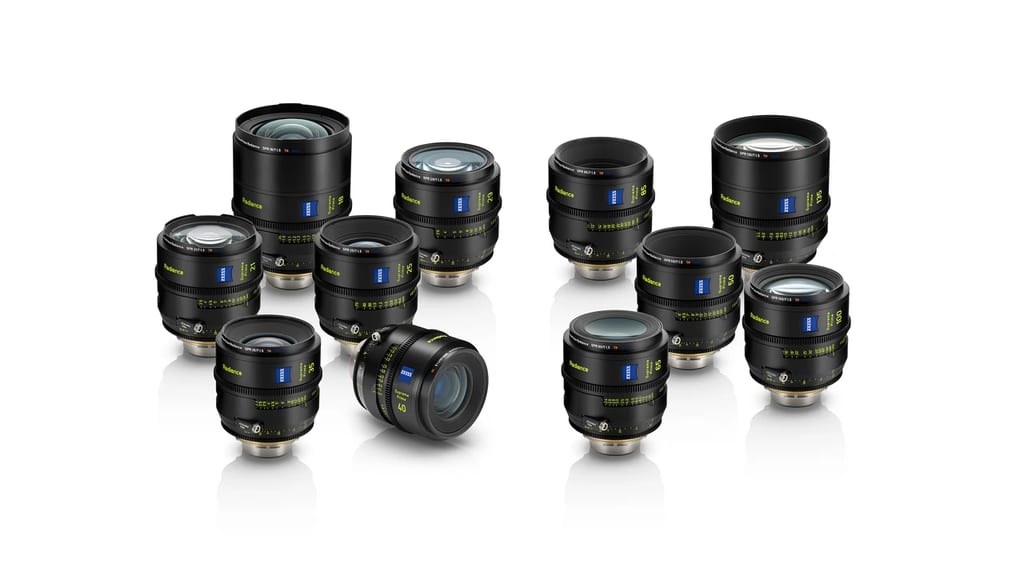
ZEISS Prime lens series with integrated LED ring producing warm organic lens flares. T1.5–T2.2, 11 focal lengths 21–200mm, remotely controlled flare intensity 0–100%.

Technical Details

Focal Lengths

2125293540506585100135200
T1.5T1.5T1.5T1.5T1.5T1.5T1.5T1.5T1.5T1.5T2.2
0.28m0.30m0.35m0.35m0.40m0.45m0.55m0.70m0.85m1.00m1.00m
1.5kg1.5kg1.6kg1.6kg1.7kg1.7kg1.8kg2.0kg2.3kg2.7kg3.2kg
9595959595959595959595
74°64°57°48°43°35°27°21°17°13°
◀━━━▶◀━━━▶◀━━▶◀━━▶◀━━▶◀━▶◀━▶◀▶◀▶◀▶◀▶

PL · 95mm Front · 300° Focus · T1.5-T2.2 · Full Frame · Radiance LED

History & Development

ZEISS first introduced the Supreme Prime Radiance lenses at NAB in 2019, responding to the growing trend for organic lens flares in cinematography. The development was based on the existing Supreme Prime series from 2017, enhanced with proprietary Radiance technology. Market launch followed in 2020, and in 2022 ZEISS expanded the series with the 40mm and 200mm focal lengths.

Practical Use in Film

The series was used in productions such as "The Mandalorian" (Season 3) and "House of the Dragon," where the warm flares were specifically utilized for candlelight and torchlight scenes. The Radiance effect activates automatically with point light sources in the frame, eliminating the need for post-production work. Typical workflow: LED ring is remotely controlled via Camera Assistant Controller (CAC-1), with intensity continuously adjustable from 0-100%. Disadvantage: Requires additional cabling and power supply.

Comparison & Alternatives

Compared to standard Supreme Primes, the Radiance version produces 20% more internal reflections in backlight situations. Competitor products like Cooke S7/i or ARRI Signature Primes achieve similar flare characteristics through optical design rather than active illumination. For TV productions, Cooke Anamorphic/i is often preferred for its wider horizontal flare. Radiance is primarily suited for feature films with an organic lighting mood, less so for documentary or technical applications.

From the crafts

Perspectives

Cinematographer

Ich setze die Radiance gezielt bei Available Light-Situationen ein, wo ich den warmen Glow verstärken will, ohne die Szene künstlich aufzuhellen. Der LED-Ring gibt mir präzise Kontrolle über die Flare-Intensität direkt am Set – das spart mir Stunden in der Post und wirkt authentischer als digitale Effekte.

Director

Die Radiance-Objektive helfen mir, emotionale Höhepunkte visuell zu unterstreichen, ohne übertrieben zu wirken. Besonders in Liebesszenen oder epischen Momenten schaffe ich durch den organischen Glow eine träumerische Atmosphäre, die das Publikum unterbewusst in die gewünschte Stimmung versetzt.

Producer

Die Tagesmiete liegt 30% über Standard-Supreme-Primes, aber ich spare Postproduktionszeit für VFX-Flares ein. Das zusätzliche Kabelmanagement verlängert Setup-Zeiten um etwa 15 Minuten pro Location – bei straffen Drehplänen muss ich das einkalkulieren, besonders bei Multi-Kamera-Setups.

More in the lexikon

Related terms

Test your knowledge

Quiz

1. Was beschreibt „ZEISS Supreme Prime Radiance" am besten?

2. Zu welchem Department gehört „ZEISS Supreme Prime Radiance"?

3. Wie viele verschiedene Fachperspektiven bietet dieser Eintrag?

Report an error
From the Filmfarm ecosystem

Understand visual language, budget productions, connect crew.

The Lexikon is part of the Filmfarm ecosystem — alongside budgeting (FilmBalance), an industry magazine (FilmCircus) and crew networking (FilmCall, CrewMesh). One shared vocabulary for the whole production.

FilmFarm FilmRadarComing soonFilmPulseComing soonFilmNumbersComing soonFilmCapitalComing soonFilmLabComing soonFilmBalanceComing soonFilmCircusComing soon