Overview
"P3" refers to the DCI-P3 color space in camera and post-production environments – an RGB color space defined in 2005 by Digital Cinema Initiatives, LLC (DCI) for theatrical digital cinema projection. The associated technical standards were published by SMPTE (including SMPTE RP 431-2 and SMPTE EG 432-1). P3 covers a significantly larger area of the visible color spectrum than the classic broadcast and web standard Rec. 709/sRGB, especially in the red and green tones.
P3 is therefore not device or grip equipment, but a colorimetric specification: it defines which primary colors, which white point, and which gamma curve a digital cinema image uses. In practice, P3 is the usual target color space for mastering feature films and creating a Digital Cinema Package (DCP).
Technical Data
Primary Colors (CIE 1931 xy coordinates):
- Red: x = 0.680 / y = 0.320
- Green: x = 0.265 / y = 0.690
- Blue: x = 0.150 / y = 0.060
White Point and Gamma Curve:
| Variant | White Point | Gamma | Typical Use |
|---|
| DCI-P3 (Theatrical) | approx. 6300 K (DCI White Point, slightly greenish) | 2.6 | Digital Cinema Projection, DCP Mastering |
| Display P3 / P3-D65 | D65 (6500 K) | sRGB-like curve (≈ 2.2) | Displays and Mobile Devices (Apple Standard) |
All P3 variants share the same primary colors; they differ in white point and gamma curve. To put the size into perspective: DCI-P3 covers approximately 86.9% of Pointer's Gamut, compared to 69.4% for Rec. 709/sRGB. The even wider color space Rec. 2020 extends noticeably beyond P3.
On Set and In Post
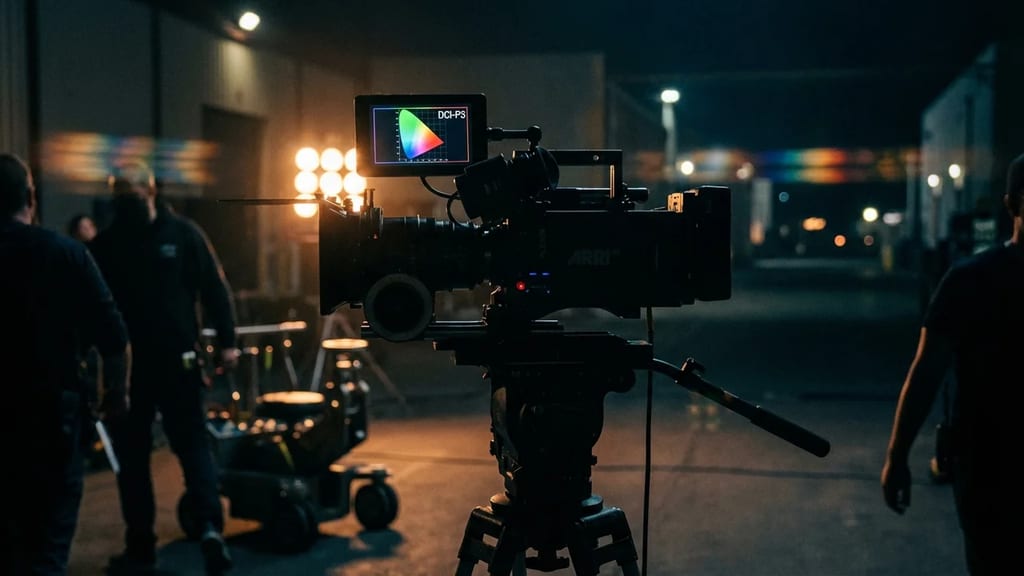
For the camera department, P3 is primarily relevant as a reference and target color space. Modern digital cameras typically record in a much wider sensor color space (Camera Native / Wide Gamut) and in Log; P3 comes into play when the material is graded and mastered for cinema projection. On set, P3 is also used for monitor control – for example, when the preview image is intended to approximate the later cinema representation.
The distinction between variants is important: the theatrical DCI white point (≈ 6300 K) is calibrated to the xenon projection lamp and appears slightly greenish on a desktop monitor. For evaluation on displays, the D65 variant (Display P3 / P3-D65) is therefore usually used. P3 is also widespread in the consumer sector today, which is why the term has established itself beyond pure Digital Cinema.