Technical Details
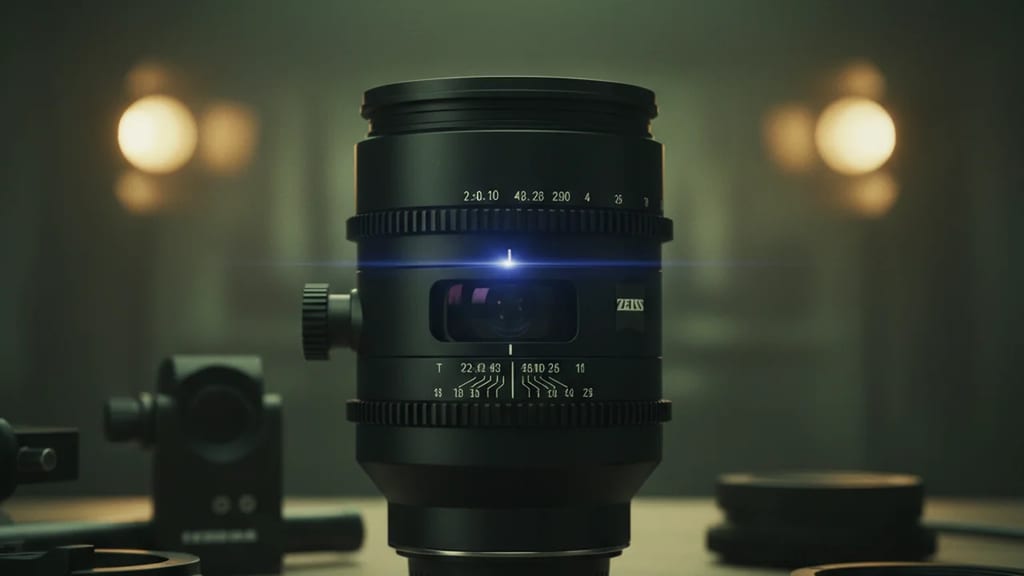
Zeiss lenses utilize a multi-layer T* (Transmission) coating that reduces reflections to below 0.5%, achieving light transmission of over 99.5%. The Master Prime series offers T-stops from T1.3 to T22 at focal lengths from 12mm to 150mm. The CP.3 series covers full-frame sensors and achieves a resolution of over 100 line pairs per millimeter at the image edge at T2.1. Characteristic features include smooth focus fall-off (bokeh) due to spherical aberrations and warm color rendition with a slight magenta shift.
History & Development
Carl Zeiss founded his optical workshop in Jena in 1846. In 1902, the company developed the first cinema lens, the "Kino-Tessar," with a 50mm focal length. In 1973, the first Super Speed lenses for 35mm film were released, followed by the Master Primes for digital cinema cameras in 2005. After the division of Germany, two Zeiss companies emerged: Carl Zeiss AG (West) and VEB Carl Zeiss Jena (East), which were reunited in 1991. Since 2010, Zeiss has closely cooperated with Sony in the development of full-frame lenses.
Practical Use in Film
Roger Deakins used Zeiss Master Primes for "Blade Runner 2049" (2017) to achieve the dystopian look with warm skin tone rendering. The Ultra Primes were used on "The Dark Knight" (2008); their low distortion was ideal for IMAX shots. Zeiss CP.2 lenses are suitable for documentary-style productions due to their low weight of 540g and uniform 95mm front diameter. The focus ring rotates over 300°, allowing for precise focus pulls.
Comparison & Alternatives
Compared to Cooke lenses, Zeiss lenses produce less of the "Cooke Look" with its characteristic flares, offering more neutral imaging with higher contrast. Canon CN-E lenses cost about 40% less but do not achieve the mechanical precision of Zeiss focus rings. ARRI Signature Primes offer similar sharpness but with softer contrast rendering. For high-end productions, Zeiss Supreme Primes compete directly with Cooke S7/i, with Zeiss scoring points for consistent color rendition across all focal lengths.