Filmlexikon.
Support
Varifocal Lens
Camera · Equipment

Varifocal Lens

Murnau AI illustration
anamorphic lens anamorphic projection lens angenieux optimo prime arri master prime arri signature prime arri ultra prime arri zeiss variable prime atlas lens co

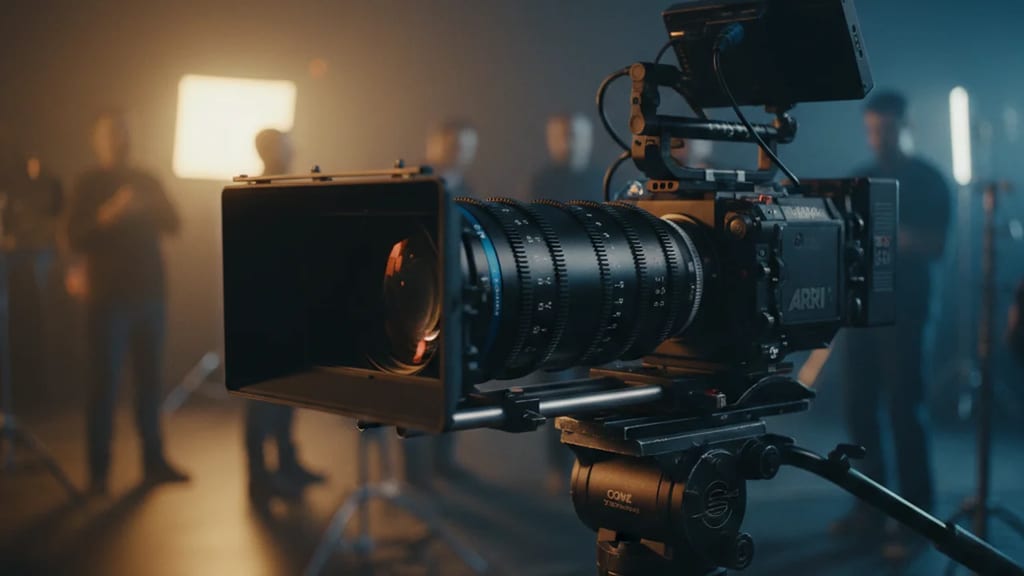
Zoom lens requiring manual refocusing after each focal length adjustment, as focus and zoom are mechanically independent.

Technical Details

Varifocal lenses use a three- or four-group lens system where the variator and compensator groups are moved independently. The mechanical construction requires separate focus and focal length rings that are not coupled. Modern servo motors allow zoom speeds from 0.5 to 120 seconds for the complete focal length range. Cinema variants typically offer 300° focus ring rotation and 90° zoom ring rotation for precise operation.

History & Development

The first varifocal lenses were developed by Zoomar Corporation in 1947 for US television, based on Frank Back's patents from 1932. Angenieux launched the legendary 12-120mm f/2.2 Type 12x12B in 1956, which remained the standard for 16mm documentaries for over two decades. Canon revolutionized the broadcast sector in 1976 with the J8x6 8mm-48mm, the first fully servo-controlled varifocal lens. Since the 1990s, varifocal systems have dominated the ENG (Electronic News Gathering) sector.

Practical Use in Film

Varifocal lenses are particularly suitable for documentaries and news, where rapid focal length changes are required without lens changes. Haskell Wexler extensively used the Angenieux 12-120mm for "Medium Cool" (1969) to capture spontaneous street scenes. In modern filmmaking, documentary directors like Errol Morris rely on varifocal lenses for interview situations, where discrete reframing is possible without interruption. The disadvantage lies in reduced optical quality compared to prime lenses and the necessity to refocus with every focal length change.

Comparison & Alternatives

True zoom lenses maintain constant sharpness across the entire focal length range but are more complex and expensive. Prime lens sets offer superior image quality but require frequent lens changes. Modern cine-varifocal lenses like the Angenieux Optimo 24-290mm combine varifocal mechanics with improved optical correction. In the high-end segment, true zoom systems are increasingly replacing varifocal designs, while the ENG and documentary sectors continue to rely on varifocal solutions.

From the crafts

Perspectives

Cinematographer

Ich nutze varifokale Objektive hauptsächlich für Dokumentar- und ENG-Arbeiten, wo die Flexibilität wichtiger ist als absolute Schärfe. Der ständige Fokus-Pull nach jeder Brennweitenänderung erfordert präzise Handarbeit und gute Kenntnis der Schärfentiefe-Markierungen. Bei narrativen Projekten bevorzuge ich echte Zooms oder Festbrennweiten, da die optische Qualität und Konsistenz entscheidend sind.

Director

Varifokale Objektive geben mir die Spontaneität, Bildausschnitte während einer laufenden Szene anzupassen, ohne die Performance zu unterbrechen. Besonders bei Dokumentarfilmen oder improvisierten Szenen kann ich organisch auf unvorhergesehene Momente reagieren. Allerdings plane ich kritische emotionale Momente lieber mit Festbrennweiten, da dort jede technische Unsicherheit die Performance beeinträchtigen könnte.

Producer

Ein varifokales Objektiv ersetzt theoretisch sechs bis acht Festbrennweiten, reduziert also Mietkosten und Transportlogistik erheblich. Bei ENG-Teams spare ich durch schnellere Setups und weniger Objektivwechsel täglich 2-3 Stunden Drehzeit. Allerdings kalkuliere ich höhere Kosten für erfahrene Focus Puller ein, da die technischen Anforderungen steigen und Wiederholungen durch Fokussier-Fehler das Budget belasten können.

More in the lexikon

Related terms

Test your knowledge

Quiz

1. Was beschreibt „Varifokales Objektiv" am besten?

2. Zu welchem Department gehört „Varifokales Objektiv"?

3. Wie viele verschiedene Fachperspektiven bietet dieser Eintrag?

Report an error
From the Filmfarm ecosystem

Understand visual language, budget productions, connect crew.

The Lexikon is part of the Filmfarm ecosystem — alongside budgeting (FilmBalance), an industry magazine (FilmCircus) and crew networking (FilmCall, CrewMesh). One shared vocabulary for the whole production.

FilmFarm FilmRadarComing soonFilmPulseComing soonFilmNumbersComing soonFilmCapitalComing soonFilmLabComing soonFilmBalanceComing soonFilmCircusComing soon