Definition
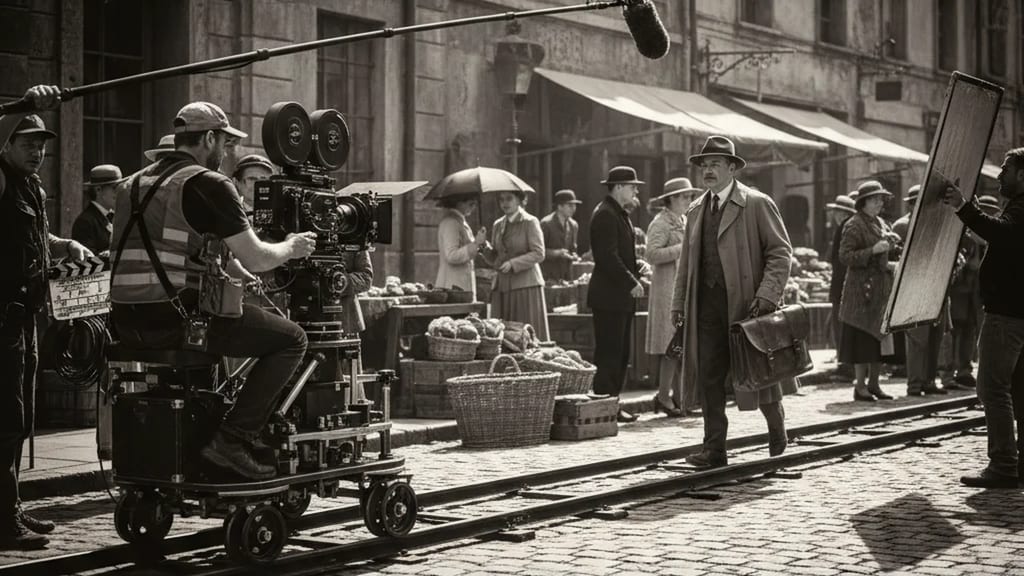
A Tracking Shot (Kamerafahrt / Verfolgungsfahrt) is a horizontal or lateral camera movement where the camera follows a subject parallel to it, or navigates through a scene, using tracks, a dolly, or other vehicles. Unlike pan movements, the entire camera physically moves through space.
Technical Execution
Track Systems
- Elemac Nova – Modular, ±2mm precision, up to 50 meters track length
- Fisher Dolly – Hollywood standard, payload 300kg, variable speed 0.01-3 m/s
- Grip Modular Track – Quick setup, flexible curve radii
- Dolly Zoom combined – Simultaneous tracking with focal length change creates distortion effect
Equipment
- Dolly Grip Operator operates the vehicle (brake, throttle, steering)
- Focus Puller (1st AC) continuously adjusts the plane of focus
- Marking System – Tape markers on tracks for positioning
- Video Assistant monitors focus and framing on a monitor
Tracking Speed
- Emotional scenes: 0.3–0.7 m/s (slow, immersive)
- Standard dialogue: 0.7–1.5 m/s (accompanying, time-correct)
- Dynamic scenes: 2–4 m/s (energetic, fast)
- Action chases: 5–8 m/s (intense, chaotic)
Focal Length Adjustment
- 28mm: Highly distorted tracking movements, large perspective shift
- 50mm: Neutral, natural-looking, standard for emotional scenes
- 85mm: Subtle, compressed movements, ideal for close-ups
- 135mm: Minimalist movements with maximum image compression
History & Development
1920s – Early Experiments
F.W. Murnau's "The Last Laugh" (1924) features one of the earliest tracking shots in film history. The system consisted of an improvised track that guided a specially constructed camera tripod dolly. The shot lasted over 90 seconds and was a technical sensation.
1940s – Hollywood Standardization
Orson Welles established the psychological power of tracking shots in "Citizen Kane" (1941). The famous cabaret scene uses a 7-meter tracking shot to visualize the emotional distance between protagonists. In parallel, grip departments like Fisher & Chapman developed standardized track systems.
1970s–1980s – Steadicam Revolution
Garrett Brown's invention of the Steadicam (1976) revolutionized tracking shots. The iconic Steadicam shot in "The Shining" (1980) through the Overlook Hotel established a new category of fluid movement without tracks.
1990s–2000s – Digital Precision
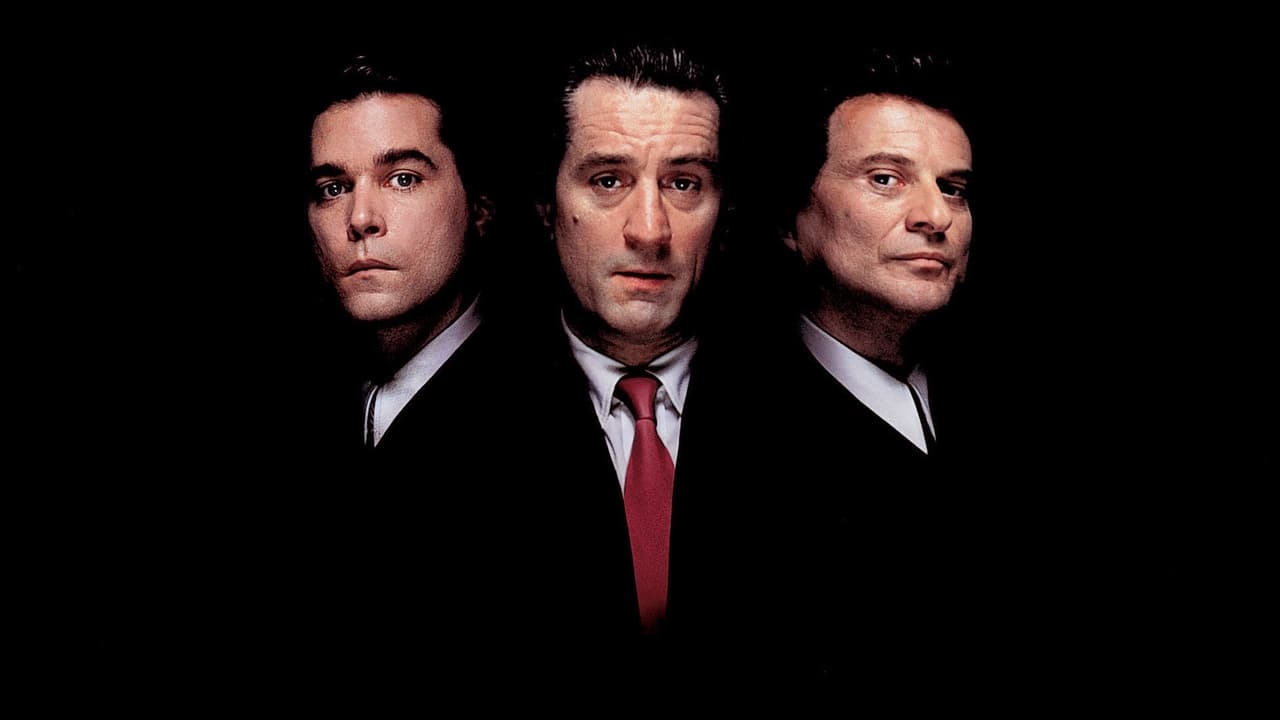
Motion control systems enabled millimeter-accurate repeatability. "Saving Private Ryan" (1998) utilized computer-controlled tracking shots for combat scenes. "Goodfellas" (1990) presents arguably the most famous tracking shot in film history – the 214-second Copacabana sequence (technically a combined tracking + crane shot).
2010s–2020s – Hybrid Systems
Gimbal systems on vehicles combine tracking mobility with optical stabilization. Drone tracking offers new perspectives. Digital mirrorless cameras allow for precise auto-focus tracking during tracking movements.
Practical Film Examples
Classics
- "The Last Laugh" (1924) – First tracking shot in film history (Murnau)
- "Citizen Kane" (1941) – Tracking shot in Xanadu scenes (Welles)
- "Goodfellas" (1990) – 214-second Copacabana shot (Scorsese)
- "The Shining" (1980) – Steadicam pursuit through hotel corridor (Kubrick)
Modern Masterpieces
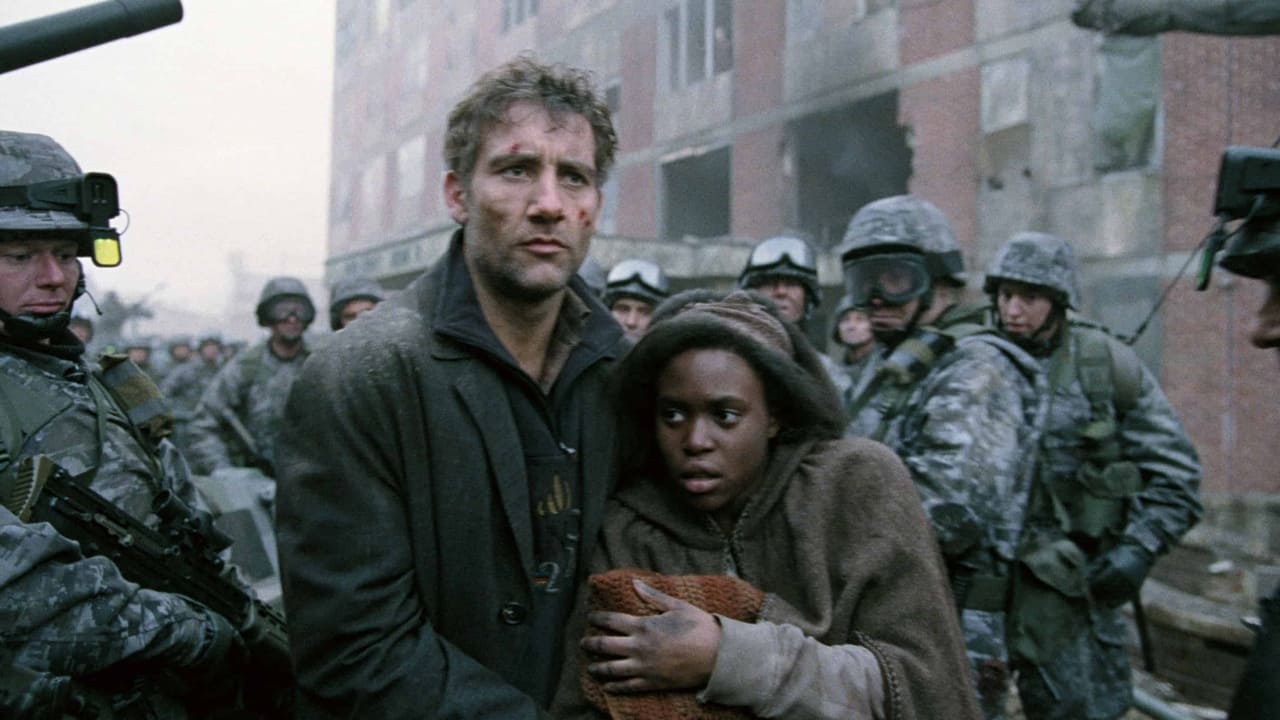
- "Children of Men" (2006) – 7-minute continuous tracking shot in war scenery (Cuarón)
- "1917" (2019) – Continuously simulated single-shot tracking cameras (Mendes)
- "Squid Game" (2021) – Multi-minute pursuits through game arenas
- "Stolen Car" (Balle Perdue) (2021) – Continuous tracking sequences through Parisian streets
Artistic Dimensions
Emotional Impact
- Intimacy through proximity: Tight tracking shots enhance psychological presence
- Fear through pursuit: Fast, unstable tracking shots feel menacing
- Continuity: Unbroken shots create a mental connection to the action
- Spatial understanding: Viewers orient themselves through consistent perspective
Narrative Function
- Revelation: A tracking shot can gradually reveal new visual elements
- Pursuit: The camera follows a fleeing character (psychological identification)
- Storytelling: Transition between scenes without cuts
- Rhythm: Tracking speed supports the emotional pulse
Comparison with Alternative Techniques
| Technique | Advantage | Disadvantage |
|---|
| Tracking Shot (Track) | Extreme precision, smooth, repeatable | Setup time-consuming, track length limited |
| Steadicam | Mobility, natural physics, elegant fluidity | Focus profile harder to control, operator-dependent |
| Gimbal Tracking | Fast mobility, remote controlled | Less precision for extreme close-ups |
| Drone Tracking | Greatest freedom of movement, aerial perspectives | Flight restrictions, wind sensitivity, regulatory |
| Digital Zoom/Reframing | Post-production flexibility | Visibly artificial, loss of detail when zooming |
Special Variants
Push-In Tracking
Combination of a tracking shot with a simultaneous zoom-in. Creates intense psychological proximity.
Lateral Tracking
Pure side-to-side movement without forward/backward component. Reveals depth planes.
360° Tracking
Circular movement around a subject (similar to an arc shot, but with a constant radius and parallel orientation).
Reveal Tracking
A shot that progressively reveals hidden visual elements – often over obstacles or through doorways.
Practical Planning Guidelines
- Ground Check: Unevenness over 1cm requires compensation
- Depth of Field: At 50mm and f/2.8 with a 3-meter focus plane and a 10-meter track, at least 3 focus pull marks are needed
- Lighting Setup: Lighting must cover the entire track path (average +40% more light)
- Rehearsals: Plan for at least 4-6 takes per setup
- Timing: 20-meter track = 4-5 hours preparation + rehearsals
Equipment Manufacturers
- Elemac: European standard (Nova, Jib Arm)
- Fisher Dolly: Hollywood premium
- Grip Modular: Flexible small-format systems
- Sachtler/O'Connor: Head stabilization
- Easyrig: Body weight compensation for operators