Filmlexikon.
Support
Dolly Shot
Camera · Terms

Dolly Shot

Murnau AI illustration
chapman dolly dana dolly dolly grip dolly track dolly zoom dolly trailer

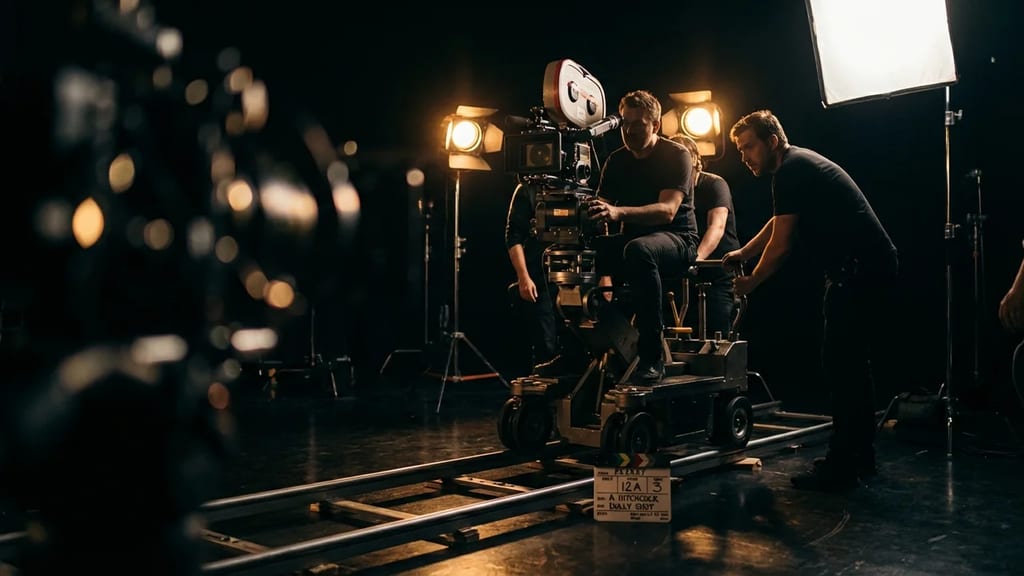
A dolly shot is a camera movement in which the camera is moved on a wheeled apparatus (dolly) on rails or smooth ground.

In film history

Famous examples · Dolly Shot

Curated examples across cinema history that illustrate the term — from compositional principle to deliberate refusal.
01 / THE DOLLY AS PSYCHOLOGICAL VERTIGO

Vertigo

Alfred Hitchcock · 1958 · Robert Burks

Hitchcock and cinematographer Burks pioneered the legendary 'dolly zoom' (Vertigo effect), combining a dolly-out with a simultaneous zoom-in to make Scottie's acrophobia and dissociation physically palpable on screen.

Vertigo · sample frame
02 / DOLLY AS MENACING PURSUIT

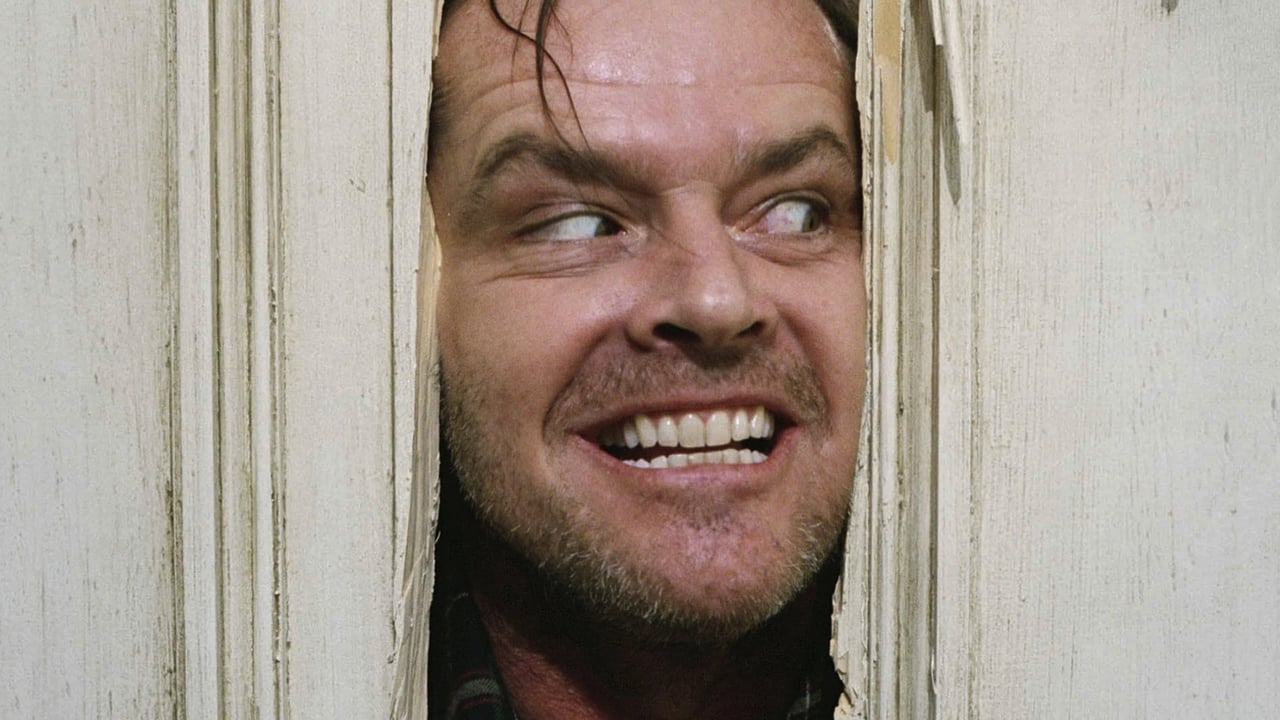
The Shining

Stanley Kubrick · 1980 · John Alcott

Kubrick deploys precise, slow dolly shots through the Overlook Hotel's corridors to create an unstoppable, claustrophobic dread – the camera trails Danny on his tricycle like a lurking predator.

The Shining · sample frame
03 / THE DOLLY AS SEDUCTIVE WORLD ENTRY

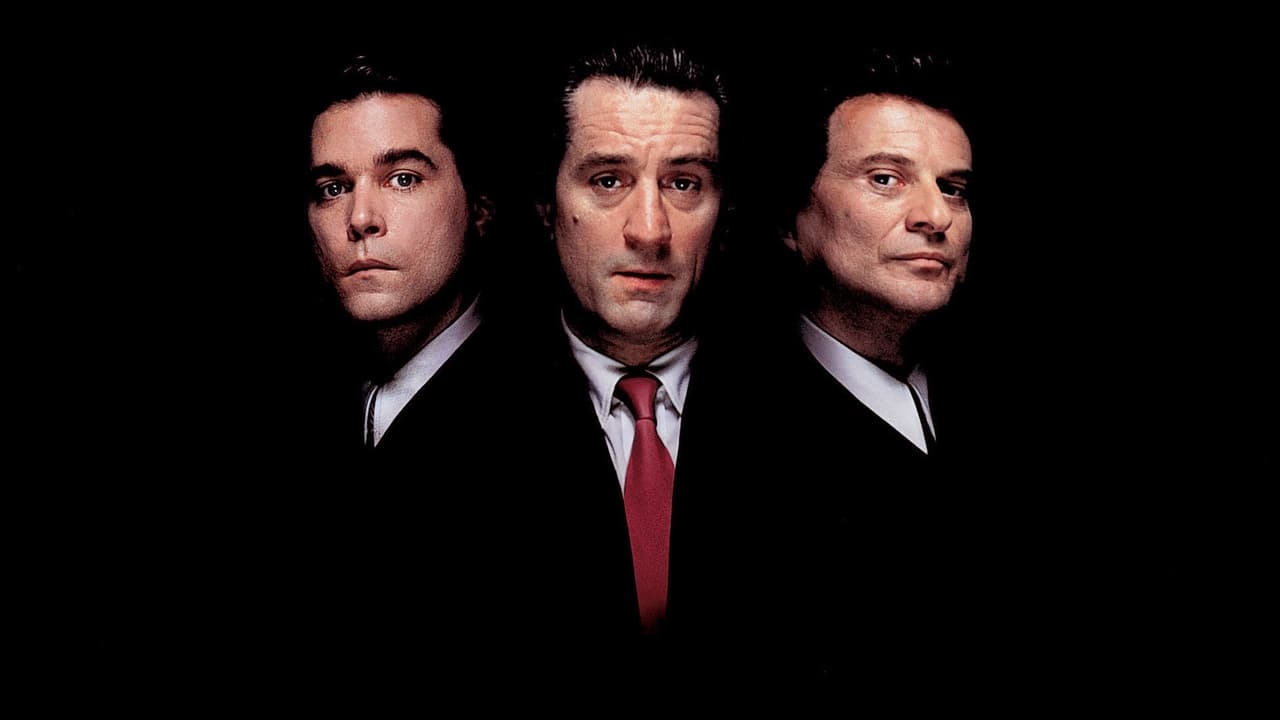
Goodfellas

Martin Scorsese · 1990 · Michael Ballhaus

The famous Copacabana sequence features an unbroken dolly shot through the kitchen and into the club, staging Henry's power and underworld belonging with dizzying elegance.

Goodfellas · sample frame
04 / DOLLY AS LOSS OF CONTROL

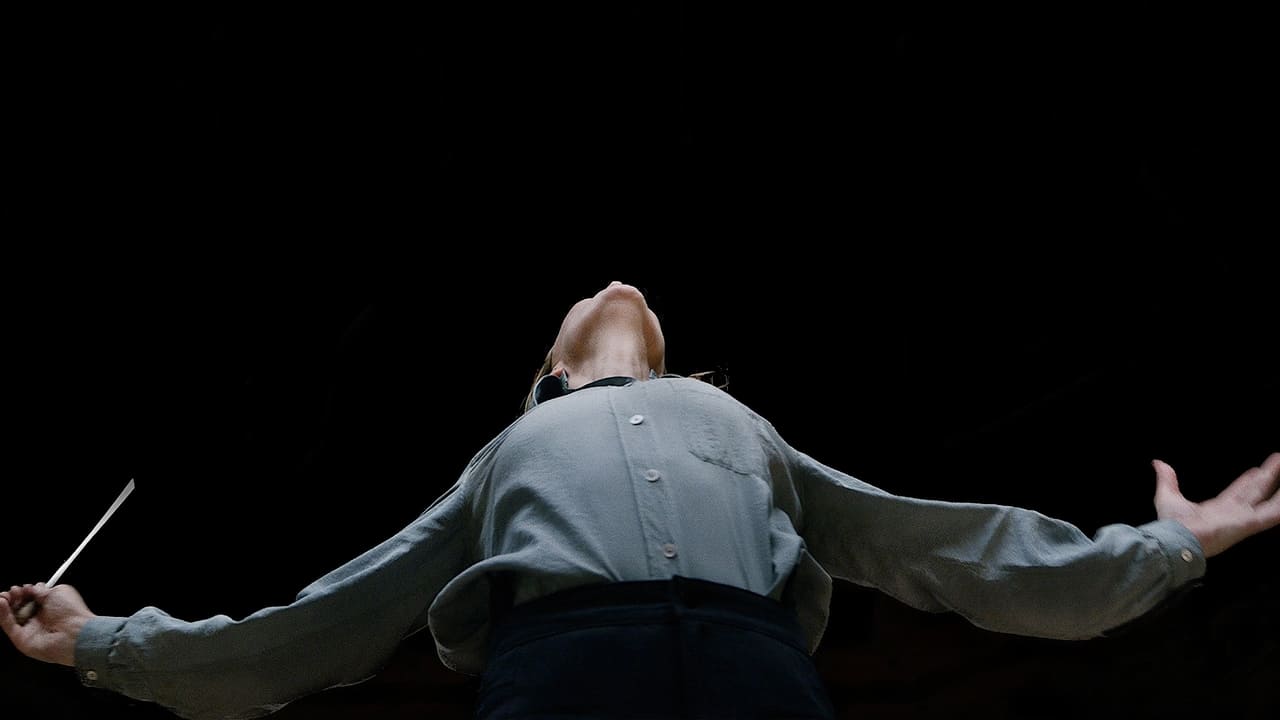
Tár

Todd Field · 2022 · Florian Hoffmeister

Florian Hoffmeister employs slow, nearly imperceptible dolly shots to subtly anchor Lydia's creeping loss of control and shifting power dynamics within the visual space.

Tár · sample frame

Film stills sourced via the TMDB API. This product uses the TMDB API but is not endorsed or certified by TMDB. themoviedb.org ›

Definition

The Dolly Shot (German: Kamerafahrt, Fahrt) is a camera movement where the entire camera is moved on a wheeled cart (dolly). Unlike a zoom, which only changes the framing, a dolly shot changes the camera's actual position in space.

Types of Dolly Shots

By Direction of Movement

Dolly In / Push In

  • Camera moves towards the subject
  • Effect: Focus, intimacy, intensification
  • Typical: Emotional moments, revelations

Dolly Out / Pull Back

  • Camera moves away from the subject
  • Effect: Contextualization, isolation, revelation
  • Typical: Scene endings, surprises (what is around the subject?)

Tracking Shot (Lateral Dolly)

  • Camera moves parallel to the subject
  • Effect: Accompanying, movement, energy
  • Typical: Walking figures, pursuits

Arc Shot

  • Camera moves in an arc around the subject
  • Effect: Dramatization, circling, unveiling
  • Typical: Hero shots, romantic scenes

Combinations

  • Diagonal: Forward and sideways simultaneously
  • Compound: Multiple movements in one shot
  • Motivated: Follows a character or object

Technical Execution

Equipment & Technical Specifications

Chapman Dolly (Hollywood Standard)

  • Payload: 300-400kg
  • Track width: 60cm or 100cm
  • Max incline: 3-5%
  • Speed: 0.01-3 m/s variable
  • Precision: ±2-3mm
  • Day rental cost: €600-900
  • Advantage: Ultra-stable, reproducible
  • Standard for: Feature Films, High-Budget Production

Fisher Dolly (Professional Variant)

  • Payload: 350kg
  • Track width: Standard 60/100cm
  • Speed: 0.05-2.5 m/s
  • Precision: ±3-5mm
  • Day rental cost: €500-800
  • Advantage: Easy transport, modular tracks
  • Standard for: Medium Budget, TV Production

Elemac Nova (European Standard)

  • Payload: 280kg
  • Modular track configuration
  • Precision: ±2mm (best on the market)
  • Speed: 0.02-3.5 m/s
  • Day rental cost: €700-1,000
  • Advantage: Extreme precision, flexible curves
  • Standard for: European co-productions

Hybrid Dolly Systems

  • Technodolly: Electronically controlled, programmable (€1,500/day)
  • Dana Dolly: Lightweight and compact (€400/day)
  • PeeWee Dolly: For tight spaces (€300/day)

Track Systems

  • Chapman/Fisher Standard: 19mm aluminum, 2-8m sections (€200-400 per 2m)
  • Flexible Track: For curves, variable 2-15m radius (€400-800)
  • Curved Track: Pre-bent with fixed radii (€300-600)

The Team

  • Dolly Grip: Operates the dolly
  • Camera Operator: Operates the camera
  • Focus Puller: Maintains focus during movement
  • Key Grip: Plans the setup

Track Setup

1. Level the floor (wedges, apple boxes)
2. Lay tracks
3. Check level
4. Mount dolly
5. Test run without camera
6. Mount camera
7. Rehearsal with camera
8. Mark end points

Dolly vs. Zoom

AspectDollyZoom
MovementCamera movesCamera stays still
PerspectiveChangesStays the same
BackgroundChanges relativelyOnly gets larger/smaller
Spatiality3D impressionFlatter, 2D
Emotional ImpactMore intenseMore distant
SetupComplexFast

The "Vertigo Effect" (Dolly Zoom)

A combination of dolly and zoom in opposite directions. The subject remains the same size, but the background distorts dramatically.

Creative Effect

Dolly In

  • Entering the character's world
  • Focusing on an important detail
  • Increasing emotional intensity
  • "We are getting closer to the truth"

Dolly Out

  • Distancing, farewell
  • Contextualization
  • Revealing the bigger picture
  • Isolation of the character

Tracking

  • Dynamism and energy
  • Equivalence with the character
  • Immersion in the movement

Practical Tips

  1. Plan Ahead: Define the shot in the storyboard/blocking
  2. Rehearse: Coordinate timing with actors
  3. Speed: Consistent, appropriate for the scene
  4. End Points: Clean start and stop

See Also

From the crafts

Perspectives

Cinematographer

Camera movement is a core tool of my visual grammar. A move on 19mm Elemac tracks demands precise collaboration: the dolly grip must work in 0.1m/s increments, I manage the framing in three dimensions, and the focus puller has to calculate the depth of field over the entire track length. On a 15-meter move at 50mm f/2.8, the plane of focus can shift by 80cm – that requires 7-10 marks for precise focus pulling. Chapman dollies offer a speed spectrum of 0.01-3 m/s; for emotional scenes, I work at 0.3-0.7 m/s, for action scenes 2-3 m/s. The psychological difference between a zoom and a move is fundamental: a move creates natural parallax shift and 3D depth, while a zoom feels flat and artificial. Stability is everything – even ±5mm track unevenness is visible in 4K.

Director

A camera move is a stronger tool than any dialogue. A slow push-in (15 seconds for 3 meters) into a face creates psychological intensity – the viewer is literally pulled into the character's inner world. Fast moves (0.5s for 2m) feel aggressive or panicked. Scorsese's famous Copacabana shot in 'Goodfellas' is a combination of tracking, dolly, and crane over 214 seconds – technically complex, but narratively irreplaceable. I work closely with the DoP during pre-production – focal length, move speed, lighting, and actor timing all have to be synchronized. The psychological effect is subtle but total: with a move, the viewer actively shares the camera's perspective, not passively.

Editor

Camera moves have an intrinsic rhythm that I have to respect. I can't shorten an 8-second move with an organic pace to 5 seconds – it would feel choppy. Unlike shot/reverse-shot editing, a continuous move creates mental continuity. I often use move takes as stand-alone sequences or cut only at natural endpoints (when the camera stops moving). Multiple variations of the same move with different framing and focus give me editing options. Color correction is critical – light values can't jump during a move, they must be adjusted gradually. Soundtrack timing has to adapt to the move's rhythm, not the other way around.

Producer

A camera move costs between 800-2,500 Euros per setup including equipment + crew. A 15-meter move requires 4-5 hours of setup: leveling the floor (wedges, apple boxes for ±5mm), laying tracks, calibrating Elemac/Chapman dolly, test run, camera balancing, 3-5 takes with adjustments. For exterior shots, time doubles due to weather protection, ground leveling, gaffer work. Chapman Titan costs 600-900€ per day rental, Elemac 700-1,000€. Dolly grip fee: 400-700€. Focus puller: 400-600€. Total budget for a professional move: 2,000-3,500€. Modern gimbal alternatives (DJI Ronin 4D) only cost 1,500€/day including operator, but save 4 hours of track building time = real cost savings.

More in the lexikon

Related terms

Test your knowledge

Quiz

1. Was beschreibt „Kamerafahrt" am besten?

2. Zu welchem Department gehört „Kamerafahrt"?

3. Wie viele verschiedene Fachperspektiven bietet dieser Eintrag?

Report an error
From the Filmfarm ecosystem

Understand visual language, budget productions, connect crew.

The Lexikon is part of the Filmfarm ecosystem — alongside budgeting (FilmBalance), an industry magazine (FilmCircus) and crew networking (FilmCall, CrewMesh). One shared vocabulary for the whole production.

FilmFarm FilmRadarComing soonFilmPulseComing soonFilmNumbersComing soonFilmCapitalComing soonFilmLabComing soonFilmBalanceComing soonFilmCircusComing soon