Filmlexikon.
Support
Arc Shot / Circumnavigation Shot
Camera · Terms

Arc Shot / Circumnavigation Shot

Murnau AI illustration
tracking shot push in pull out crane shot dolly shot jib shot steadicam shot

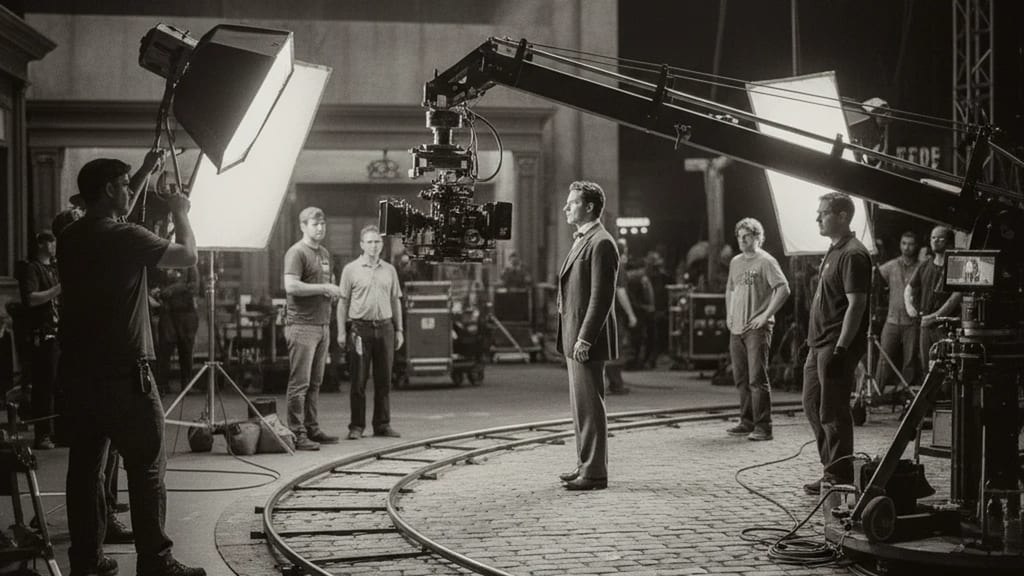
A camera movement that travels in a curved or circular path around a subject, changing viewpoint progressively to reveal spatial relationships and shift viewer perspective without cutting.

Technical Details

Classic arc shots are realized with curved dolly tracks that have a radius between 3 and 12 meters. Modern Steadicam systems enable arc movements with variable radii, while camera cranes can execute arcs up to 25 meters in diameter. The standard speed is 0.5 to 2 m/s, depending on the desired dramatic effect. Technocrane systems achieve precision values of ±2 cm in path guidance.

Three main variants dominate: the reveal arc shot (gradually reveals image elements), the circumference shot (complete 360° circle), and the parallax arc shot (uses depth layering between foreground and background).

History & Development

Friedrich Wilhelm Murnau first used a complete arc shot in "The Last Laugh" in 1924, employing a specially constructed track system. The technique was perfected in 1927 by Abel Gance's "Napoleon," which used triple track arcs for battle scenes. Orson Welles established the arc shot as a narrative stylistic device in 1941 with "Citizen Kane," realizing 270° shots around the fireplace in the Xanadu salon.

Digitization brought millimeter-accurate repeatability in 1993 with motion control systems. Since 2010, gimbal systems on rail vehicles have enabled complex arc movements with simultaneous pan/tilt control.

Practical Use in Film

Stanley Kubrick used 180° arc shots around the rotating space station in "2001: A Space Odyssey" (1968) to visualize weightlessness. Martin Scorsese realized the famous Copacabana sequence in "Goodfellas" (1990) as a 214-second arc shot through the kitchen and restaurant. The Russo brothers employed 360° camera circles around fighting superheroes in "Avengers: Endgame" (2019).

Arc shots require precise focus pulling, as distances change continuously. Lighting must cover the entire range of motion, increasing lighting expenditure by an average of 40%.

Comparison & Alternatives

While tracking shots move the camera parallel to the subject, an arc shot constantly changes the viewing angle. Pan movements rotate around the camera's axis, not the subject. Drone shots have offered three-dimensional arc movements since 2015 but do not achieve the precision of track-guided systems.

Modern alternatives include Bolt camera systems (computer-controlled robotic arms) and Spidercam installations for vertical arcs. Virtual reality productions use volumetric arc shots with 48 synchronized cameras along an 8-meter circle.
From the crafts

Perspectives

Cinematographer

Bogenfahrten sind Präzisions-Königsdisziplin. Ich plane jede Bogenbahn mit Schablonen und Tape-Markierungen - bei einem 6-Meter-Radius und 90-Grad-Bogen dauert die Schiene-Konstruktion 4-6 Stunden. Der Focus-Pull variiert kontinuierlich - die Distanz zum Subjekt ändert sich nicht, aber die perspektivische Kompression ändert sich constant. Mit 50mm und f/2.8 über einen 90-Grad-Bogen kann die wahrgenommene Schärfeebene um bis zu 80cm driften. Ich nutze Mark-Points alle 10 Grad für Focus-Referenzierung. Die Beleuchtung ist kritisch - Lichtwechsel während Bogen wirken künstlich. Ich benötige 360-Grad-Ausleuchtung mit LED-Panels (270-Grad Strahlwinkel).

Director

Bogenfahrten visualisieren subtile psychologische Verschiebungen. Ein 180-Grad-Bogen um zwei Gesprächspartner kann einen Rollentausch - psychologische Machtverschiebung - unterstreichen. 360-Grad-Fahrten isolieren Protagonisten visuell und unterstreichen Einsamkeit oder Verwirrung. Der Rhythmus ist entscheidend: Langsame Bögen (45 Sekunden für 90 Grad) erzeugen Kontemplation, schnelle Fahrten (8 Sekunden) wirken chaotisch oder bedrängend. Ich nutze Bogenfahrten oft für Moment-der-Wahrheit-Szenen, wo Charakters Perspektive sich fundamentalisch ändert.

Editor

Bogenfahrten sind im Schnitt mächtig. Sie schaffen inhärente Rhythmen und psychologische Kurven, an die ich meine Schnittmuster anpassen muss. Ein 180-Grad-Bogen sollte ein natürliches psychologisches Abschlussmoment haben - schneiden davor wirkt unterbrochen. Ich nutze Bogenfahrten oft als Stand-Alone-Takes oder schnide nur an natürlichen Pausen. Color-Correction muss für kontinuierliche Lichtwechsel über die Bogenbahn korrigiert werden. Multiple Takes ermöglichen alternative Schnitt-Punkte.

Producer

Eine komplexe Bogenfahrt kostet 2.000-5.000 Euro pro Setup - Spezial-Bogenschienen, Grip-Equipment, verlängerte Beleuchtungszeit. Eine 90-Grad-Bogenfahrt mit 6-Meter-Radius benötigt 4-6 Stunden Setup. 360-Grad-Bögen verdoppeln Komplexität und kosten. Der Zeitaufwand reduziert andere Setups - statt 8 Setups schaffe ich vielleicht 4 pro Tag. Moderne Gimbal-Lösungen auf Fahrzeugen reduzieren Kosten um 40-60%, erreichen aber nicht Schienen-Präzision. Ich plane Arc-Shots strategisch und nutze sie nur für narrative High-Points.

More in the lexikon

Related terms

Test your knowledge

Quiz

1. Was beschreibt „Bogenfahrt / Kreisfahrt" am besten?

2. Zu welchem Department gehört „Bogenfahrt / Kreisfahrt"?

3. Wie viele verschiedene Fachperspektiven bietet dieser Eintrag?

Report an error
From the Filmfarm ecosystem

Understand visual language, budget productions, connect crew.

The Lexikon is part of the Filmfarm ecosystem — alongside budgeting (FilmBalance), an industry magazine (FilmCircus) and crew networking (FilmCall, CrewMesh). One shared vocabulary for the whole production.

FilmFarm FilmRadarComing soonFilmPulseComing soonFilmNumbersComing soonFilmCapitalComing soonFilmLabComing soonFilmBalanceComing soonFilmCircusComing soon