Definition
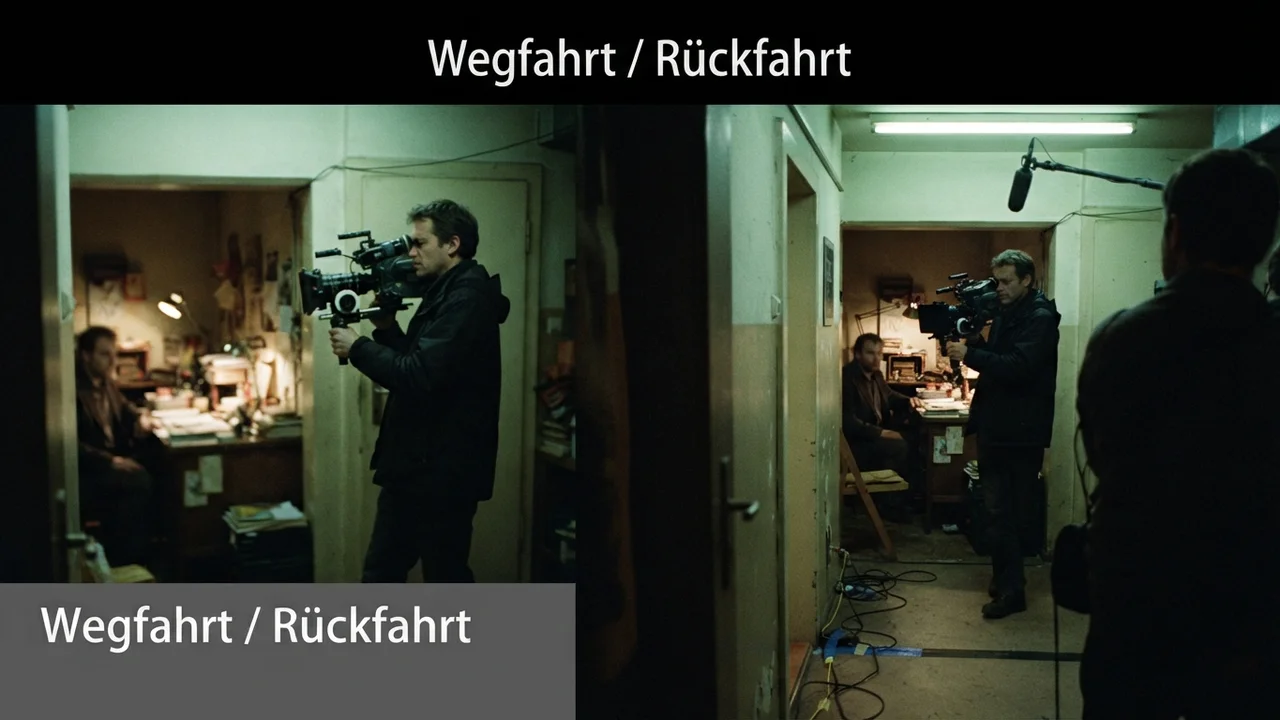
A Pull-Out (Rückfahrt / Wegfahrt) is a camera movement that continuously moves away from a subject or point of focus. The camera moves backward spatially, progressively revealing more environmental context. Unlike push-ins, the pull-out reduces psychological proximity and creates new spatial perspective.
Technical Execution
Track Systems & Equipment
Standard Dolly Pull-Out
- Moving backward on tracks
- Precision: ±2-5mm (identical to Push-In)
- Speed: 0.2-2 m/s, variable
- Challenge: Dolly grip drives blind backward (Video assistant navigates)
- Alternative: Remote control for precise backward movement
Steadicam Pull-Out
- Operator walks backward with Steadicam
- Significantly more unstable than forward movement
- Operator uses video monitor behind their back for navigation
- Risk of tripping increases error rate
- Usually 5-8 takes for a usable shot
Crane Pull-Out (Vertical Component)
- Crane moves backward while arm extends upward
- 3D pull-out with simultaneous height change
- Creates monumental, revealing effects
- Technocrane: up to 22 meters height, 15 meters reach
Gimbal Pull-Out
- Remote controlled, quickly repeatable
- Modern standard method in streaming production
- Can program specific pull-out curves
- DJI Ronin 4D with LiDAR focus tracking
Focus Profile
- Negative Focus Ramp: Focus continuously shifts backward
- Multi-Zone Focus: Foreground sharp at start, then transitions to background
- Soft Reveal: Starts with shallow focus, progressively increasing depth of field
- Swing Out: Focus jumps from foreground to background at the end
Focal Lengths & Perspective
| Focal Length | Reveal Effect | Usage |
|---|
| 14mm | Extreme perspective widening | Montage effect, dramatic reveal |
| 24mm | Subtle perspective shift | Standard exterior pull-outs |
| 35mm | Naturalistic feel | Dialogues, interior scenes |
| 50mm | Neutral, psychological | Narrative pull-outs |
| 85mm | Minimal perspective | Close-ups to wide shots |
History & Development
1920s – Silent Film Technology
F.W. Murnau's "The Last Laugh" (1924) used primitive pull-outs for context revelation. The technical challenge was greater than push-ins – cameramen had to navigate blind.
1940s – Welles Innovation
Orson Welles perfected the monumental pull-out in "Citizen Kane" (1941). The famous closing sequence slowly pulls back from Rosebud details to a monumental wide shot of Xanadu – a shot carrying narrative significance. The system required a custom-built 100-meter track.
1970s – New Hollywood Era
Terrence Malick used slow, meditative pull-outs in "Badlands" (1973) and "Days of Heaven" (1978). Stanley Kubrick experimented with controlled pull-outs in "The Shining" (1980) for psychological disorientation. Paul Thomas Anderson would later use pull-outs as a narrative structural element.
1980s–1990s – Technical Refinement
Motion control systems enabled precise, repeatable pull-outs. David Fincher used stylized pull-outs in "Se7en" (1995) for scene closure. Gimbal systems dramatically reduced setup time.
2000s–2020s – Digital Integration
Filmmakers combine in-camera pull-outs with digital zoom pull-outs in post-production. Alfonso Cuarón used extended pull-outs in "Gravity" (2013) for spatial disorientation. Gimbal technology allows for precise variable-speed pull-outs.
Practical Film Examples
Classic Pull-Out Masterpieces
- "Citizen Kane" (1941) – Monumental pull-out as conclusion (Welles)
- "Badlands" (1973) – Meditative pull-outs through landscape (Malick)
- "Days of Heaven" (1978) – Golden hour pull-outs (Malick)
- "The Shining" (1980) – Psychological pull-outs (Kubrick)
Modern Applications
- "Se7en" (1995) – Stylized pull-outs as scene closure (Fincher)
- "There Will Be Blood" (2007) – Extended pull-outs (P.T. Anderson)
- "Gravity" (2013) – Spatial disorientation pull-outs (Cuarón)
- "The Lighthouse" (2019) – Slow pull-outs in black and white (Eggers)
Artistic Dimensions
Psychological Impact
- Distancing: Progressive movement away creates reflexivity
- Context Revelation: Viewers re-understand the scene
- Isolation: Pull-out isolates the character in a larger space
- Melancholy: The pull-out often feels melancholic/reflective
Narrative Functions
- Closure: Pull-outs signal scene endings
- Reinterpretation: Revealed contexts change meaning
- Spatial Understanding: Viewers orient themselves in space
- Temporal Distance: A pull-out can also create metaphorical temporal distance
Technical Challenges
| Challenge | Solution | Cost |
|---|
| Blind Navigation | Video monitor behind camera, spotter | +€100 |
| Focus Drift Backward | Negative focus ramp with mark points | Part of setup |
| Stability Variance | Steadicam > Dolly for smoothness | Operator +€300 |
| Ground Surface | Tracks eliminate unevenness | 3-4 hours setup |
| Space Requirement | Clear space behind camera | +1-2 hours |
Special Variants
Reveal Pull-Out
A pull-out that gradually reveals hidden image elements – often over obstacles or through doorways.
Surprise Pull-Out
A rapid pull-out (2-4 seconds) revealing shocking contexts. Creates a surprise effect.
Crane Pull-Out
Simultaneous backward and upward movement. Creates monumental, epic effects.
Rotational Pull-Out
A pull-out combined with a panning movement. Creates 3D spatial understanding.
Comparison: Pull-Out vs. Push-In
| Dimension | Push-In | Pull-Out |
|---|
| Psychological Impact | Intensifying | Distancing |
| Narrative Function | Escalation | Closure/Reflection |
| Technical Complexity | Moderate | Higher (navigation) |
| Focus Challenge | Forward | Backward |
| Emotional Effect | Confinement/Intimacy | Melancholy/Isolation |
| Frequency of Use | Very frequent | Selective |
Practical Planning Guidelines
- Space Check: Clear at least 20% more space behind the camera
- Navigation Spotter: Specialized person behind camera required for safety
- Multiple Takes: Plan for 6-10 takes for a flawless pull-out
- Focus Adjustment: Test negative focus ramp before production
- Timing: Pull-out duration should carry narrative meaning
Equipment Manufacturers
- Elemac: Track systems with optional remote control
- Fisher Dolly: Standard for professional pull-outs
- Technocrane: For crane pull-outs with a vertical component
- Steadicam Operator: Specialized training programs
- DJI Ronin 4D: Gimbal-based remote pull-outs