Filmlexikon.
Support
TLCI
Lighting · Technique

TLCI

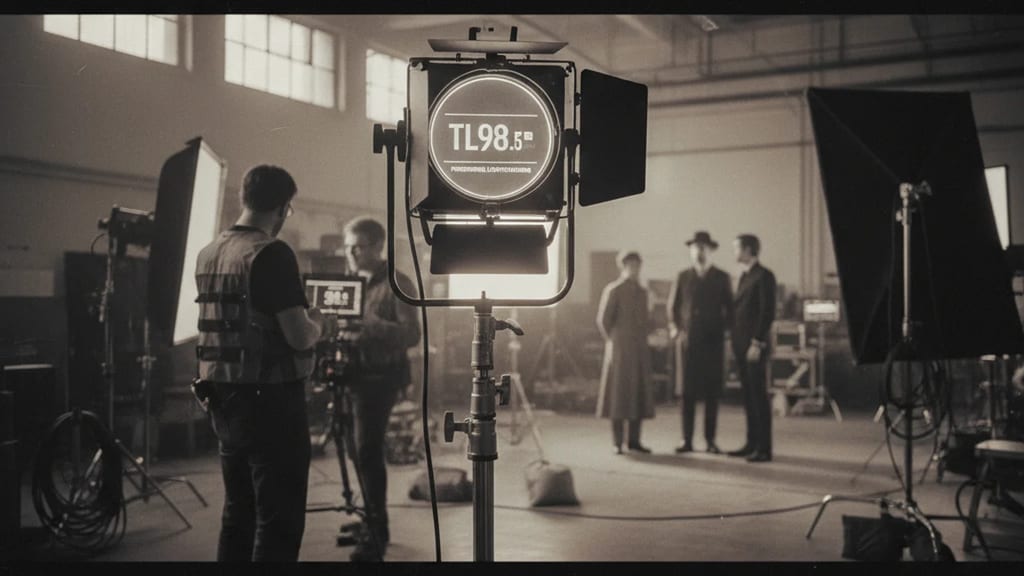
Murnau AI illustration
color temperature flow roll take light emitting diode cri

EBU color rendering index for broadcast lighting. Measures how accurately light sources reproduce colors on TV cameras; high-quality LED panels typically achieve TLCI values of 95–98.

Technical Details

The TLCI is based on the CIE color system and uses specific test colors according to the ColorChecker standard. Measurement is performed with a spectroradiometer that captures the spectral energy distribution between 380 and 780 nanometers. High-quality LED panels achieve TLCI values of 95-98, while inexpensive fluorescent lamps often only manage 70-85. The index takes into account the camera pipeline and subsequent post-production, thus differentiating itself from the purely physical CRI (Color Rendering Index).

History & Development

The European Broadcasting Union (EBU) developed the TLCI in 2012 in response to the shortcomings of the CRI in evaluating LED lighting for television productions. The first official standard, EBU Tech 3355, was published in 2013 after tests with various camera manufacturers had demonstrated the need for a TV-specific measurement method. In 2017, a revision with expanded test colors was carried out, followed by the integration of HDR workflows in 2020.

Practical Application in Film

In "Blade Runner 2049" (2017), cinematographer Roger Deakins exclusively used LED panels with TLCI values above 96 for the complex color moods. In TV series like "The Crown," Netflix mandates minimum TLCI standards of 90 for all light sources. The workflow includes measuring all luminaires before shooting begins, with sets featuring mixed lighting (daylight/artificial light) requiring special attention. Low TLCI values lead to color shifts that must be laboriously corrected in post-production.

Comparison & Alternatives

The CRI (Color Rendering Index) measures only the physical color rendition, while TLCI includes the complete camera pipeline. The newer TM-30 standard from the IES offers more detailed analysis but is less film-specific. SSI (Spectral Similarity Index) was developed as an alternative but has not gained traction. For cinema productions, TLCI remains the gold standard, while for streaming content, the respective platform standards (Netflix, Amazon) must also be observed.
From the crafts

Perspectives

Cinematographer

Ich verlasse mich auf TLCI-Werte ab 95, besonders bei Hautton-kritischen Szenen und Mixed-Lighting-Setups. Niedrigere Werte bedeuten für mich mehr Zeit beim Weißabgleich und Probleme mit Farbverschiebungen, die sich erst im Grading zeigen. Bei LED-Wänden prüfe ich zusätzlich die TLCI-Konstanz über verschiedene Helligkeitsstufen.

Director

TLCI-konforme Beleuchtung gibt mir die Sicherheit, dass meine gewählte Farbpalette vom Set bis zur finalen Ausspielung erhalten bleibt. Bei emotionalen Szenen kann ich mich auf subtile Farbnuancen verlassen, ohne befürchten zu müssen, dass sie in der Post verloren gehen. Schlechte TLCI-Werte zerstören mein visuelles Storytelling bereits bei der Aufnahme.

Producer

TLCI-Standards über 90 sind für mich Pflicht, da niedrigere Werte teure Nachkorrekturen in der Post bedeuten und Delivery-Standards gefährden. Die Mehrkosten für hochwertige LED-Panels amortisieren sich durch gesparte Grading-Stunden und vermiedene Re-Deliveries. Bei internationalen Koproduktionen sind TLCI-Zertifikate oft Vertragsbestandteil.

More in the lexikon

Related terms

Test your knowledge

Quiz

1. Was beschreibt „TLCI" am besten?

2. Zu welchem Department gehört „TLCI"?

3. Wie viele verschiedene Fachperspektiven bietet dieser Eintrag?

Report an error
From the Filmfarm ecosystem

Understand visual language, budget productions, connect crew.

The Lexikon is part of the Filmfarm ecosystem — alongside budgeting (FilmBalance), an industry magazine (FilmCircus) and crew networking (FilmCall, CrewMesh). One shared vocabulary for the whole production.

FilmFarm FilmRadarComing soonFilmPulseComing soonFilmNumbersComing soonFilmCapitalComing soonFilmLabComing soonFilmBalanceComing soonFilmCircusComing soon