Filmlexikon.
Support
CRI
Lighting · Technique

CRI

Murnau AI illustration
color temperature flow roll take light emitting diode tlci ssi dimmer

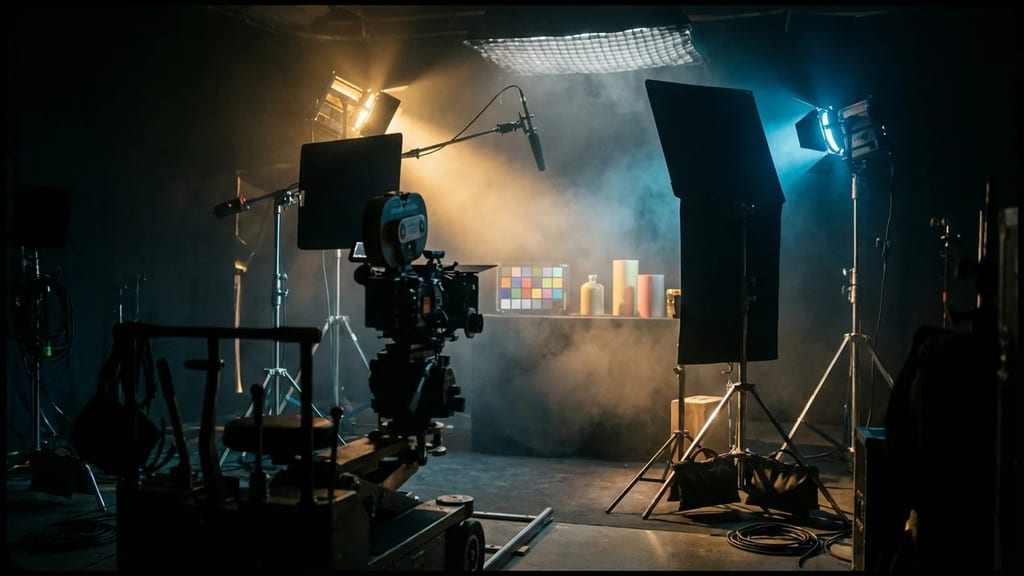
Color Rendering Index: measures how accurately a light source reproduces colors against 8 standard samples. LED panels with CRI >95 are film-grade; HMI typically 90–95; tungsten near 100.

Technical Details

The CRI value is calculated from the average deviation of eight defined pastel colors (R1-R8). Additional test values include saturated colors (R9-R12) and skin tones (R13-R15). LED panels with CRI >95 are considered film-ready, while standard lighting often only achieves CRI 80-85. HMI spotlights typically achieve CRI values of 90-95, while tungsten lamps reach nearly 100. The extended TLCI standard (Television Lighting Consistency Index) uses 24 test colors and is considered a more precise benchmark for video productions.

History & Development

The International Commission on Illumination (CIE) developed the CRI standard in 1965 for evaluating indoor lighting. With the advent of LED technology in the 2000s, the original standard proved insufficient, as LEDs have different spectral properties. In 2012, the European Broadcasting Union introduced the TLCI, which is specifically tuned for camera sensors. Since 2020, the TM-30 standard with 99 test colors has also been establishing itself for even more precise measurements.

Practical Application in Film

For "Mad Max: Fury Road" (2015), DoP John Seale exclusively used HMI lights with CRI >92 for consistent skin tones in the desert scenes. LED panels with low CRI (<80) particularly distort reds and skin tones, requiring extensive color correction in post-production. High CRI values are essential for documentaries, as subsequent corrections can blow the budget. Mixed-lighting setups require CRI-matched light sources to avoid color casts between different types of lamps.

Comparison & Alternatives

TLCI is better suited for digital cameras than the classic CRI, as it considers the spectral sensitivity of modern sensors. The R9 value (saturated red) is often more telling than the overall CRI, as many LEDs struggle here. SSI (Spectral Similarity Index) evaluates the complete spectral distribution rather than individual test colors. For HDR productions, full-spectrum LEDs with CRI >98 are increasingly used, but they are 3-5 times more expensive than standard LEDs with CRI 85.
From the crafts

Perspectives

Cinematographer

Ich messe jeden LED-Panel mit einem Spektrometer, da die Herstellerangaben oft geschönt sind – ein angeblicher CRI 95 entpuppt sich häufig als CRI 87 bei R9-Werten unter 60. Bei Hautton-lastigen Szenen verwende ich nur Leuchten mit R9 >90, da ich sonst in der Farbkorrektur keine sauberen Hauttöne hinbekomme. Mixed Lighting zwischen HMI und LED funktioniert nur, wenn beide ähnliche CRI-Profile haben.

Director

Schlechte CRI-Werte zerstören die emotionale Wirkung meiner Farbpalette – wenn das warme Rot eines Sonnenuntergangs orangestichig wird oder Hautfarben kränklich aussehen. Ich bestehe darauf, dass kritische Szenen mit High-CRI-Equipment beleuchtet werden, auch wenn das Budget drückt. Bei stylisierten Looks kann niedriger CRI sogar gewollt sein, aber das muss eine bewusste Entscheidung sein.

Producer

High-CRI-LEDs kosten 40-60% mehr als Standard-Equipment, aber sie sparen mir Stunden in der Post-Production und reduzieren das Risiko von Reshoots wegen Farbproblemen. Ich kalkuliere die CRI-Anforderungen bereits im Pre-Production-Budget ein, da nachträgliche Equipment-Upgrades den Drehplan durcheinanderbringen. Für Low-Budget-Produktionen priorisiere ich High-CRI nur für Hauptdarsteller-Nahaufnahmen.

More in the lexikon

Related terms

Test your knowledge

Quiz

1. Was beschreibt „Farbwiedergabeindex" am besten?

2. Zu welchem Department gehört „Farbwiedergabeindex"?

3. Wie viele verschiedene Fachperspektiven bietet dieser Eintrag?

Report an error
From the Filmfarm ecosystem

Understand visual language, budget productions, connect crew.

The Lexikon is part of the Filmfarm ecosystem — alongside budgeting (FilmBalance), an industry magazine (FilmCircus) and crew networking (FilmCall, CrewMesh). One shared vocabulary for the whole production.

FilmFarm FilmRadarComing soonFilmPulseComing soonFilmNumbersComing soonFilmCapitalComing soonFilmLabComing soonFilmBalanceComing soonFilmCircusComing soon