Cinematographer
Aus DoP-Perspektive ist dieses Element essentiell für die visuelle Gestaltung. Es ermöglicht mir die gewünschte Farbstimmung und das ästhetische Bild konsistent umzusetzen.
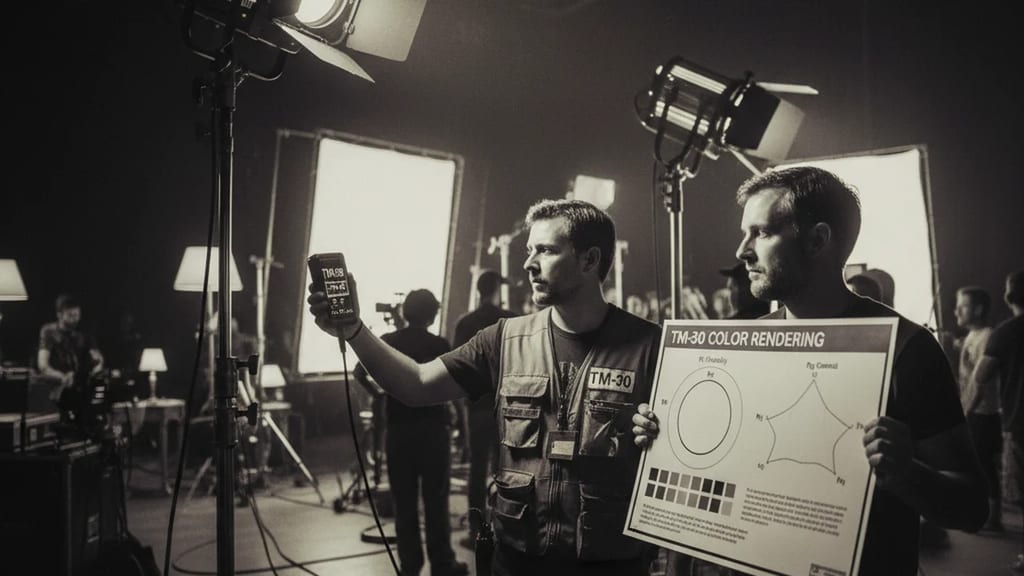
TM-30 is the ANSI/IES method for evaluating color rendering of light sources using Rf (fidelity) and Rg (gamut) metrics.
TM-30 (full name ANSI/IES TM-30, "IES Method for Evaluating Light Source Color Rendition") is not a device or a fixture, but a measurement and evaluation method for the color rendition of light sources. It was first published by the Illuminating Engineering Society (IES) in 2015 as TM-30-15 and further developed in the revisions TM-30-18 and TM-30-20.
TM-30 is considered a more modern and informative alternative to the classic CRI (Color Rendering Index Ra). While CRI only provides a single average value over a few, mostly unsaturated test colors, TM-30 describes color rendition with multiple metrics and a graphical representation. This is relevant for film and TV because CRI is known to poorly represent saturated colors and skin tones (especially red components, cf. the CRI value R9).
TM-30 is based on a set of 99 Color Evaluation Samples (CES) that cover a wide and evenly distributed color space and are modeled after real object colors. The tested light source is compared against a reference light source of the same color temperature (incandescent lamp/tungsten in the warm range, daylight in the cool range).
Additionally, TM-30 provides hue-bin-related values (16 hue segments) as well as the Color Vector Graphic – a circular representation that shows in which direction individual hues are shifted in saturation and hue. This allows, for example, to see whether a fixture overemphasizes reds (skin appears "sunburned") or weakens them.
TM-30 values are increasingly provided by manufacturers for LED fixtures in their datasheets. For gaffers, key grips, and DoPs, they serve to assess how true-to-life a fixture renders colors and skin tones – particularly important when mixing different LED fixtures with each other or with existing tungsten and HMI lights.
In practice, Rf and Rg are not read in isolation, but together with the Color Vector Graphic: a fixture can have a high Rf value and still significantly shift individual hues. TM-30 thus complements other film-specific metrics like CRI/R9 and TLCI, but does not replace their evaluation on the monitor. The standard itself does not provide a binding, universally applicable minimum threshold for "film-suitable" Rf/Rg values; the evaluation depends on the application and the production's requirements.
Aus DoP-Perspektive ist dieses Element essentiell für die visuelle Gestaltung. Es ermöglicht mir die gewünschte Farbstimmung und das ästhetische Bild konsistent umzusetzen.
Diese professionelle Lösung erhöht die Produktionseffizienz und reduziert Post-Production-Anforderungen. Sie ermöglicht flexible, schnelle Anpassungen während des Drehs.
Als Gaffer ist dies ein unverzichtbares Werkzeug meines täglichen Handwerkszeugs. Es ermöglicht mir professionelle Lichtkontrolle und schnelle Anpassungen auf Set, was Zeit spart und Qualität sichert.
1. Zu welchem Department gehört „TM-30"?
2. Wie viele verschiedene Fachperspektiven bietet dieser Eintrag?
The Lexikon is part of the Filmfarm ecosystem — alongside budgeting (FilmBalance), an industry magazine (FilmCircus) and crew networking (FilmCall, CrewMesh). One shared vocabulary for the whole production.