Filmlexikon.
Support
Silver Board
Lighting · Terms

Silver Board

Murnau AI illustration
color temperature flow roll take

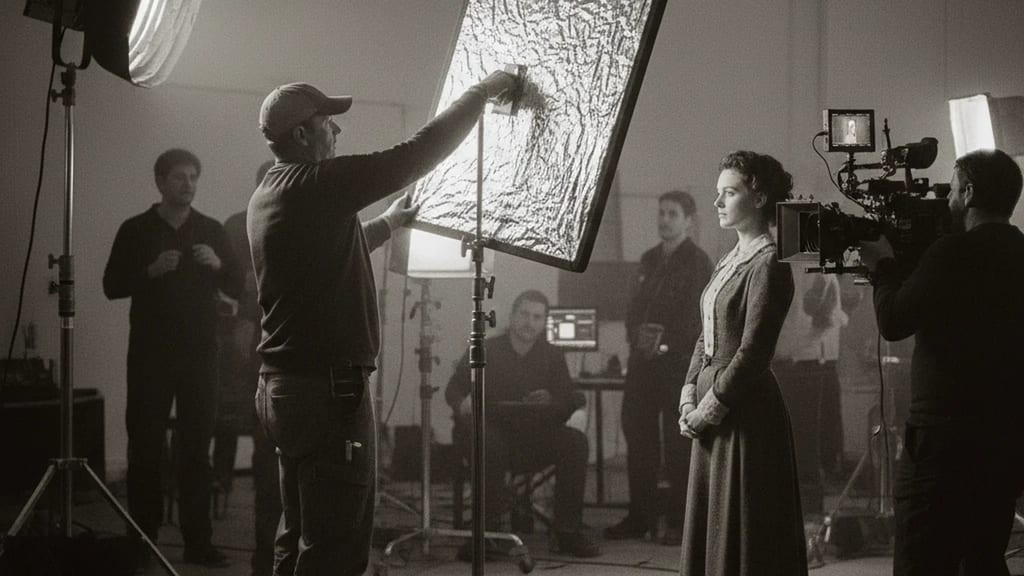
Reflector board with textured aluminum surface producing hard, directional light at 85–95% reflectance. Standard sizes 60×90 to 120×180 cm.

Technical Details

Commercially available Silver Boards measure 60x90 cm, 90x120 cm, or 120x180 cm with a thickness of 3-5 mm. The surface has a textured grain that varies between smooth (mirror finish) and finely textured (brushed). The reflectivity is 95% for smooth variants and 85-90% for textured ones. Silver Boards are available as rigid boards, foldable versions with hinges, or as stretched frames (Bounce Boards). The color temperature of the reflected light remains virtually unchanged, with a minimal shift of +50-100K towards blue.

History & Development

Silver Boards evolved in the 1940s from the simple mirror reflectors of the silent film era. Mole-Richardson introduced the first standardized aluminum reflectors in 1952, which quickly became the industry standard. In the 1980s, lighter versions made of metallized styrofoam came onto the market. Modern Silver Boards have utilized highly efficient multi-layer coatings since the 2000s, optimizing durability and reflectivity.

Practical Use in Film

Silver Boards primarily serve as fill light in exterior shots or to enhance light in dimly lit interiors. Roger Deakins extensively used Silver Boards in "No Country for Old Men" (2007) for the harsh desert scenes to amplify the glaring intensity of the sun. In portrait photography, they create striking catchlights and emphasize facial structures. The disadvantage: Silver Boards can become dazzlingly bright in direct sunlight and irritate actors. The light quality is difficult to control and can appear unnatural if positioned incorrectly.

Comparison & Alternatives

Silver Boards differ from White Boards through their harder light quality and higher efficiency. While White Boards produce soft, diffused light, Silver Boards deliver directional light with pronounced shadows. Gold Boards shift the color temperature by 800-1200K towards warm. Modern LED panels are increasingly displacing Silver Boards as they offer controllable brightness and variable color temperature. However, Silver Boards remain indispensable for exterior shoots as they function without a power supply and efficiently redirect sunlight.
From the crafts

Perspectives

Cinematographer

Silver Boards geben mir bei Available Light-Situationen die Kontrolle zurück – ich kann gezielt Schatten aufhellen oder Gesichter modellieren, ohne zusätzliche Stromversorgung zu benötigen. Bei Außenaufnahmen nutze ich sie als Gegenlicht-Ersatz, indem ich Sonnenlicht von hinten um das Motiv lenke. Allerdings muss ich vorsichtig sein: Die harte Lichtqualität kann schnell unnatürlich wirken, besonders bei Close-ups von Schauspielern.

Director

Mit Silver Boards kann ich die Härte natürlichen Lichts dramaturgisch einsetzen – für Thriller oder Western verstärken sie die raue Atmosphäre perfekt. In emotionalen Szenen nutze ich sie gezielt als Augenlicht, um Intensität in Nahaufnahmen zu erzeugen. Das harte, reflektierte Licht eignet sich ideal für Charaktere in extremen Situationen oder um psychische Anspannung visuell zu unterstützen.

Producer

Silver Boards sind mit 80-200 Euro pro Stück kostengünstig und amortisieren sich durch gesparte Stromkosten und verkürzte Beleuchtungszeiten. Bei Location-Drehs reduzieren sie den Generator-Bedarf erheblich – das spart täglich 200-400 Euro Technikkosten. Allerdings brauche ich erfahrene Beleuchter, da Silver Boards präzise Positionierung erfordern und bei falscher Handhabung Schauspieler blenden können, was zu kostspieligen Verzögerungen führt.

More in the lexikon

Related terms

Test your knowledge

Quiz

1. Zu welchem Department gehört „Silver Board"?

2. Wie viele verschiedene Fachperspektiven bietet dieser Eintrag?

Report an error
From the Filmfarm ecosystem

Understand visual language, budget productions, connect crew.

The Lexikon is part of the Filmfarm ecosystem — alongside budgeting (FilmBalance), an industry magazine (FilmCircus) and crew networking (FilmCall, CrewMesh). One shared vocabulary for the whole production.

FilmFarm FilmRadarComing soonFilmPulseComing soonFilmNumbersComing soonFilmCapitalComing soonFilmLabComing soonFilmBalanceComing soonFilmCircusComing soon