Filmlexikon.
Support
Shiny Board
Lighting · Terms

Shiny Board

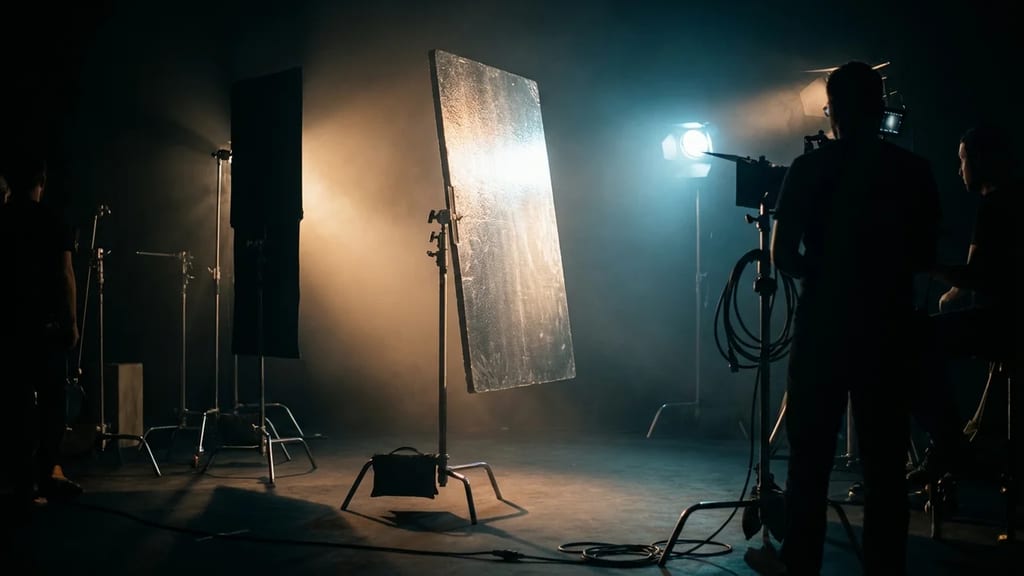
Murnau AI illustration
color temperature flow roll take

Hard reflector (60×90 or 120×180 cm) with mirror-like surface that bounces direct sunlight with intensity and sharp definition. Creates intense fill light without diffusion at 2–8 meter working distance.

Technical Details

Standard Shiny Boards measure 60x90 cm or 120x180 cm with a material thickness of 0.8-1.2 mm. The reflective surface has a gloss level of 85-95 GU (Gloss Units) and produces a light fall-off according to the inverse square law without additional diffusion. Professional models feature double-sided surfaces: one side highly polished mirrored, the reverse side matted or gold-coated. The angle of reflection precisely matches the angle of incidence, enabling accurate light direction.

History & Development

Shiny Boards became established in the 1940s in Hollywood as a cost-effective alternative to expensive Fresnel lights for exterior shots. Cinematographer Gregg Toland already used them in "Citizen Kane" (1941) for dramatic facial illumination. In the 1960s, the company Matthews Studio Equipment standardized the construction with robust handles and foldable frames. Modern variants use anodized aluminum with a nano-coating for increased scratch resistance.

Practical Use in Film

For exterior shots, Shiny Boards serve as natural sun reflectors for fill light or dramatic accent lighting. In "Mad Max: Fury Road" (2015), John Seale used dozens of Shiny Boards for character illumination in the desert. The hard shadows are suitable for Film Noir aesthetics or thriller atmospheres. Typical working distance: 2-8 meters from the subject. Disadvantages: uncontrollable glare, weather-dependent positioning, difficult fine-tuning due to strong light pooling.

Comparison & Alternatives

In contrast to Soft Boards or Bounce Cards, Shiny Boards exclusively produce hard light without diffusion. Silk reflectors offer softer illumination, while gold or silver collapsible reflectors are more portable but less intense. LED panels are increasingly replacing Shiny Boards due to their constant light temperature and dimmability. Shiny Boards remain the first choice for intense sunlight where artificial light sources would be insufficient, and for specific hard-light effects in controlled environments.

From the crafts

Perspectives

Cinematographer

Das Shiny Board ist mein präzisestes Werkzeug für dramatische Lichtführung – ich kann einzelne Gesichtshälften isoliert ausleuchten oder harte Schatten als Gestaltungselement einsetzen. Bei Sonnenlicht erreiche ich damit Beleuchtungsstärken von 10.000-20.000 Lux, die selbst bei f/8 und ISO 200 ausreichend Spielraum für natürliche Bewegungen lassen.

Director

Für emotionale Extreme ist das Shiny Board unersetzlich – die harten Schatten verstärken psychologische Spannungen und schaffen visuelle Metaphern für innere Zerrissenheit. In Verhörszenen oder Momenten der Selbstreflexion nutze ich die messerscharfen Lichtgrenzen, um Charaktere buchstäblich zwischen Licht und Schatten zu positionieren.

Producer

Ein 60x90cm Shiny Board kostet 180-250 Euro und ersetzt am Set oft 2-3 HMI-Scheinwerfer samt Stromversorgung – das spart täglich 400-600 Euro Equipmentkosten. Der Transport erfordert lediglich einen Kombi statt Licht-LKW, reduziert aber die Flexibilität bei wechselnden Wetterbedingungen erheblich.

More in the lexikon

Related terms

Test your knowledge

Quiz

1. Zu welchem Department gehört „Shiny Board"?

2. Wie viele verschiedene Fachperspektiven bietet dieser Eintrag?

Report an error
From the Filmfarm ecosystem

Understand visual language, budget productions, connect crew.

The Lexikon is part of the Filmfarm ecosystem — alongside budgeting (FilmBalance), an industry magazine (FilmCircus) and crew networking (FilmCall, CrewMesh). One shared vocabulary for the whole production.

FilmFarm FilmRadarComing soonFilmPulseComing soonFilmNumbersComing soonFilmCapitalComing soonFilmLabComing soonFilmBalanceComing soonFilmCircusComing soon