Filmlexikon.
Support
Hard Silver
Lighting · Terms

Hard Silver

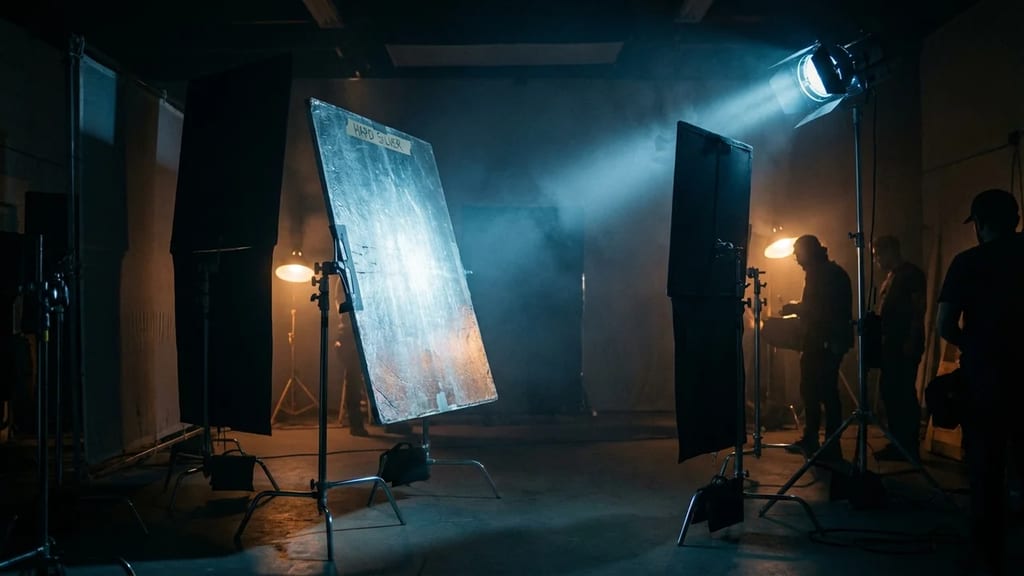
Murnau AI illustration
color temperature flow roll take

Highly reflective hard mirror made from anodized aluminum or silvered steel (99.9% purity) that amplifies sunlight fourfold and creates sharp shadows.

Technical Details

Hard Silver reflectors are made of anodized aluminum with a surface roughness of 0.1-0.3 micrometers or of silver-plated steel sheets with a purity of 99.9%. The reflectors are available in standard sizes from 30x45cm to 120x180cm, with the 60x90cm variant considered the industry standard. The coating withstands temperatures up to 200°C and shows less than 5% loss of reflectivity even after 10,000 operating hours. Professional versions feature a removable diffusion frame and foldable barn doors.

History & Development

Mole-Richardson developed the first Hard Silver reflectors in 1952 for Hollywood studio productions, after previous chrome-plated surfaces caused color casts in Technicolor shoots. Arri introduced the first European version with interchangeable reflector inserts in 1967. Since the 1990s, manufacturers like Dedolight and K5600 have been using precision-milled facet structures, enabling more uniform light distribution at a 15° beam angle.

Practical Use in Film

Roger Deakins extensively used Hard Silver reflectors for the prison scenes in "The Shawshank Redemption" (1994) to enhance the hard shadows of the bars. For daylight shots, they serve as fill light for faces, with the reflector positioned at a 45° angle to the camera axis. The hard shadows are particularly suitable for Film Noir aesthetics or for emphasizing facial structures. The disadvantage is the difficult control in wind and the risk of glare for actors with direct reflection.

Comparison & Alternatives

Soft Silver produces softer shadows due to a matte surface with 70% reflectivity, while White Bounce offers only 40% reflection with neutral color rendition. LED panels with 5600K have largely replaced Hard Silver for interior shots due to their more precise controllability. For exterior shots, Hard Silver remains unrivaled, as it can amplify sunlight fourfold without a power supply.

From the crafts

Perspectives

Cinematographer

Ich setze Hard Silver ein, wenn ich dramatische Beleuchtung mit scharfen Schattenkanten brauche – besonders bei 35mm-Film, wo die Körnung die harten Kontraste abmildert. Bei digitalen Kameras mit hohem Dynamikumfang muss ich aufpassen, dass die Spitzlichter nicht clippen, deshalb verwende ich oft einen 0.3 ND-Filter direkt am Reflektor.

Director

Hard Silver gibt mir die Möglichkeit, Charaktere visuell zu isolieren und emotionale Spannung durch harte Licht-Schatten-Kontraste aufzubauen. Wenn ich Protagonisten von Antagonisten unterscheiden will, nutze ich Hard Silver für die "Bösen" – die scharfen Schatten verstärken die psychologische Distanz zum Publikum.

Producer

Ein professioneller Hard Silver Reflektor kostet 800-1200 Euro, rechnet sich aber durch die Einsparung von Stromkosten und Generatoren bei Außendreh. Das Equipment ist robust und nach 15 Jahren noch verwendbar, während LED-Panels nach 5-7 Jahren technisch überholt sind – die Investition amortisiert sich bereits nach drei größeren Produktionen.

More in the lexikon

Related terms

Test your knowledge

Quiz

1. Zu welchem Department gehört „Hard Silver"?

2. Wie viele verschiedene Fachperspektiven bietet dieser Eintrag?

Report an error
From the Filmfarm ecosystem

Understand visual language, budget productions, connect crew.

The Lexikon is part of the Filmfarm ecosystem — alongside budgeting (FilmBalance), an industry magazine (FilmCircus) and crew networking (FilmCall, CrewMesh). One shared vocabulary for the whole production.

FilmFarm FilmRadarComing soonFilmPulseComing soonFilmNumbersComing soonFilmCapitalComing soonFilmLabComing soonFilmBalanceComing soonFilmCircusComing soon