Overview
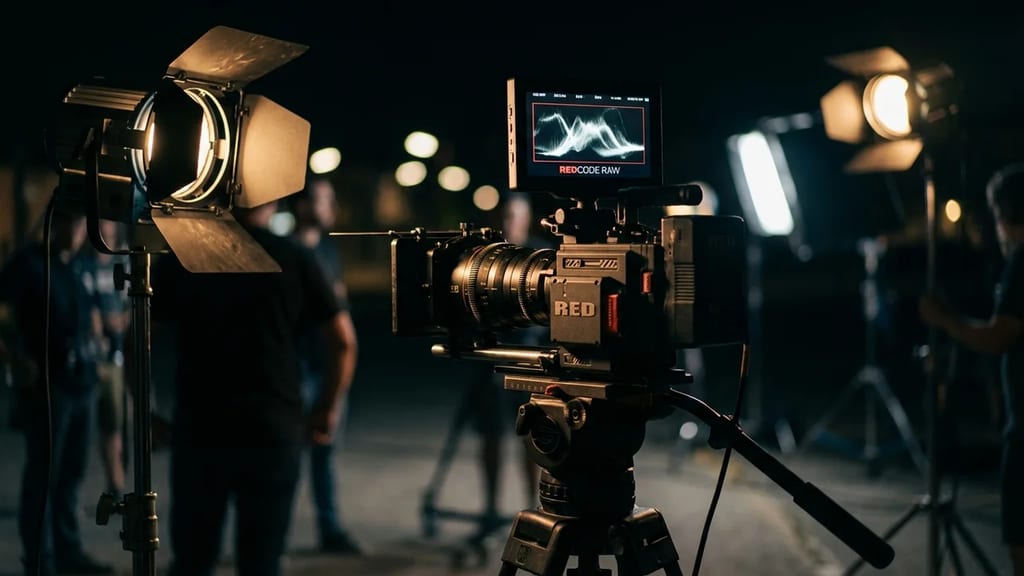
REDCODE RAW is the proprietary RAW recording format of RED Digital Cinema Camera Company. Footage is saved as files with the extension .R3D. Unlike fully processed video material, this captures the unprocessed sensor data (Bayer mosaic), allowing image parameters such as ISO/sensitivity and white balance to be set in post-production, remaining creatively decoupled on set.
REDCODE is a lossy format: there is no lossless variant. The compression is wavelet-based (Discrete Wavelet Transform) and intraframe – each individual frame is compressed independently, without dependency on preceding or subsequent frames. RED describes the process as visually lossless; technically, however, it is always lossy.
Compression and R3D File
The compression strength is indicated as a ratio (e.g., REDCODE 8:1). A lower ratio (around 2:1) means higher image quality and larger files, while a higher ratio (around 22:1) means lower quality and more compact files. The available levels depend on the sensor/camera model.
| Sensor | Available Range | Default |
|---|
| MYSTERIUM-X | 3:1 to 18:1 | 8:1 |
| RED DRAGON | 2:1 to 22:1 | 8:1 |
The effective data rate results from the compression ratio in conjunction with resolution, aspect ratio, frame rate, and settings such as Anamorphic or HDRX – it is automatically recalculated when these parameters change. An R3D file contains not only the compressed RAW data but also sensor characterization, extensive metadata, and RED's Color Science, which is intended to ensure consistent results from sensor to screen.
On-Set Usage
In practice, the desired compression ratio is set before shooting as a compromise between image quality and data rate (and thus recording time per storage medium). Larger productions often consciously choose not to use the lowest possible compression to reduce storage requirements without accepting visible quality degradation. Since R3D works intraframe, footage can be trimmed and processed in tools like REDCINE-X PRO or DaVinci Resolve without the RAW data needing to be recompressed. For lighting and grip, it is relevant that the format allows for a large exposure latitude and subsequent adjustment of ISO and white balance – lighting and color temperature can therefore still be corrected in grading, but do not replace clean illumination on set.