Filmlexikon.
Support
Parfocal Lens
Camera · Equipment

Parfocal Lens

Murnau AI illustration
anamorphic lens anamorphic projection lens angenieux optimo prime arri master prime arri signature prime arri ultra prime arri zeiss variable prime atlas lens co

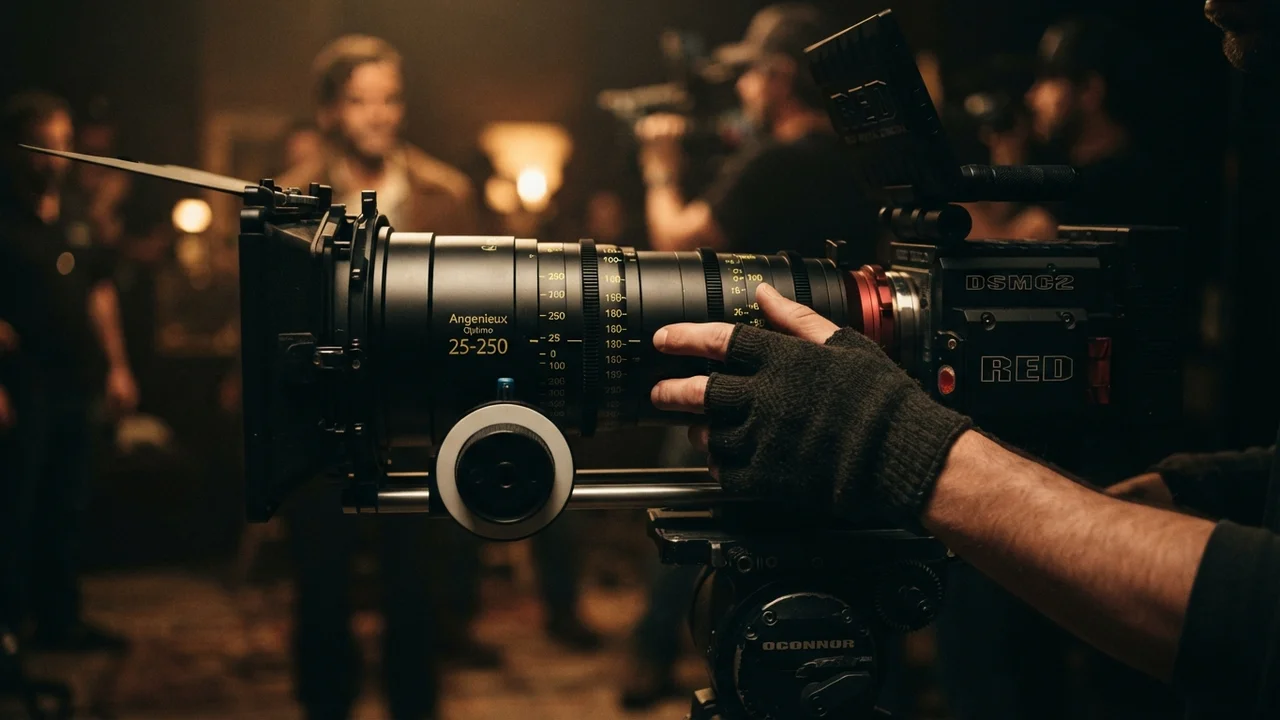
Zoom lens that maintains focus automatically when changing focal length. Cinema zooms like Angenieux 25-250mm or Fujinon Premier 18-85mm achieve ±0.02mm focus precision.

Technical Details

Parfocal lenses achieve their property through complex lens constructions with 15-25 elements in 10-16 groups, which are moved relative to each other in precisely calculated curves. Typical cine zooms like the Angenieux 25-250mm T3.5 or Fujinon Premier 18-85mm T2.0 maintain focus across the entire focal length range with a deviation of a maximum of ±0.02mm at the sensor. The mechanical precision requires manufacturing tolerances in the micrometer range, which is why these lenses achieve weights between 2-8kg. Modern parfocal zooms use aspherical lenses and low-dispersion glass to minimize aberrations while maintaining constant sharpness.

History & Development

Canon developed the first parfocal zoom lens for television cameras in 1961, the TV Zoom 17-68mm. Angenieux perfected the technology in 1964 with the 12-120mm for 16mm cameras, which was used in Kubrick's "2001: A Space Odyssey." In the 1980s, parfocal zooms established themselves as the standard for documentary and ENG through lenses like the Zeiss 11-110mm. Since 2010, computer-aided designs and precise CNC manufacturing have enabled parfocal full-frame zooms like the Fujinon 20-120mm Cabrio.

Practical Use in Film

Roger Deakins used the Angenieux Optimo 24-290mm for the famous hotel sequence in "No Country for Old Men" to seamlessly switch between wide shots and details. In live broadcasts, parfocal lenses allow operators to make spontaneous framing changes without refocusing. Documentary filmmakers appreciate the flexibility in unpredictable situations. The disadvantage lies in the higher weight and reduced light transmission compared to prime lenses - typical cine zooms are 2-3 stops slower than comparable primes.

Comparison & Alternatives

Varifocal lenses lose focus when changing focal length and require refocusing – an advantage for precise focus control in a controlled studio environment. Prime lenses offer higher light transmission and better image quality, but require lens changes for different focal lengths. Modern servo zooms combine parfocal properties with motorized control for remote applications. In high-end cinema production, manually focused parfocal zooms like the Cooke Varotal series continue to dominate.

From the crafts

Perspectives

Cinematographer

Ich setze parfokale Zooms hauptsächlich bei Handheld-Aufnahmen und Dokumentationen ein, wo ich spontan den Bildausschnitt ändern muss, ohne die Schärfe zu verlieren. Das Angenieux 25-250mm ist mein Arbeitspferd für lange Drehtage, auch wenn ich bei statischen Setups die bessere Bildqualität von Festbrennweiten bevorzuge.

Director

Parfokale Objektive geben mir die Freiheit, während einer Einstellung emotional zu intensivieren - vom establishing Shot zur Großaufnahme ohne Schnitt. Bei Dialogen kann ich die Dynamik zwischen Charakteren visuell verstärken, indem ich nahtlos zwischen den Brennweiten wechsle und dabei die emotionale Kontinuität der Performance erhalte.

Producer

Ein parfokales Zoom-Set ersetzt 6-8 Festbrennweiten und reduziert damit Equipmentkosten um 30-40% bei ENG-Produktionen. Die gesparte Zeit beim Objektivwechsel bedeutet 15-20 zusätzliche Setups pro Drehtag, allerdings steigen die Versicherungsprämien aufgrund der höheren Einzelwerte der Objektive um etwa 25%.

More in the lexikon

Related terms

Test your knowledge

Quiz

1. Was beschreibt „Parfokales Objektiv" am besten?

2. Zu welchem Department gehört „Parfokales Objektiv"?

3. Wie viele verschiedene Fachperspektiven bietet dieser Eintrag?

Report an error
From the Filmfarm ecosystem

Understand visual language, budget productions, connect crew.

The Lexikon is part of the Filmfarm ecosystem — alongside budgeting (FilmBalance), an industry magazine (FilmCircus) and crew networking (FilmCall, CrewMesh). One shared vocabulary for the whole production.

FilmFarm FilmRadarComing soonFilmPulseComing soonFilmNumbersComing soonFilmCapitalComing soonFilmLabComing soonFilmBalanceComing soonFilmCircusComing soon