Filmlexikon.
Support
Paper Tape
Lighting · Terms

Paper Tape

Murnau AI illustration
color temperature flow roll take

Matte kraft paper tape with <3% reflectance for gaff-free masking of lights and securing diffusion without unwanted reflections.

Technical Details

Paper tape is made of bleached kraft paper with a matte surface and a reflectivity of less than 3%. The acrylic adhesive allows residue-free removal up to 72 hours after application at temperatures up to 60°C. The tensile strength is 45 N/cm with a maximum elongation of 4%. Specialized variants include heat-resistant paper tape (up to 120°C), colored tape in red, blue, and green, and perforated tape with 2mm holes on a 5mm grid for partial light transmission.

History & Development

3M developed the first film-compatible paper tape in 1963 in response to requests from the Cinematographers Guild, who complained that conventional adhesive tapes caused light reflections. The first documented use occurred in 1964 during the filming of "My Fair Lady" under cinematographer Harry Stradling Sr. In the 1980s, Permacel introduced black paper tape with improved heat resistance. Modern LED lighting has reduced thermal requirements since 2010, making thinner variants with a thickness of 0.06 mm possible.

Practical Use in Film

On "Blade Runner" (1982), cinematographer Jordan Cronenweth used paper tape to mask Fresnel lenses to create hard shadow edges for the noir atmosphere. Typical applications include taping barn doors for precise adjustment of the light beam, fixing diffusion gels without creating tension, and marking lamp positions on set. Roger Deakins used perforated paper tape on LED panels in "1917" (2019) to create textured light for trench scenes. The advantage lies in its matte surface, which does not create unwanted light reflections.

Comparison & Alternatives

Gaffer tape reflects 15-20% of light and leaves adhesive residue when exposed to heat, whereas paper tape is matte and residue-free. Vinyl tape offers higher heat resistance up to 180°C, but is more expensive and harder to remove. Modern alternatives include magnetic shields for LED panels and reusable silicone barn doors. Paper tape remains standard for tungsten lighting and precise light shaping, while digital control and mechanical solutions are increasingly preferred for LED setups.
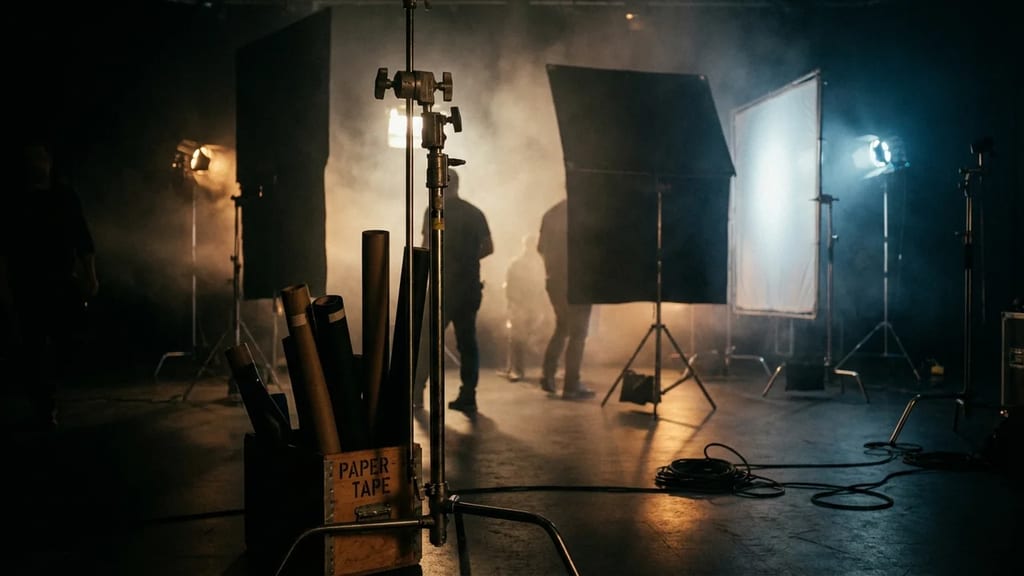
From the crafts

Perspectives

Cinematographer

Ich verwende Papier-Tape hauptsächlich zum Feinjustieren von Lichtformen – wenn ich beispielsweise bei einem Close-up nur einen schmalen Lichtstreifen auf der Wange des Schauspielers haben möchte, klebe ich die Barn Doors millimetergenau ab. Das matte Papier verhindert, dass ungewollte Reflexe ins Objektiv gelangen, was besonders bei Weitwinkel-Aufnahmen mit sichtbaren Lichtquellen kritisch ist.

Director

Für mich ist Papier-Tape ein Werkzeug zur atmosphärischen Kontrolle – wenn ich in einer Verhörszene nur einen harten Lichtstreifen über die Augen des Verdächtigen legen will, arbeite ich mit dem Kameramann zusammen, um die Lampen präzise abzukleben. Diese kleinen Details verstärken die psychologische Wirkung einer Szene, ohne dass das Publikum bewusst registriert, woher die Spannung kommt.

Producer

Eine Rolle kostet 3-8 Euro und spart mir teure Nacharbeiten durch Lichtreflexe, die in der Post aufwendig retuschiert werden müssten. Da das Tape rückstandsfrei entfernbar ist, entstehen keine Schäden an gemieteten Lampen, was Zusatzkosten vermeidet – bei einem 30-Tage-Dreh rechne ich mit etwa 200 Euro Verbrauch für Papier-Tape im gesamten Licht-Department.

More in the lexikon

Related terms

Test your knowledge

Quiz

1. Zu welchem Department gehört „Papier-Tape"?

2. Wie viele verschiedene Fachperspektiven bietet dieser Eintrag?

Report an error
From the Filmfarm ecosystem

Understand visual language, budget productions, connect crew.

The Lexikon is part of the Filmfarm ecosystem — alongside budgeting (FilmBalance), an industry magazine (FilmCircus) and crew networking (FilmCall, CrewMesh). One shared vocabulary for the whole production.

FilmFarm FilmRadarComing soonFilmPulseComing soonFilmNumbersComing soonFilmCapitalComing soonFilmLabComing soonFilmBalanceComing soonFilmCircusComing soon