Filmlexikon.
Support
Gaffer Tape
Lighting · Roles

Gaffer Tape

Murnau AI illustration
color temperature flow gaffer roll take

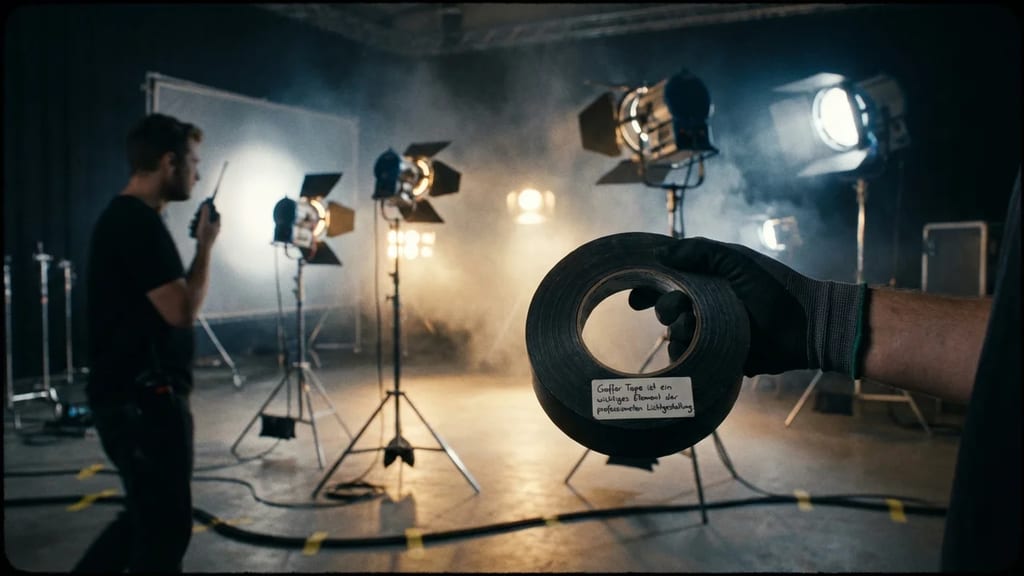
Matte, reinforced cloth tape with residue-free removal, used to secure cables, shape light, and mark positions on set.

Technical Details

Genuine gaffer tape consists of a matte vinyl backing with a cotton cloth reinforcement and a natural rubber or acrylic adhesive. The adhesive strength is 14-16 N/25mm, and the tensile strength is at least 180 N/25mm. Crucially, it is removable without residue, even after months and temperatures ranging from -18°C to +60°C. Available widths are 12mm, 19mm, 25mm, 38mm, and 50mm. Color variants include black, white, gray, green, blue, and red, with black achieving 99% light absorption.

History & Development

Gaffer tape was developed in 1959 by Ross Lowell and Permacel specifically for the film industry. Its predecessor was shiny duct tape, which caused unwanted light reflections. In 1977, 3M introduced the first industry standard with the "Scotch 235." Since the 1990s, specialized manufacturers like Pro Tapes & Specialties have established themselves, with the "Pro 001" becoming a reference product.

Practical Use in Film

Gaffer tape secures cables on the floor, preventing trip hazards and cable noise during camera movements. In "Blade Runner 2049" (2017), DoP Roger Deakins used black gaffer tape for light baffling on LED panels. Typical applications include taping lamps for light shaping, attaching diffusion gels, marking actor positions (Spike Marks), and repairing equipment. White gaffer tape serves as a bounce reflector or for labeling. Disadvantage: The adhesive can harden at extreme heat.

Comparison & Alternatives

Gaffer tape differs from duct tape by its matte surface and residue-free removal. Spike tape (13mm wide, various neon colors) marks positions, while console tape (1" wide) is used on mixing consoles. Modern alternatives include reusable cable ties and magnetic cable guides, which, however, only function on ferromagnetic surfaces. For temporary floor markings, camera tape – a thinner paper tape that is peelable without residue – is increasingly becoming established.
From the crafts

Perspectives

Cinematographer

Ich verwende schwarzes Gaffer Tape täglich zur Lichtformung – ein Streifen über die LED-Leiste eliminiert störende Hotspots im Hintergrund. Beim Dreh mit Steadicam klebe ich alle Kabel mit 50mm-Tape am Boden fest, damit die Kameraführung nicht über lose Strippen stolpert und meine Einstellung ruiniert wird.

Director

Für mich ist Gaffer Tape ein unsichtbarer Helfer beim Blocking – farbige Streifen markieren exakte Schauspielpositionen für komplexe Choreografien. Bei Actionszenen verwende ich rotes Tape für Stunt-Marks und blaues für Kamera-Positionen, so behalte ich auch bei 15 Takes den Überblick über die räumliche Inszenierung.

Producer

Eine Rolle Profi-Gaffer Tape kostet 12-18 Euro, aber billige Alternativen für 3 Euro hinterlassen Kleberückstände, die uns Locationschäden von 500+ Euro einbringen können. Ich kalkuliere pauschal 200 Euro Tape-Budget pro Drehtag – das spart teure Nacharbeiten und Regressforderungen von Vermietern.

More in the lexikon

Related terms

Test your knowledge

Quiz

1. Was beschreibt „Gaffa-Tape" am besten?

2. Zu welchem Department gehört „Gaffa-Tape"?

3. Wie viele verschiedene Fachperspektiven bietet dieser Eintrag?

Report an error
From the Filmfarm ecosystem

Understand visual language, budget productions, connect crew.

The Lexikon is part of the Filmfarm ecosystem — alongside budgeting (FilmBalance), an industry magazine (FilmCircus) and crew networking (FilmCall, CrewMesh). One shared vocabulary for the whole production.

FilmFarm FilmRadarComing soonFilmPulseComing soonFilmNumbersComing soonFilmCapitalComing soonFilmLabComing soonFilmBalanceComing soonFilmCircusComing soon