Filmlexikon.
Support
Cloth Tape
Lighting · Terms

Cloth Tape

Murnau AI illustration
color temperature flow roll take

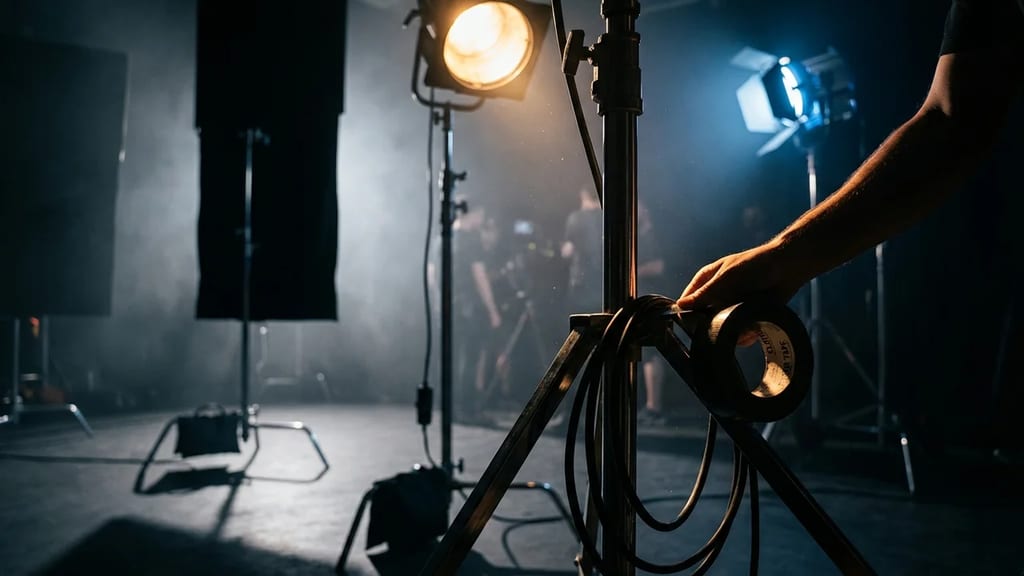
Matte fabric tape with residue-free removal, used for controlling light spill, cable routing, and securing equipment on set.

Technical Details

Professional gaffer tape achieves an adhesive strength of 15-20 N/cm at temperatures between -10°C and +80°C. The matte surface reflects less than 5% of incident light and prevents unwanted light reflections in front of the camera. The fabric can be torn by hand and leaves no adhesive residue on most surfaces after removal. High-quality variants use a synthetic rubber adhesive that does not harden even with prolonged UV exposure.

History & Development

Cloth tape was adapted for film production in 1959 by Ross Lowell, after he modified military "duck tape" from World War II for lighting purposes. In 1963, the company Permacel developed the first gaffer tape specifically designed for the film industry with an improved matte surface. In the 1970s, black became the standard color after cinematographers found that gray tape could become visible in wide-angle shots.

Practical Use in Film

Cloth tape is used to shield stray light from luminaires, attach diffusion gels, and seal flag connections. Over 200 rolls were used on Ridley Scott's "Blade Runner" (1982) to seal complex lighting setups. The tape secures cables on the floor, marks positions for repeat takes, and seals camera housings against dust. Its residue-free removal makes it ideal for location shoots where rented spaces must be returned undamaged.

Comparison & Alternatives

Unlike standard packing tape (duct tape), gaffer tape has a matte surface and a weaker adhesive for residue-free removal. Aluminum tape, with its shiny surface, is used for light reflection. Modern LED systems reduce the need for tape through more precise light control, but cloth tape remains indispensable for fine-tuning and controlling stray light. Magnetic mounting systems are increasingly replacing tape on metal structures, but they cannot fully compensate for the versatility of cloth tape.
From the crafts

Perspectives

Cinematographer

Ich führe immer mindestens drei Rollen Gaffer-Tape in verschiedenen Breiten mit mir – 19mm für Kabelführung, 50mm für großflächige Abschirmungen. Besonders bei Available-Light-Situationen tape ich störende Lichtquellen ab oder modifiziere vorhandene Leuchten, ohne die Location zu beschädigen. Die matte Oberfläche garantiert mir, dass auch bei extremen Weitwinkel-Aufnahmen keine ungewollten Reflexe entstehen.

Director

Für mich ist Gaffer-Tape ein unsichtbarer Helfer, der die Lichtdramaturgie meiner Szenen perfektioniert. Wenn ich harte Schatten für Film-Noir-Atmosphäre brauche, lasse ich damit präzise Lichtschlitze formen. Bei Nahaufnahmen tape ich gezielt Lichtquellen ab, um die gewünschte Stimmung im Gesicht zu erreichen – das Publikum soll die Emotion spüren, nicht die Technik sehen.

Producer

Pro Drehtag kalkuliere ich 50-80 Euro für Verbrauchsmaterialien wie Gaffer-Tape ein – erscheint klein, summiert sich aber bei 40 Drehtagen. Der Vorteil liegt in der Zeitersparnis: Schnelle Licht-Adjustments ohne aufwendige Umbauten halten den Drehplan ein. Besonders bei Mietobjekten spare ich teure Reparaturkosten, da das Tape rückstandsfrei entfernt werden kann.

More in the lexikon

Related terms

Test your knowledge

Quiz

1. Zu welchem Department gehört „Stoff-Tape"?

2. Wie viele verschiedene Fachperspektiven bietet dieser Eintrag?

Report an error
From the Filmfarm ecosystem

Understand visual language, budget productions, connect crew.

The Lexikon is part of the Filmfarm ecosystem — alongside budgeting (FilmBalance), an industry magazine (FilmCircus) and crew networking (FilmCall, CrewMesh). One shared vocabulary for the whole production.

FilmFarm FilmRadarComing soonFilmPulseComing soonFilmNumbersComing soonFilmCapitalComing soonFilmLabComing soonFilmBalanceComing soonFilmCircusComing soon