Technical Details
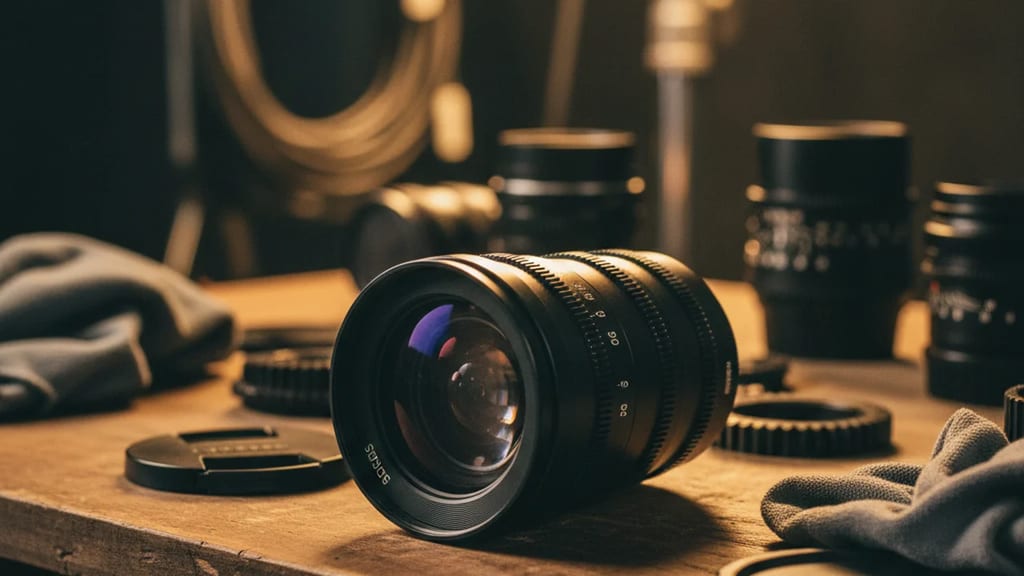
The classic design of the 50mm normal lens is based on Gauss optics with six to eight lens elements in four to six groups. Typical apertures range from f/1.2 to f/2.8, with f/1.4 and f/2.0 being the most common. The minimum focus distance is usually between 35-45cm. Cine variants such as the Zeiss Standard Prime 50mm T2.1 or Cooke S4/i 50mm T2.0 feature geared rings for follow focus systems and T-stop calibration. The optical construction allows for natural depth-of-field transitions (bokeh) without the characteristic distortions of shorter or longer focal lengths.
History & Development
Carl Zeiss developed the first normal lens-like lens in 1896 with the Planar 1:3.5 f=50mm for photography. For cinematographers, the 50mm focal length only became established in the 1920s, when filmmakers like F.W. Murnau began to appreciate the "neutral" perspective. In 1925, Leica standardized the 50mm f/3.5 Elmar as a kit lens, cementing the focal length as "normal." In the 1950s, Zeiss, Canon, and Nikon developed the first fast f/1.4 designs. Modern cine versions emerged from the 1990s onwards from Cooke, Zeiss, and ARRI.
Practical Use in Film
Directors like Sidney Lumet used normal lenses for more intimate dialogue scenes, for example in "12 Angry Men" (1957), where the 50mm focal length captures the jury discussions without dramatic exaggeration. Christopher Nolan uses normal lenses specifically for "honest" perspectives, for instance in interrogation scenes in "The Dark Knight" (2008). The neutral distortion makes normal lenses ideal for shot-reverse-shot dialogues and medium shots. Disadvantages arise in confined sets where wide-angle lenses are more flexible, or in action sequences that require longer focal lengths for image stabilization.
Comparison & Alternatives
Compared to 35mm wide-angle lenses, normal lenses avoid perspective distortion and unnatural proportions in faces. In comparison to 85mm telephoto focal lengths, they offer more spatial context and require shorter working distances. Modern zoom lenses like the Fujinon 19-90mm cover the normal focal length but rarely achieve the aperture or optical quality of prime lenses. 40mm (from Canon) or 55mm (from Sony) are increasingly establishing themselves as "modern" normal focal lengths, taking digital sensor characteristics into account.