Filmlexikon.
Support
Maya
VFX · Technique

Maya

Murnau AI illustration
non uniform rational b spline nurbs 3ds max ray tracing photogrammetry cinema 4d opengl

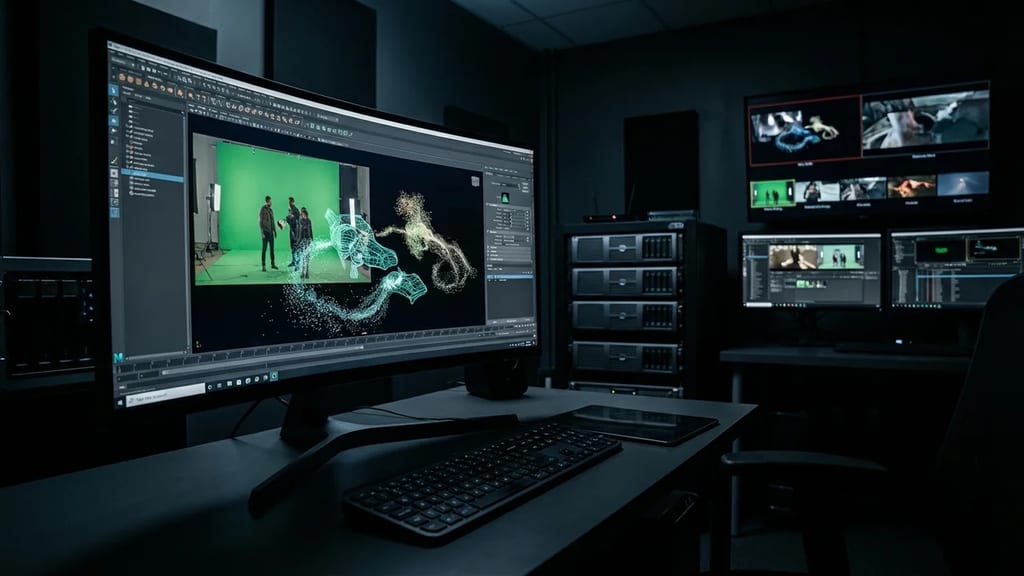
Autodesk Maya is professional 3D software for modeling, animation, simulation, and rendering; industry standard in VFX, animation, and games.

Overview

Maya (full name Autodesk Maya) is professional 3D software for modeling, animation, simulation, and rendering. It is one of the most widely used tools (DCC, Digital Content Creation) in the fields of Visual Effects (VFX), feature animation, and video game production. Maya was originally developed by Alias and first released in 1998; today it is distributed by Autodesk.

Unlike set equipment such as lights or grip hardware, Maya is pure software and part of the digital post-production and VFX pipeline. It is typically used after shooting, for example, for computer-generated imagery (CGI), set extensions, animation, and simulations.

Features

  • Modeling: polygonal modeling, NURBS, and subdivision surfaces for building 3D geometry.
  • Animation & Rigging: Keyframe animation, skeleton, and rig systems for character animation.
  • Simulation: dynamic effects through systems like nCloth (fabric), nParticles (particles), and Bifrost (procedural effects/fluids).
  • Hair & Fur: Generation and control via the XGen system.
  • Shading & Rendering: Material editing in Hypershade; bundled with the Arnold renderer.

Maya is extensible via the MEL and Python scripting languages, allowing for customization to studio pipelines.

Classification & Platforms

AspectInformation
ManufacturerAutodesk (originally Alias)
First Release1998
Category3D DCC Software / VFX Pipeline
Integrated RendererArnold
Operating SystemsWindows, macOS, Linux
ScriptingMEL, Python

Maya is often used in conjunction with other tools like Houdini, Nuke, or ZBrush in a pipeline. In the animation sector, it competes with Autodesk's own 3ds Max, as well as Blender, among others.
From the crafts

Perspectives

Cinematographer

Maya beeinflusst meine Arbeit hauptsächlich bei der Pre-Visualization, wo ich mit dem VFX-Team Kamerafahrten und Brennweiten für CGI-intensive Sequenzen abstimme. Die Software simuliert realistische Kameraobjektive inklusive Bokeh und Lens Distortion, was mir hilft, die Integration von Live-Action und CG-Elementen bereits in der Planung zu beurteilen. Bei Virtual Production verwende ich Maya-Daten direkt für LED-Wall-Projektionen am Set.

Director

Maya ermöglicht mir detaillierte Animatics und Previs, besonders bei komplexen Action-Sequenzen oder Creature-Performances, die ich später mit Motion-Capture-Schauspielern umsetze. Die Software hilft mir, Charaktere zu entwickeln und deren Bewegungssprache zu definieren, bevor die teuren Dreharbeiten beginnen. Bei Dialog-Szenen nutze ich Maya für Gesichtsanimation-Tests, um die emotionale Wirkung digitaler Charaktere vorab zu prüfen.

Producer

Eine Maya-Lizenz kostet aktuell 1.785 Euro jährlich pro Arbeitsplatz, bei größeren Studios sind Volumenrabatte bis 40% möglich. Die Render-Zeiten bestimmen maßgeblich meine VFX-Budgetplanung – ein Frame kann bei komplexen Szenen 2-8 Stunden Rechenzeit benötigen. Maya-Pipeline-Integration reduziert Fehlerquellen zwischen Abteilungen, spart aber Initial-Setup-Kosten von 50.000-200.000 Euro je nach Studiogröße.

More in the lexikon

Related terms

Test your knowledge

Quiz

1. Was beschreibt „Maya" am besten?

2. Zu welchem Department gehört „Maya"?

3. Wie viele verschiedene Fachperspektiven bietet dieser Eintrag?

Report an error
From the Filmfarm ecosystem

Understand visual language, budget productions, connect crew.

The Lexikon is part of the Filmfarm ecosystem — alongside budgeting (FilmBalance), an industry magazine (FilmCircus) and crew networking (FilmCall, CrewMesh). One shared vocabulary for the whole production.

FilmFarm FilmRadarComing soonFilmPulseComing soonFilmNumbersComing soonFilmCapitalComing soonFilmLabComing soonFilmBalanceComing soonFilmCircusComing soon