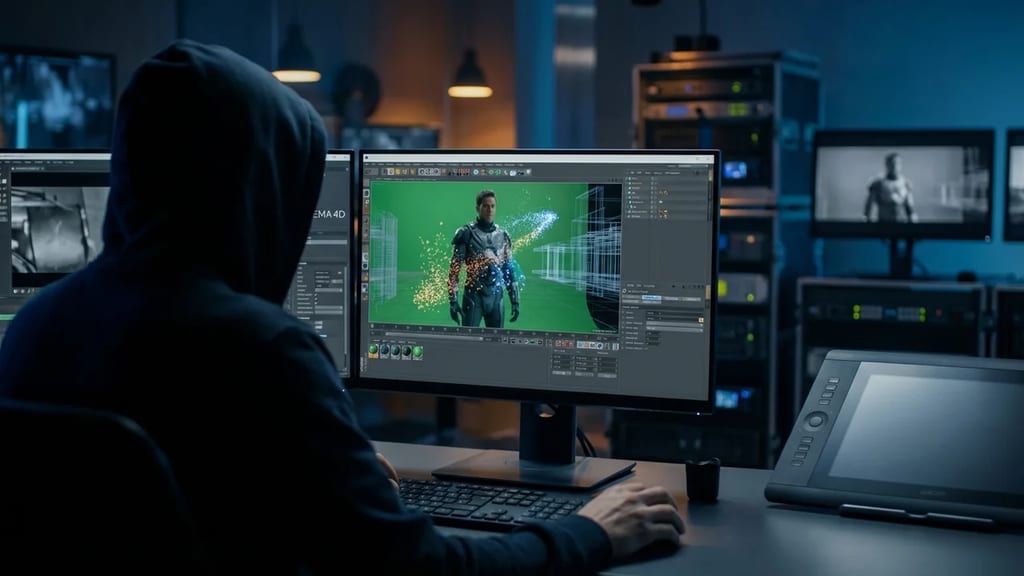
Technical Details
Cinema 4D supports polygonal modeling, NURBS surfaces, volumetric modeling, and procedural workflows. The software operates with 32-bit color depth, offers physically accurate lighting (Global Illumination), and includes over 200 integrated shaders. The MoGraph module enables motion graphics with up to one million clones per object. The current version R25 utilizes GPU rendering with OpenGL 4.1 and Vulkan API, with Octane Render and Redshift Renderer seamlessly integrated. The Team Render system distributes computations across up to 1000 client computers simultaneously.
History & Development
Maxon first developed Cinema 4D in 1990 for the Commodore Amiga as "FastRay." In 1993, it was renamed Cinema 4D with the first Windows version. In 2000, Maxon introduced BodyPaint 3D for texturing directly on 3D models. The MoGraph module was added in 2006, making Cinema 4D the standard for motion graphics. Following its acquisition by Nemetschek in 2014, it was integrated into Adobe Creative Cloud in 2017. Version R23 (2021) brought full GPU rendering and node-based material creation.
Practical Use in Film
Cinema 4D dominates title sequences and motion graphics, such as the title animations for "Guardians of the Galaxy" (2014) or the HUD interfaces in "Iron Man" (2008). VFX studios use the software for previs and environment design – for example, the spaceship concepts for "Interstellar" (2014) were created in Cinema 4D. Seamless exchange with After Effects makes C4D the standard for broadcast design and advertising. The typical workflow includes modeling, rigging, animation, and final compositing in external programs. Disadvantages become apparent in character animation and highly complex fluid simulations compared to specialized tools.
Comparison & Alternatives
Cinema 4D positions itself between the more complex Maya/3ds Max and simpler tools like Blender. Maya dominates character animation and VFX pipelines, while C4D leads in motion graphics and product visualization. Houdini surpasses C4D in procedural workflows and simulations. Blender offers similar features for free but does not achieve C4D's workflow efficiency and third-party integration. Studios choose Cinema 4D for short production cycles and design-oriented projects, and Maya for character-driven feature films.