Overview
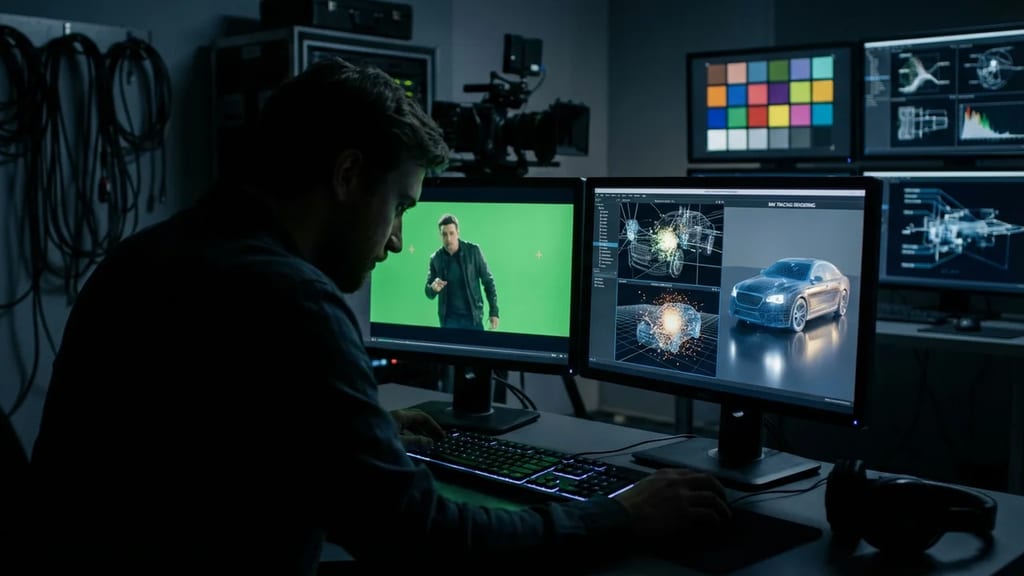
Ray Tracing (German "Strahlenverfolgung") is not set equipment or a light source, but a rendering method in computer graphics used in VFX, CGI, and increasingly in Virtual Production. Instead of breaking down a scene directly into pixels as in classic rasterization, Ray Tracing follows individual light rays through a virtual 3D scene and calculates how these rays interact with objects, surfaces, and materials. This creates shadows, reflections, and refractions that mimic the behavior of real light.
The crucial difference from rasterization: In rasterization, light does not "bounce" from surface to surface, meaning lighting artists have to simulate indirect lighting with additional, manually placed light sources. In Ray Tracing, the distribution of light in the scene is physically simulated, including indirect lighting (Global Illumination).
Principle of Operation
Ray Tracing simulates the path of light by tracking rays and evaluating them at their intersection points. This allows central optical phenomena to be depicted with physical accuracy:
- Shadows: calculated from actual light paths rather than approximations.
- Reflections and Refraction: rays that "bounce" between surfaces create reflections and refraction effects.
- Global Illumination: indirect light that "bounces" multiple times through the scene, creating realistic lighting moods.
The price for this is significantly higher computational effort than with rasterization. Consequently, Ray Tracing was initially used primarily where long render times are acceptable: for pre-rendered (offline rendered) CGI images and VFX for film, TV, and advertising.
Use on Set / in Virtual Production
With powerful GPU hardware, Ray Tracing is now also possible in real-time (Real-Time Ray Tracing) and has thus become relevant for Virtual Production. Game engines like Unreal Engine use it to display photorealistic digital environments on LED walls (LED Volumes) for In-Camera VFX. This allows backgrounds and virtual light sources to move live and react to camera movements, while the LED walls simultaneously act as interactive set lighting for actors and real objects.
The breakthrough for real-time Ray Tracing was marked, among other things, by the "Reflections" tech demo shown in 2018 by Epic Games, NVIDIA, and ILMxLAB, featuring characters from Star Wars: The Last Jedi. Unreal Engine 4.22 was the first game engine to offer real-time Ray Tracing via Microsoft's DirectX Raytracing framework (DXR) and NVIDIA's RTX technology. On set, however, Ray Tracing remains a software/GPU topic for the Virtual Production or VFX department and not a piece of grip or lighting equipment.