Technical Details
The iris in is achieved mechanically via a system of 6-20 aperture blades arranged concentrically. In 1920s film cameras, the opening time was standard at 2-4 seconds at 24 fps, corresponding to 48-96 individual frames. Modern digital systems allow precise control of the opening speed between 0.5 and 10 seconds. The iris can open centrally from the image center or eccentrically from any desired position. Variable ND filters with electronically controllable iris mechanisms today achieve precision values of 1/10th of a stop.
History & Development
The iris in established itself in 1895 with the first film cameras by Lumière and Méliès as a standardized transition effect. D.W. Griffith perfected the technique in 1915 in "The Birth of a Nation" through precisely choreographed iris movements. In 1922, the German company Ernemann developed the first automatic iris control for the cinema camera model IV. The introduction of zoom lenses in the 1950s expanded iris effects to include combined zoom-iris movements. Digital post-production since the 1990s enables pixel-accurate iris simulations with arbitrary geometries.
Practical Use in Film
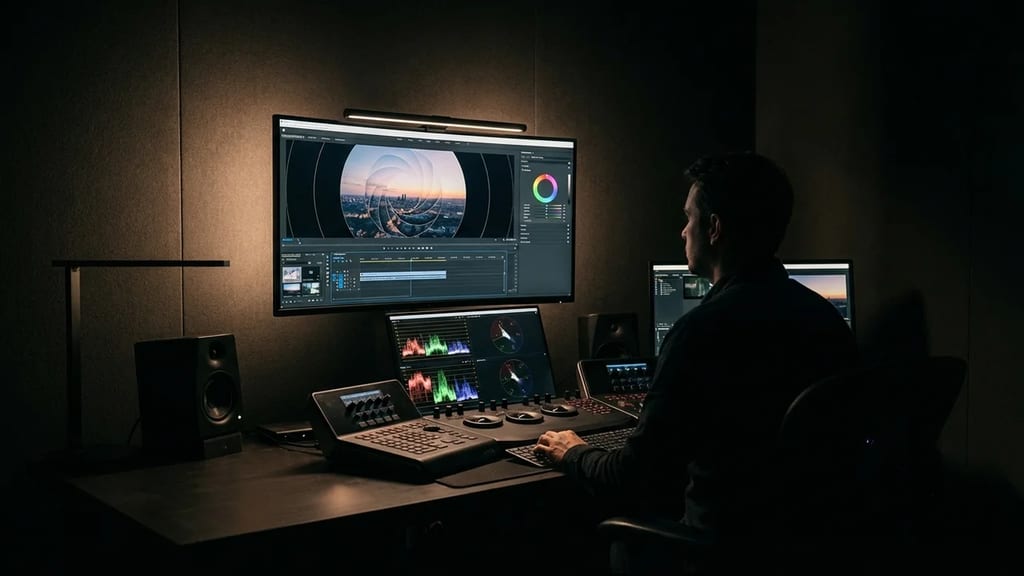
Charlie Chaplin used the iris in in "The Gold Rush" (1925) for emotional close-up reveals. Sergio Leone employed it in "Once Upon a Time in the West" (1968) for building tension, combined with 200mm telephoto lenses. Modern productions like "The Grand Budapest Hotel" (2014) use digitally created iris effects for nostalgic flashbacks. The technique is particularly suitable for dream sequences, memories, and dramatic reveals. Workflow-wise, the iris in today is mostly done in post-production with After Effects or DaVinci Resolve, as it offers more precise control over timing and position.
Comparison & Alternatives
Iris in differs from a simple fade-in by its circular geometry instead of a linear brightness gradient. Unlike a zoom, the focal length does not change, only the visible image area. Wipe effects use geometric shapes, whereas the iris remains exclusively circular. Modern alternatives include digital masks with arbitrary shapes or lens flare effects. In live productions, the electronically controlled variable ND filter replaces mechanical iris control, as it allows for smooth transitions without visible aperture blades.