Filmlexikon.
Support
Wipe
Editing · Terms

Wipe

Murnau AI illustration
dissolve fade in fade out fade to black fade to white quasar x crossfade iris gear

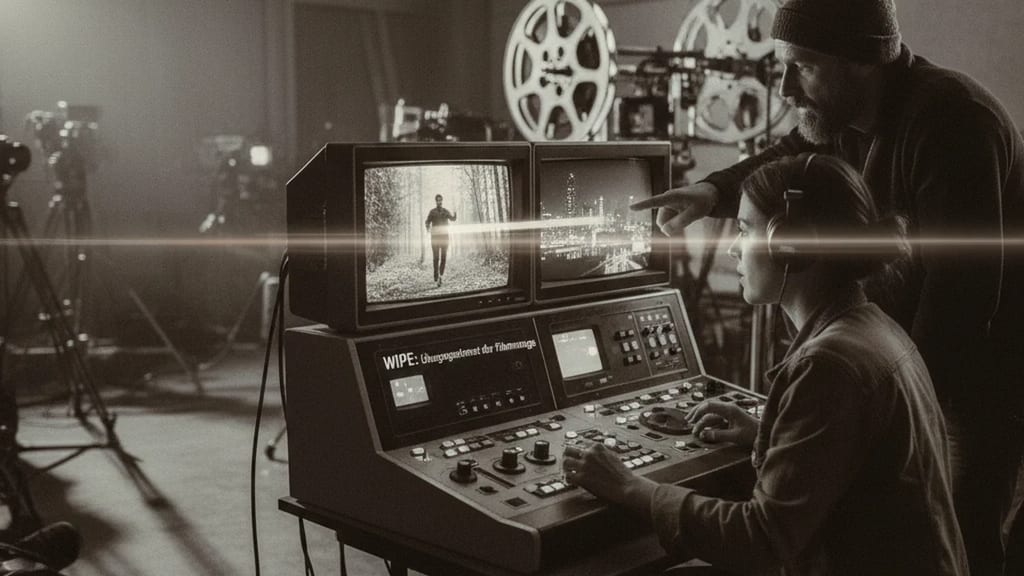
Transition effect where a sharp geometric edge sweeps across the frame, progressively revealing the new shot while obscuring the previous one.

Technical Details

Classic wipes operate with basic geometric shapes: horizontal or vertical lines, circles, stars, or iris effects. The duration is typically between 12-48 frames, corresponding to 0.5-2 seconds at 24fps. Modern NLE systems offer over 200 wipe variations, including complex 3D transitions and organic shapes. In the analog era, wipes were created using masks (mattes) in an optical printer or through special trick mixers. Digitally, the calculation is performed in real-time via alpha channels and transition masks.

The three main categories include: Push-wipes (new image pushes the old one away), Reveal-wipes (new image is uncovered), and Split-wipes (both images move).

History & Development

Georges Méliès already used primitive wipes in 1902 by covering the lens. Wipes reached technical perfection in the 1930s through Linwood Dunn at RKO, who revolutionized the optical printer. Orson Welles used 174 different transitions in "Citizen Kane" in 1941, including spectacular wipe combinations.

The Star Wars saga, starting in 1977, popularized wipes as a deliberate stylistic device of pulp aesthetics – George Lucas used over 60 wipes as a homage to the serials of the 1930s. With Avid (1989) and digital editing systems, complex wipes became accessible for all productions.

Practical Use in Film

Wipes usually signal significant changes in time or location. Akira Kurosawa used horizontal wipes for epic landscape transitions in "Yojimbo" (1961). Brian De Palma perfected the split-screen wipe in "Carrie" (1976) for simultaneous plotlines.

In the digital workflow, wipes are inserted during the fine cut phase but require handles of at least 1-2 seconds per shot. Rendering time for complex 3D wipes increases 8-15 times compared to hard cuts.

Comparison & Alternatives

Wipes differ from dissolves by their hard dividing edge and from morphs by the absence of image distortion. While dissolves suggest continuity, wipes emphasize the break between scenes.

In modern editing, conspicuous wipes are considered antiquated – except for deliberate retro aesthetics or genre films. Subtle wipes like lens whips or motivated camera movements often replace classic geometric shapes today. Motion graphics and compositing software enable seamless transitions that combine wipe principles with natural movements.
From the crafts

Perspectives

Cinematographer

Ich plane Wischblenden bereits bei der Aufnahme mit, indem ich identische Kameraeinstellungen und Lighting-Setups für beide Einstellungen verwende. Bei digitalen Wipes achte ich auf ausreichende Auflösung und vermeide extreme Kontraste an der Wipe-Kante, da diese zu harten Artefakten führen können. Besonders bei Split-Screen-Wipes muss ich die Bildkomposition so anlegen, dass beide Hälften visuell balanciert funktionieren.

Director

Ich setze Wischblenden gezielt für Genre-spezifische Erzählformen ein - in Science-Fiction oder Abenteuerfilmen verstärken sie die pulpige Atmosphäre der 1930er Serials. Dabei verwende ich sie niemals arbiträr, sondern immer zur Betonung narrativer Wendepunkte oder für bewusste Zeitsprünge. Ein horizontaler Wipe kann beispielsweise eine Reise symbolisieren, während ein Iris-Wipe den Fokus auf einen wichtigen Handlungsgegenstand lenkt.

Producer

Wischblenden verlängern die Post-Produktion um durchschnittlich 15-20% der Schnittzeit, da jeder Übergang einzeln abgestimmt werden muss. Bei komplexen 3D-Wipes kalkuliere ich zusätzliche Renderzeit von 2-4 Stunden pro Minute Endmaterial ein. Gleichzeitig reduzieren Wischblenden den Bedarf an aufwendigen Establishing Shots zwischen Szenen, was Drehtage einsparen kann - ein gut geplanter Wipe ersetzt oft eine kostspielige Zwischensequenz.

More in the lexikon

Related terms

Test your knowledge

Quiz

1. Was beschreibt „Wischblende" am besten?

2. Zu welchem Department gehört „Wischblende"?

3. Wie viele verschiedene Fachperspektiven bietet dieser Eintrag?

Report an error
From the Filmfarm ecosystem

Understand visual language, budget productions, connect crew.

The Lexikon is part of the Filmfarm ecosystem — alongside budgeting (FilmBalance), an industry magazine (FilmCircus) and crew networking (FilmCall, CrewMesh). One shared vocabulary for the whole production.

FilmFarm FilmRadarComing soonFilmPulseComing soonFilmNumbersComing soonFilmCapitalComing soonFilmLabComing soonFilmBalanceComing soonFilmCircusComing soon