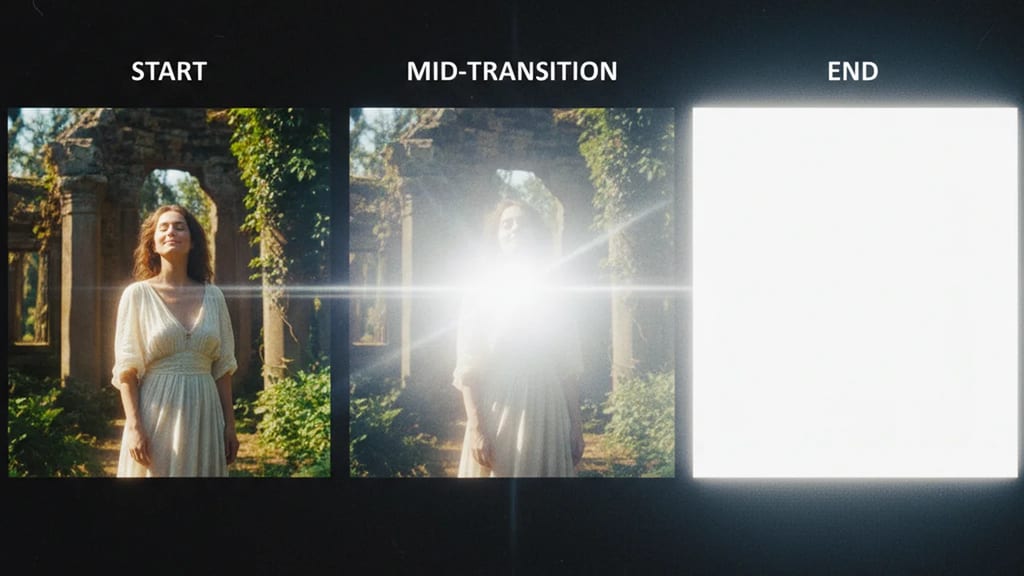
Technical Details
The fade to white is created digitally through additive blending (Add Blend Mode) or linear interpolation of luminance values. In color correction, this is achieved by continuously raising the lift value to +1.0 or the gain value to maximum while simultaneously reducing contrast to zero. In analog film production, the effect was achieved through double exposure with a pure white field or through overexposure during printing by 3-5 stops. Modern editing systems offer three variants: Linear Fade (uniform progression), Exponential Fade (accelerated brightening), and S-Curve Fade (gentle start and end).
History & Development
The first documented fade to white appeared in 1903 in Edwin S. Porter's "The Great Train Robbery" as a technical workaround for overexposed footage. Fritz Lang established its deliberate dramaturgical use for vision sequences in "Metropolis" in 1927. With the introduction of Technicolor processes in 1932, the fade to white gained popularity as it allowed for spectral purity without color casts. The digital revolution since 1990 has significantly simplified precise control of the transition – modern color grading systems allow for millisecond-accurate timing adjustments.
Practical Use in Film
Kubrick's "2001: A Space Odyssey" (1968) uses 47 fades to white for the monolith sequences, each exactly 72 frames long. Malick employs over 200 fades to white for spiritual transitions in "The Tree of Life" (2011). Christopher Nolan used fades to white with a 5000K color temperature for the Tesseract sequence in "Interstellar" (2014). The workflow requires precise coordination between the camera department and post-production: Log footage with +2 EV headroom is already planned on set for clean white transitions. Disadvantages arise in HDR mastering, as peak values above 1000 nits can cause clipping in the display.
Comparison & Alternatives
The fade to white fundamentally differs from the fade to black through additive rather than subtractive light management. Flash cuts (1-3 frames of pure white) create shock effects, while fades to white create contemplative transitions. Cross-dissolves via a white intermediate frame require double render time but offer more precise control over timing. Modern alternatives include bokeh transitions or lens flare transitions, which, however, require special plug-ins like Sapphire or Red Giant. In 4K workflows, colorists increasingly prefer lift-based fades to white over additive methods, as they produce fewer banding artifacts.