Filmlexikon.
Support
Intercutting
Editing · Terms

Intercutting

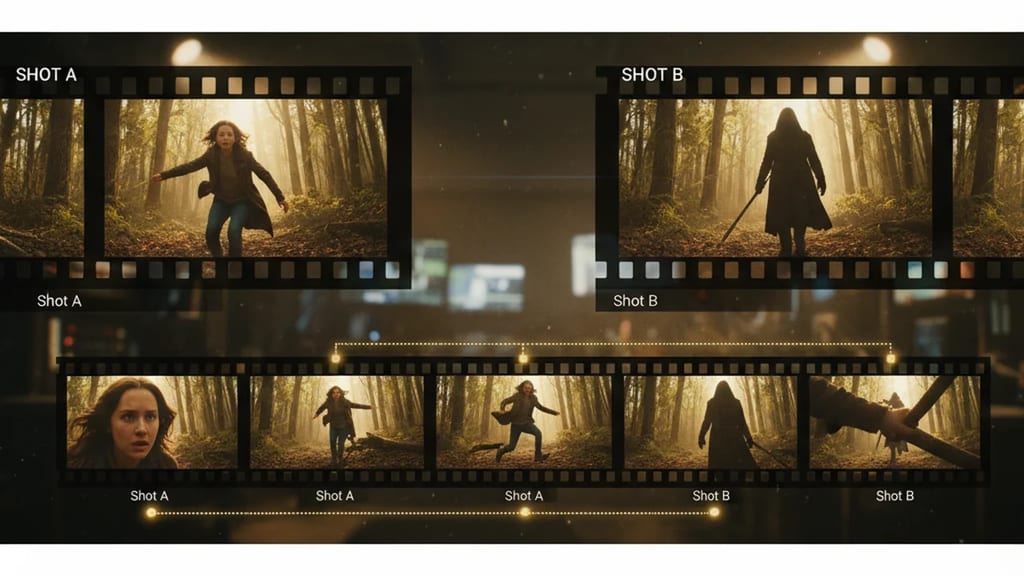
Murnau AI illustration
axial cut cross cut cross cutting cut cutter cutting on dialogue cutting on movement cutting rhythm

Cutting technique that alternates between two or more parallel storylines, typically in a 50:50 to 70:30 ratio, to build tension and cross-cut narrative momentum.

Technical Details

In classic intercutting, at least two plotlines are divided temporally in a ratio of 50:50 to 70:30. Modern digital editing systems like Avid Media Composer or Adobe Premiere use multicam sequences with timecode synchronization in 24p or 25p format. Cut lengths often follow mathematical progressions: 8-6-4-3-2-1 seconds for building suspense, or uniform 4-second intervals for neutral parallel narration. Three main variants exist: parallel intercutting (simultaneous action), temporal intercutting (time-shifted events), and contrastive intercutting (thematic juxtaposition).

History & Development

D.W. Griffith first perfected systematic intercutting between a ticking bomb and its unsuspecting victims in 1908 in "The Fatal Hour." Sergei Eisenstein expanded the technique in 1925 in "Battleship Potemkin" to include ideological contrast montage. Alfred Hitchcock standardized psychological intercutting in 1960 in "Psycho" with precisely timed 3.2-second intervals in the shower scene. The digital revolution of the 1990s enabled more complex multiple intercuts with up to six parallel plot levels, as demonstrated by Christopher Nolan in 2010 in "Inception."

Practical Application in Film

Brian De Palma intercut the train station stairs in "The Untouchables" (1987) back and forth over 4 minutes and 32 seconds across 47 shots. Quentin Tarantino uses asymmetrical intercuts in "Kill Bill Vol. 1" (2003) in a 2:1 ratio between action and flashback. The workflow requires precise script supervision: both plotlines are shot separately, then intercut frame-accurately using an EDL (Edit Decision List). Advantage: maximum dramaturgical control. Disadvantage: 30-40% longer post-production compared to linear editing.

Comparison & Alternatives

Intercutting differs from shot-reverse-shot by featuring simultaneous rather than reactive action and from jump cuts by the spatial separation of locations. Split-screen shows parallel actions simultaneously but requires special 2.35:1 aspect ratios. Match cuts connect scenes thematically, not temporally. Modern alternatives include digital picture-in-picture compositing and 360° VR edits. Intercutting is suitable for chase scenes and suspense sequences, split-screen for phone calls, and match cuts for time jumps.

From the crafts

Perspectives

Cinematographer

Ich muss beide Handlungsstränge mit identischer Farbtemperatur (3200K/5600K) und Belichtung (T2.8) drehen, damit der Editor nahtlos schneiden kann. Die 180°-Regel gilt für jeden Schauplatz separat - ich kann nicht zwischen den Locations "springen" ohne die räumliche Orientierung zu verlieren. Besonders kritisch wird's bei Nachtaufnahmen: beide Settings brauchen die gleiche ISO-Einstellung, sonst wirkt ein Schauplatz heller als der andere.

Director

Ich nutze Gegenschnitt gezielt für emotionale Manipulation - verkürze die Intervalle von 8 auf 2 Sekunden, um Spannung zu steigern, oder schneide bewusst gegen den erwarteten Rhythmus. In "Heat" hat Mann den Bankraub über 9 Minuten mit der häuslichen Szene verschnitten - das macht die Gewalt noch brutaler. Ich zeichne die Schnittfrequenz bereits im Storyboard vor: Sekunde 12, 18, 23, 26, 28, 29 - dann Explosion.

Producer

Gegenschnitt verdoppelt faktisch meine Drehkosten, weil ich zwei komplette Set-ups parallel fahren muss - doppelte Crew, doppelte Locations, doppelte Genehmigungen. Der Trick ist intelligente Drehplanung: erst alle A-Handlung an einem Tag, dann B-Handlung am nächsten. Spart 40% Umrüstzeit. In der Post brauche ich 2,5 Editoren statt einem - einer schneidet linear vor, der andere baut die Gegenschnitte ein.

More in the lexikon

Related terms

Test your knowledge

Quiz

1. Was beschreibt „Gegenschnitt" am besten?

2. Zu welchem Department gehört „Gegenschnitt"?

3. Wie viele verschiedene Fachperspektiven bietet dieser Eintrag?

Report an error
From the Filmfarm ecosystem

Understand visual language, budget productions, connect crew.

The Lexikon is part of the Filmfarm ecosystem — alongside budgeting (FilmBalance), an industry magazine (FilmCircus) and crew networking (FilmCall, CrewMesh). One shared vocabulary for the whole production.

FilmFarm FilmRadarComing soonFilmPulseComing soonFilmNumbersComing soonFilmCapitalComing soonFilmLabComing soonFilmBalanceComing soonFilmCircusComing soon